9. Monetary spillovers: from incidence to bounded attribution
Chapter 9 of 15 · ≈ 72 min read · 119 paragraphs · section 15 of 40 · search the book
Among the five transmission modes of Table 4, policy spillovers are the least theorised at the institutional level — and the one this research programme has dissected most completely.
The demonstrator of Chapter 8 took a case file through the whole of the chain; this chapter goes deeper into one of the mechanisms that chain must know how to handle. Among the five transmission modes of Table 4, policy spillovers are the least theorised at the institutional level — and the one this research programme has dissected most completely. The present section descends one level into the mechanism, for three reasons. First: it demonstrates, on a worked case, the measurement discipline that the architecture’s measurement layer (§5.2) would apply to every family of externality. Second: it establishes that a “spillover” is not a single phenomenon but a bundle of distinct mechanisms, separately attributable — which explains why undisciplined headline figures (“central bank X cost country Y sixteen billion”) are both common and, as they stand, indefensible: not because the order of magnitude would be wrong, but because a single amount, undecomposed and unattributed, cannot be substantiated. Third: it is the mode I have known from the recipient side, and whose transmission chain I can therefore render at first hand. The anatomy that follows is generic: these mechanisms operate on any low- or middle-income country endowed with external debt, an open capital account and energy and food imports; a full country-level companion document is reserved for future work.¶ 1
The monetary case is a case, not the thesis. It is retained here because it is the least theorised at the institutional level, the most contested, and the one where the break in the chain is most visible — not because it would be the most serious. It is one family out of twenty.¶ 2
The epistemic consequence must be drawn from this, as §4.4 draws it for an organ. If this case were refuted — if it were established that these spillovers are efficient, or that the recipient jurisdiction has the instruments to protect itself from them —, the chain would not thereby be refuted: it would lose a family. The architecture rests on no particular case. It rests on the proposition that, in each of the twenty families, the same interface is broken.¶ 3
9.1 Four families, fifteen mechanisms
This decomposition is disciplined but not exhaustive, and conditioned by the recipient-country profile retained (external sovereign debt, open capital account, energy and food imports). It isolates the fifteen material channels for this case; other profiles — heavy external corporate debt, a dollarised banking system — activate others, themselves documented: the cross-border banking and risk-taking channel (Bruno and Shin, 2015a, 2015b), the balance-sheet channel of firms indebted in foreign currency (di Giovanni, Kalemli-Özcan et al., 2022), trade credit (London and Silvestrini, 2025), or the discreet loss of market access (sudden stop; Calvo, 1998). The taxonomy is open and versioned — in the manner of the measurement layer (§5.2) —, and a detailed country-level decomposition (Annex G) would itemise them.¶ 4
Each family of channels rests on an established literature: the monetary and financial channels on the global financial cycle and monetary policy spillovers (Miranda-Agrippino and Rey, 2020; Kalemli-Özcan, 2019; González-Rozada and Levy-Yeyati, 2008), the real channels on capital flow waves (Forbes and Warnock, 2012), and imported price shocks on commodity markets (World Bank, Commodity Markets Outlook). The attribution ranges remain reasoned estimates, not measurements. To these channels is added a composition effect on credit itself: under asymmetric information, a global tightening translates not only into higher rates but into a rationing of credit — lenders restrict quantities rather than raise prices, for fear of attracting the riskiest borrowers (Stiglitz and Weiss, 1981) —, so that the recipient economy undergoes a sharper contraction of financing than the interest-rate spread alone would suggest. One theoretical result gives this spillover its structural character: under free capital mobility, the global financial cycle — largely governed by the monetary policy of the centre — constrains domestic financial conditions whatever the exchange rate regime, so that the classical trilemma is reduced to a dilemma and floating no longer secures autonomy (Rey, 2015). The recipient economy therefore cannot “float” its way out of the spillover: the exposure is undergone and not chosen, which grounds its examination within the accountability chain. Whether it calls for a financial correction still depends on what §9.7 establishes — a net welfare loss, an imperfection not internalised and an insufficient national remedy.¶ 5
When the major central banks tighten their policy, the cost reaches the recipient country through at least fifteen cash-flow mechanisms distributed across four families — plus one balance-sheet memo item that must never be added to them. Table 24 presents them. At this stage, only one thing is at issue: establishing that these mechanisms are real and signed — twelve work against the recipient country, three in its favour; what each of them has that is attributable to the source policy is the matter of sections 9.2 to 9.6.¶ 6
The table is wider than the screen: drag it sideways.
| # | Mechanism | Mode of transmission | Effect for the recipient country |
|---|---|---|---|
| A1 | Additional exchange-rate cost on debt service (cash flow) | Tightening → stronger reserve currencies → local depreciation → more local currency required for each unit of foreign-currency debt service actually paid | Negative — cash flow |
| A2 | Additional floating-rate interest cost | Reference rates (SOFR, Euribor) rise → the floating-rate tranche of external debt reprices automatically | Negative — cash flow |
| A3 | Refinancing — risk-free curve | Each new issue or rollover is priced off a higher risk-free curve | Negative — cash flow |
| A4 | Refinancing — global emerging-market spread | Global risk aversion widens emerging-market spreads indiscriminately, irrespective of the country’s fundamentals | Negative — cash flow |
| A5 | Refinancing — idiosyncratic premium | The country-specific premium (programme status, ratings, politics) | Negative — cash flow |
| A6 | Cost of carrying reserves | Reserves yield less than the rising cost of domestic funding — the negative carry widens | Negative — cash flow |
| A7 | Domestic crowding-out | Imported tightening compels the domestic central bank to raise its own policy rate → domestic debt service rises | Negative — cash flow |
| B1 | Imported cereal-price shock | World cereal prices surge under supply shocks | Negative — imported prices |
| B2 | Imported energy-price shock | World energy prices deepen the energy deficit | Negative — imported prices |
| C1 | Drag on export demand | Tightening slows the main trading partner’s economy → export orders fall | Negative — real economy |
| C2 | Drag on FDI and financing | Risk aversion delays or reduces inward investment | Negative — real economy |
| C3 | Tourism (buffer, negative sign) | Tightening at the centre compresses the income of its residents, who travel less, and the recipient country’s tourism receipts fall | Negative (real economy) |
| O1 | Return on reserves (gain) | Reserves invested at the higher policy rates yield more — a genuine offset, deducted once only | Positive — offset |
| O2 | Revaluation of diaspora remittances (gain) | Depreciation raises the local-currency value of remittances | Positive — offset |
| O3 | Ebb in world prices (gain) | End-of-cycle easing in energy and food prices | Positive — offset |
| — | Memo item: exchange-rate revaluation of the debt stock | Balance-sheet revaluation of the entire external debt stock — presented separately, never added to cash flows | Neutral — balance-sheet item, memo |

Three of the fifteen are gains (the offsets O1 to O3), and three are nil by construction (the idiosyncratic premium and the two supply-driven price shocks): the discipline is visible in the structure itself. A set in which some lines are attributed at 100 per cent, others at zero, and in which the offsets are subtracted, is the exact opposite of an advocacy figure.¶ 7
9.2 The discipline of attribution
Before the rules of calculation, one distinction governs everything that follows: the epistemic status of a figure — what it entitles one to assert, and what it does not. One and the same amount may belong to three very different levels of proof, and conflating them is the fault this section forbids itself. Box 10 sets the ladder; the seven rules that follow are its guarantees.¶ 8
Seven rules govern the calculation, and each of them constitutes a general lesson for the measurement of externalities. First, no attribution without a declared counterfactual — here, “policy rates held at their end-2021 level”, denoted c₀ and retained as a polar reference — not as an upper bound by definition: its position within the range is an empirical question (§F.2); a neutral-rate counterfactual would reduce the gross figure by about a third. Second, attribution is carried out mechanism by mechanism, never uniformly: 100 per cent is reserved for the risk-free curve itself; the idiosyncratic premium and supply-determined price shocks are held at zero by construction, however tempting their inclusion may be; and each share is a reasoned range accompanied by its sensitivity, not a point measurement (§9.5). Third, stocks and flows are never mixed: the revaluation of the outstanding debt stock is a balance-sheet memo item, not a budgetary cost. Fourth, offsets are not netted blindly: higher returns on reserves, revalued transfers, the easing of prices at the end of the cycle are reported separately, by beneficiary, and are deducted from a loss only if an effective or legally committed transfer is documented (matrix T = 0 by default, §F.7). Fifth, horizons are kept separate: a figure cumulated over the cycle and an annualised structural figure are two different objects, and adding them together — or comparing the figure cumulated over the cycle, or any gross aggregate mixing market costs and welfare valuations, with the GDP of a single year — constitutes a category error. Sixth, no double counting in the total: an effect that passes through two channels — depreciation, for example, present both in foreign-currency debt service and in refinancing — is allocated once only, at the level of primitive economic components, before aggregation (allocation weights summing to one, §F.6); pairwise seam correction (in the manner of the sixty-six pairs documented in the workbook of the twenty families) is retained as a robustness check, not as the principal estimator: each channel’s gross exposure remains visible, and the cumulation remains honest. Seventh, costs and offsets are attributed on the same base and the same counterfactual: one does not take the costs prudently and the gains generously, or the reverse — the net figure is honest only if both its sides are measured by the same yardstick. To attribute is not to incriminate: the chain is causal and accounting, not a finding of fault or of bad faith — the policies at issue are legitimate and mandated (§2.1); this is what separates measurement from accusation. The programme’s own communication rule is blunt: never publish the gross sum without its non-additivity warning, and never say “the central banks cost this country sixteen billion” — that sentence mixes causes that the taxonomy exists precisely to distinguish.¶ 10
The table is wider than the screen: drag it sideways.
| Attributable share | Mechanisms (Table 24) | Principle |
|---|---|---|
| Full (100%) | A3 — refinancing on the risk-free curve | The curve is the policy instrument itself |
| Near-full (90–100%) | A2 — additional floating-rate interest cost | Mechanical indexation to reference rates |
| Partial (reasoned ranges) | A1 exchange rate (30–60%); A4 global spread (30–70%); A6 reserve carry (40–60%); A7 domestic crowding-out (30–50%); C1–C3 real channels (20–45%); O1–O3 offsets (40–70%) | Global and domestic determinants intertwined; each share is a range accompanied by its sensitivity (§9.5); offsets are attributed on the same base and the same counterfactual as the costs |
| Nil by construction | A5 idiosyncratic premium; B1–B2 supply shocks (cereals, energy) | Never attributable to foreign monetary policy, however tempting inclusion may be |
Three features emerge from Table 25: attribution is never uniform — it runs from the whole, when the curve is the very instrument of the policy, to zero, when the shock comes from supply; offsets are judged by the same yardstick as costs; and the exclusions by construction protect the calculation from its commonest temptation — counting everything.¶ 11
An objection from symmetry, and the rule it imposes. The decomposition that precedes bears on a tightening cycle. An easing cycle may produce effects of the opposite sign — and it must be said again here: the object of this chapter is not to assess the appropriateness of monetary policies, it is to measure what they displace. The objection is no less serious: if tightening is priced without easing being credited, the attributable share becomes an accounting artefact. Ocampo states it himself, and he is not to be suspected of indulgence towards the source jurisdiction: in the aftermath of the failure of Lehman Brothers, he writes, “part of the stimulus of US expansionary policies was exported to the rest of the world” (Ocampo, 2011).¶ 12
This observation is exact, and it must be entered on the debit side before answering it. A part of the stimulus did indeed cross borders: capital inflows, cross-border credit, demand addressed to the recipient economies. But two features change its nature. The first is distributive: liquidity does not spread uniformly, it benefits first those who receive it first — the centre of the dollar network and the holders of assets —, an effect of proximity to the monetary tap that theory has long identified. The second is that this stimulus is in large part an asset-valuation effect, concentrated and reversible, and not a real and acquired creation of wealth. It is therefore not a transfer of wealth symmetrical with the damage: it is a transfer of risk towards a periphery that chooses neither the cycle nor its timing. The exported gain is real; it is also conditional, temporary and backed by an exposure that it itself builds.¶ 13
The rule adopted is the following: one does not offset a loss with the gain that caused it. The capital inflow of the easing phase is not an offset to the reflux: it is its condition. Three links, all of them established, connect it to the damage. The recipient cannot refuse the flow: in the presence of a global financial cycle, a floating exchange rate does not insulate (Rey, 2015) — nor, for that matter, does a fixed one, even if it may protect partially. The flow builds the exposure: the depreciation of the dollar widens bank leverage and cross-border credit, and foreign-currency indebtedness accumulates (Bruno and Shin, 2015). The reflux destroys investment, and it does not give it back: emerging market output remains depressed at the tenth quarter (International Monetary Fund, 2023). One does not credit the damage with the flow that made it possible: the capital inflow of the easing phase built the exposure from which the reflux subsequently draws its violence; it is its condition, not its offset. That all agents belong to the same global system does not dissolve the distributive question: it is, on the contrary, what grounds it. An externality exists only because the action of one propagates into the balance sheets of others; the unity of the financial planet is the premise of this chapter, not an objection against it.¶ 14
A second reason, independent of the first, forbids the cancelling out. Even were a gain causally unconnected with the loss, it could not be credited against it once it accrues to different subjects, at a different moment, and none of them has chosen either the one or the other. To sum algebraically a benefit borne by some and a detriment borne by others in order to display the balance is to treat distinct persons as a single agent; it is the fiction that welfare economics knows under the name of hypothetical compensation — the Kaldor-Hicks criterion (Kaldor, 1939; Hicks, 1939), whose reversibility Scitovsky (1941) moreover demonstrated —, and which holds only if the compensation actually takes place. Without a real transfer, the net balance cancels nothing: it redistributes while concealing that it does so. This requirement does not contradict the deduction of items O1-O3 (return on reserves, revaluation of transfers, reflux of prices), for these are contemporaneous with the shock, proceed from the same cause and strike the same recipient: they measure the net effect of one and the same event on one and the same subject, not the compensation of one group by another across time.¶ 15
The discipline that follows from this is explicit. The offsets of family O in Table 24 (O1–O3) — return on reserves, revaluation of transfers, reflux of prices — are contemporaneous with the shock: they are entered as deductions, and they remain so. The capital inflow of the earlier phase is not, and the document states here why. No item may be entered as an offset against a detriment of which it is the cause. The condition of refutation is stated and accepted: if the response functions proved symmetrical — an easing creating as much durable investment as a tightening destroys —, the claim would vanish; the Fund has measured half the cycle (§9.5), no one has yet measured the other, and until then the rule remains a disciplined hypothesis. This disagreement is not one of principle but of measurement, and it is refutable. It reduces to a precise question — are the response functions of an easing cycle the exact mirror of those of a tightening? — which the empirical protocol treats as such, by requiring that gains and costs be estimated with the same horizon and the same counterfactual. The available evidence — investment hysteresis, emerging market output still depressed at the tenth quarter — points towards asymmetry; but the burden of proof is accepted, and the rule will fall if symmetry is established.¶ 16
Since then, these seven rules no longer remain at the level of principles: they form a model of bounded partial attribution, set out in full in Annex F. There the counterfactual ceases to be a rate path and becomes a coherent vector of trajectories — rates, risk-free curve, exchange rate, global risk appetite, commodity prices —, failing which an endogenous reaction would be counted as an effect. Exposure is fixed before the shock, and not read off after it, so that an adaptation undergone is not treated as predetermined. Each mechanism receives its own measurement function, and not a single “base × price spread” formula, so that the rationing of credit — a restriction of volume, not of price — can be represented. The attribution coefficients α are not chosen one by one but belong to a joint admissible set: taking each adverse channel at its maximum and each offset at its minimum, when the same shock links them, is not permitted. Double counting is eliminated at the level of primitive economic components, allocated once only before aggregation, rather than by an ex post subtraction. And offsets do not enter blindly: a gain accruing to one agent reduces another’s loss only if an effective or legally committed transfer is documented, so that consolidation preserves the resources without masking a distributive loss. No new figure results from this: the gain is that every input, allocation, exclusion, counterfactual and stopping rule becomes inspectable and refutable, line by line, and that the chain knows how, when the evidence is lacking, to refuse to attribute or to price.¶ 17
9.3 Orders of magnitude, at three scales
Applied to Tunisia over the 2022-2025 tightening cycle, the decomposition yields gross imported externalities, all causes taken together, of about 15 billion dinars (≈ 4.5 billion euros) — of which a strictly attributable monetary core, net of offsets, of about 0.76-1 billion euros (envelope 0.6-1.9 billion). This core is triangulated internally from three of the programme’s models, not by independent external methods: it is a contestable estimate, not a measurement. The net core represents only about a fifth of the gross, because the bulk of the Tunisian gross figure arises from imported energy and food price shocks — of supply origin, held at zero by construction (§9.2). The early estimate I published in 2023 (Yaiche, 2023), one year after the beginning of the cycle (4.2-4.5 billion dinars), lies within the trajectory that the full-cycle model subsequently confirmed. At the global scale, the anatomy is transposable — and this document does not transpose it. An extrapolation to the whole of the emerging market and developing economies would require what is not yet published: the coverage of the countries retained, the weightings, the treatment of the heterogeneity of exchange rate regimes and capital controls, the treatment of missing observations, and the separation from domestic drivers. As long as the supporting evidence pack does not carry these elements, this document reports no global figure — neither gross, nor net, nor incidence ratio. The rule it applies to itself here is the one it asks of others: a programme result whose deposit has not reached its publication threshold does not enter the body. A worked case, set out with its method and its limits, can be defended; the extrapolation of that case to eighty countries, without published coverage or weighting, cannot. The global extrapolation, like the continental estimate, belongs to Annex G (protocol specified in §9.5) and to the research agenda (Section 14). The void itself deserves to be interrogated: the Fund publishes the elasticity but aggregates no cost; the Bank for International Settlements documents the cycle without quantifying it as a detriment; UNCTAD quantifies financing costs without relating them to their monetary cause. No institution publishes a global estimate of the cost of monetary policy spillovers — not because the thing is impossible, the ingredients exist (§9.5-9.6): it is that none has the mandate for it. The absence of the figure is not a gap in science; it is a piece of the deficit this document describes — the link charged with producing it does not exist (§5.2). Since revision 2.1 of Annex F, these magnitudes are requalified as disciplined illustrations under the inherited framework — and not as verifiable aggregates (§F.16); their recomputation in Configuration M is the first deliverable of the empirical programme of the present report (Annex I). The reconciliation between this core and the programme’s national net figure is henceforth closed with a zero residual (Annex I, §I.5): a pre-Configuration M reclassification of the same channels, under the inherited counterfactual alone, places the strictly monetary core at about 0.9 billion euros — the very order of magnitude of the published core —, the gap to the national net figure being carried entirely by the non-monetary channels (supply-origin price shocks, external demand, private credit, capital flows).¶ 18
Three registers, never added together. The magnitudes that precede belong to a single register: that of cash-flow incidence. They state what the country disburses. They do not state what it loses. The distinction, laid down in §9.6, has a consequence that §9.7 makes decisive: the efficiency correction is not computed on a disbursement, but on a loss. A second account is therefore needed, and a third — and, in accordance with the discipline of Box 2, they must never be added together.¶ 19
Register I — cash-flow incidence. It is the one that precedes: fifteen mechanisms, four families, a Tunisian monetary core net of 0.76 to 1 billion euros (inherited illustration, §F.16). It answers the question: how much goes out, and what share of it is imputable to a decision. It is the register of attribution.¶ 20
Register II — balance-sheet revaluation. Memo item of Table 24, never added to the preceding ones: the revaluation, in local currency, of the outstanding stock of debt denominated in foreign currency. It is not a flow, and the document does not claim it.¶ 21
Register III — welfare loss. This is the account that was missing, and this document does not produce it: it borrows it. The International Monetary Fund (2023) estimates that a 10% appreciation of the dollar is associated with a 1.9% decline in real output in the emerging markets — against 0.5% in the advanced economies — two quarters after the shock; that the output of the advanced economies is restored after three quarters, while that of the emerging markets remains depressed at the tenth; and that the differential is carried by a collapse of real investment. Applied to Tunisia’s 2023 gross domestic product (51.1 billion dollars; World Bank, 2024), this elasticity implies a loss of the order of 0.90 billion euros. §9.6 already named forgone investment among the channels required by the “welfare” object and called for a bridge towards it: this register is that bridge, borrowed from an independent source.¶ 22
What this register changes. A transfer has a beneficiary; a destroyed investment has none. The excess interest paid to a creditor is, until proof to the contrary, a transfer: it leaves one balance sheet to join another, and the global loss, if there is one, lies in the distortions it triggers, not in its amount. The output that was not produced, the investment that was not made and that still has not been made ten quarters later, are nobody’s gain. It is there, and there alone, that inefficiency lodges — that is to say, the foundation of the correction opened in §9.7. The claim under the correction window therefore does not bear on Register I: it bears on the attributable share of Register III. Register I supplies the attribution bands; Register III supplies the base. To conflate them would amount to claiming a disbursement in respect of a loss, or a loss in respect of a disbursement.¶ 23
What this scale means for the recipient. A cycle cumulation is not compared with the GDP of a single year (§9.2, fifth rule); annualised, it is. Reduced to the year, the attributable core represents of the order of four to five tenths of a point of Tunisian GDP — each year of the cycle, in cash flow alone and net of offsets; and Register III above recalls what cash flow does not see: a single episode of a 10% appreciation of the dollar is associated with a 1.9% decline in emerging market real output. The same magnitude, related to the output of the source jurisdiction, counts in ten-thousandths of a point: small for the jurisdiction that is its source, structuring for the one that receives it — it is this asymmetry, and not the absolute amount, that makes the spillover an object of governance.¶ 24
A triangulation, not a validation. The shock retained by the Fund — an appreciation of the dollar — is monetary and financial in origin: it is close to the Tunisian monetary core, not to the all-causes gross figure, the bulk of which arises from supply shocks held at zero by construction. Brought together on a like-for-like basis, the two estimates — one of cash flow, the other of output, obtained by unrelated methods — converge: the value implied by the Fund’s elasticity falls inside the range retained here. The objects differ, and this juxtaposition therefore does not amount to confirmation. It assumes a multiplier close to unity, which is plausible for an economy deprived of fiscal space.¶ 25
What Register III does not establish. It does not establish inefficiency: it indicates it. A contraction of investment could, in principle, reflect an efficient reallocation of capital towards higher returns; that is the objection the normative literature raises (§9.7). Two facts make it unlikely — persistence, and asymmetry with the advanced economies —, but neither of them refutes it. Register III establishes a prima facie case, and nothing more. That is exactly the status conferred on it by the presumption rule of §9.7: a presumption of inefficiency, for the source jurisdiction to rebut.¶ 26
The table is wider than the screen: drag it sideways.
| Register | What it measures | Tunisia | World | Function |
|---|---|---|---|---|
| I — Cash-flow incidence | What the country disburses | €0.76–1 bn net (monetary core); ≈ €4.5 bn gross, all causes | Not reported — filing required (§9.3) | Supplies the attribution bands |
| II — Balance-sheet revaluation | The revalued foreign-currency stock | Memo item | Memo item | Never claimed |
| III — Welfare loss | What the country loses | ≈ €0.90 bn (output, at the trough) | −1.9% of emerging-market output | Supplies the base for the correction (§9.7) |
| Aggregation rule | Three distinct ontologies | — | — | The three are never added together |
Three distinct validations. An accounting reconciliation verifies that the items of the scenario are defined and that their sum respects the identities retained. It validates neither the counterfactual, nor the shock, nor the attribution coefficients. A causal identification then seeks to isolate the exogenous component of the shock and the trajectory that would otherwise have prevailed; it does not, by itself, determine the justice of a consequence. Normative and legal attribution comes last: it qualifies the loss, the share of domestic vulnerabilities, equity, the applicable obligation and the admissible remedy. None of these three validations can be deduced from the preceding one.¶ 27
9.4 What the architecture would do in the face of a spillover effect
The object of this anatomy is institutional : it shows, step by step, how a spillover effect, once decomposed, becomes a governable object. The organs invoked here — a measurement board, a rating authority, a solidarity fund, a border mechanism — are designated here by their function as much as by their name; they were introduced and specified in detail in Section 5, and are convened at this point only in order to make visible the passage of a spillover along the chain. A scientific measurement board (§5.2) would publish exactly this decomposition — the declared counterfactual, mechanism-by-mechanism attribution, the offsets subtracted, the two horizons kept separate — not as a verdict, but as a public and contestable measurement. Before any publication, an adversarial notification stage would give the source central banks standing to contest the attribution: they could produce their own data, discuss the counterfactual retained, have a share they consider wrongly imputed revised. It is this upstream contestability — and not the unilateral assertion of a figure — that separates a measurement from an indictment, and that makes the result opposable because it has been tested rather than asserted.¶ 28
On this basis, a rating authority (§5.3) would assign the externality a severity coefficient — a normalised order of magnitude of the harm, not a finding of fault. The distinction is cardinal: the monetary policies at issue are lawful, mandated and often necessary. It is precisely for this reason that the response to a public policy spillover is neither prohibition nor blame, but the triad measurement → visibility → equity consequence (§2.3, §9.2): the sovereign decision-maker is not forbidden to exercise its mandate; the cost it displaces onto third parties is made visible, and reparative consequences are drawn on the side of those who bear it. The equity consequence then designates a debtor: the attributable share would be claimed from the source central bank itself — on its profits or its seigniorage, and not from the recipient country’s treasury or from its taxpayer —, so that the social cost of the spillover returns into its decision function and weighs on its subsequent trade-offs. The independence of the decision remains entire; only immunity to its externalities ceases. Whether the spillover under consideration authorises this correction — whose debtor is the central bank, on an efficiency basis — or opens only an equity sharing — whose debtor is the State — is not settled at this stage: the classification, the burden of proof and the applicable window are established in §9.7, which forbids that a distributive contribution be presented as an efficiency correction that has not been demonstrated.¶ 29
A reservation must be entered concerning the base and the horizon. When the source central bank no longer generates any remittance — the Federal Reserve has remitted nothing to the Treasury since September 2022, absorbing its losses in a “deferred asset” that the projections do not see resorbed before the end of the decade, and several Eurosystem central banks are in loss —, a charge levied on its profits or its seigniorage is temporarily inoperative, and the indirect control exercised by the fiscal authority fades away along with the remittances. The consequence is not that the mechanism fails, but that its temporality is that of the regime, not of the financial year: the attributed charge is entered in the public register and deferred until monetary income permits it, so that the price remains visible even when it is not immediately exigible.¶ 30
These consequences then borrow distinct organs according to their nature. The stability window of a solidarity fund (§5.6) treats the shock on the receiving side symmetrically: it absorbs the cash-flow jolt of the country affected as it would absorb any covered shock, without waiting for a culprit to be designated. Where legislatures choose to incorporate it, the border component devoted to capital flows (§5.5) supplies the levy instrument that internalises the attributable share. Above all — and this is the decisive point for adoption — none of this requires the authorisation of the source jurisdictions in order to begin. The chain is graduated: its first links — measure, notify, rate, publish — presuppose no consent from the source jurisdiction and already produce transparency and reputational pressure; only the binding links, downstream, call for legislative incorporation. Measurement needs no treaty.¶ 31
What the case teaches the architecture. The gap between Tunisia and the global aggregate — a heavier gross figure but a smaller net attributable share — is not an accounting curiosity: it teaches that the incidence of externalities is a function of the country’s profile, not of the shock alone. Three consequences. First, measuring at the aggregate level is not enough: the measurement layer and the rating layer (§5.2–5.3) must capture exposure footprints — energy and food dependence, debt structure, capital account openness —, for it is the profile, not the average, that determines who bears what. Second, one and the same imported detriment is multi-source, and each source calls for a different organ: piloted externalities (monetary, regulatory or fiscal) lend themselves to the chain measurement → rating → pricing → compensation, because a decision-maker can answer for them; supply shocks — a war that raises the price of energy, a harvest that fails — cannot be priced, and the architecture responds to them through compensation and the rapid modes of Section 11, not through price. Third, attribution is the condition of a just compensation: because the bulk of the Tunisian gross figure is not imputable to monetary policy, compensating the gross would address the bill to the wrong debtor; it is the discipline of attribution (§9.2) that allows the financing layer and the Court to claim the right share from the right source.¶ 32
A guard is required, symmetrical with the idiosyncratic premium held at zero (§9.2): exposure undergone is not exposure chosen. An architecture that compensated vulnerability without distinguishing what is structural from what stems from a policy choice — not diversifying, not building buffers — would reward improvidence and would create moral hazard. Exposure rating must therefore separate the share undergone, eligible for reparation, from the share the country could reasonably have reduced. Hence a principle: compensation follows the attributable damage weighted by structural exposure, never vulnerability as such — being more vulnerable gives a right to more reparation only in so far as the detriment actually suffered, and imputable to a third party, is greater. The vulnerable receive more through another channel: a forward-looking support (transition window, §12.6; rapid modes, §11) that helps them to reduce their exposure, earmarked to that result and extinguishing itself upon success, without policy conditionality — not a transfer that would remunerate the maintenance of vulnerability. Solidarity with vulnerability undergone; responsibility for avoidable vulnerability.¶ 33
The claim that the present paragraph has just stated is not new. It is as old as the system itself — and it has been formulated, in every generation, by those who ran it.¶ 35
1944. Keynes’s plan proposed an International Clearing Union whose object was “to correct this fundamental asymmetry by automatically obliging surplus countries to finance those which are in deficit”. The mechanism made the creditor pay for the contraction it imposes on the debtor. It “was therefore unacceptable to the host of the Bretton Woods negotiations” — the United States, then a major creditor. In exchange, White conceded the “scarce currency clause” (Article VII, Section 9, of the Fund’s Articles of Agreement), which formally authorises countries in chronic deficit to impose trade restrictions against the currency declared scarce, but which remains in force without ever having been applied — a relic of a post-war cooperation that remained a dead letter (Ocampo, 2017, p. 5; IMF Articles of Agreement, Article VII).¶ 36
2009. The Commission of Experts of the President of the United Nations General Assembly on Reforms of the International Monetary and Financial System, chaired by Joseph Stiglitz and counting José Antonio Ocampo among its members, calls for “compensatory payments” in favour of developing countries for the distortions created by the policies of the advanced economies (Box 7, infra). No duty-holder is designated.¶ 37
2009. A few days before the London G20 summit, the then governor of the People’s Bank of China calls for a supranational reserve currency, “disconnected from individual nations”, and explicitly invokes Keynes’s bancor: the collapse of the Bretton Woods system, founded on White’s approach, shows in his view that “the Keynesian approach may have been more farsighted” (Zhou, 2009). This time the proposal comes from the dominant creditor of the system, not from its debtors. It comes to nothing: reassigning reserve issuance to a multilateral institution would oblige the incumbent issuer to renounce its privilege.¶ 38
2011. The Palais-Royal Initiative — a group of eighteen former officials convened at the end of 2010 by Michel Camdessus, Alexandre Lamfalussy and Tommaso Padoa-Schioppa (the last of these having died before publication), and bringing together in particular Paul Volcker, former Chairman of the Board of Governors of the Federal Reserve; Michel Camdessus and Horst Köhler, former Managing Directors of the International Monetary Fund; Andrew Crockett and Alexandre Lamfalussy, former General Managers of the Bank for International Settlements; Y. Venugopal Reddy, former Governor of the Reserve Bank of India; Guillermo Ortiz and Arminio Fraga, former governors of the central banks of Mexico and Brazil; and Hu Xiaolian, then Deputy Governor of the People’s Bank of China — proposes a complete chain: policy norms accompanied by quantitative thresholds, an assessment of the deviations, and “consequences, including the possibility of incentives and sanctions”. The Fund could impose “graduated corrective measures if a country has persistently violated one or more obligations”; at the end of the process, these consequences “could include […] public reports on the country’s policies and its global spillovers; financial penalties; the freezing of all or part of its voting rights; restrictions on capital flows”, as well as recourse to the procedures and trade sanctions of the World Trade Organization. The obligations are common to all, the procedure being more demanding for countries whose policies affect the stability of the system. The political level of the decision is entrusted to a ministerial “Council” already provided for in the Fund’s Articles of Agreement — and never brought into being (Boorman and Icard, eds, 2011).¶ 39
A distinction is needed here, and it delimits what the present document adds. The Palais-Royal penalties are not the price of a damage: they sanction the persistent violation of a norm whose effects disrupt the system. It is a regime of discipline, not of responsibility. The group proposes neither to measure the welfare loss borne by each third country, nor to separate the transfer from the inefficiency, nor to establish a marginally attributable share, nor to allocate the amounts to the victims.¶ 40
The motif is then complete, and it is threefold. Where the detriment possesses a contract, the chain has been built: the 2009 Commission proposes a debt restructuring court, principles, a judge, and decisions that the parties follow (Box 7, infra). Where it possesses a rule, the chain has been built: the Palais-Royal proposes a norm, an assessment of the deviation, and a sanction for the violation. Where it possesses only a path — the spillover, which has neither creditor, nor debtor, nor infringement —, the chain has never been built. By anyone.¶ 41
2015. The then governor of the Reserve Bank of India suggests that the major central banks “reinterpret their domestic mandate to take into account other country reactions over time”, and asserts that “The international rules of the game need to be revisited” (Rajan, 2015). He calls for an impartial assessment — and himself concedes that it is not politically viable.¶ 42
2025. The Commission of Experts preparing Sevilla, chaired by a member of that of 2009, calls for an analysis within the framework of Article IV consultations. The word compensation does not appear there a single time (Box 9, infra).¶ 43
2012. The decision of the International Monetary Fund on bilateral and multilateral surveillance strengthened the analysis of spillovers and their discussion under Article IV. It created no new obligation, nor any enforceable mechanism allowing a consequence to be attached to the persistence of a spillover. The trajectory running from the Palais-Royal proposals to the reform actually adopted is not a demonstrated filiation: it is an illustration.¶ 44
This illustration has a name, and this document holds it to be a testable proposition: the attrition of consequences. The functional accountability deficit does not proceed from a shortage of proposals — they abound, and it is the most authoritative figures who carry them. It proceeds from a selection criterion that negotiation applies without ever stating it: what survives is what obliges no one; what disappears is what obliges someone who has not consented to it.¶ 45
Measurement survives, because it obliges no one; surveillance survives; consultation survives; voluntary financing survives. Pricing, mandatory transfer, sanction and reparation do not survive. Institutions become progressively capable of seeing, and not of following through. The corpus of §3 verifies it: of the one hundred and thirty initiatives of the Sevilla Platform, seventy-one bear on financing — voluntary — and none creates a binding instrument. Keynes’s charge, the compensatory payments of 2009 and the penalties of 2011 have in common that they oblige: none has ever existed.¶ 46
The consequence, for design, is decisive. One does not fight this law: one employs it. That is the raison d’être of principle P3 (§4.2) — nothing, in the architecture, binds without incorporation and consent. This is not a weakness conceded reluctantly: it is the only form in which a consequence has ever survived a negotiation.¶ 47
This sequence must be read as a single curve. It is not a story of declining conviction: the authors of 2011 ran the system, and Paul Volcker was not to be suspected of radicalism. It is a story of duty-holder. Keynes was the only one to demand a new institution to carry the consequence — and he was set aside by the one who would have paid. All those who followed him entrusted the consequence to an existing institution: a Council of the Fund never activated, Article IV, surveillance. And each time, for want of a duty-holder, the consequence retracted — from an automatic charge to a compensatory payment, from a payment to a penalty, from a penalty to a rating, from a rating to an analysis.¶ 48
The contribution of the present document is therefore neither the diagnosis nor the remedy. It is the duty-holder — the institution which, at each link, is charged with carrying the consequence, and which is forbidden to carry the others. That is what distinguishes a chain from a list of wishes. And it is the only thing that eighty years of proposals have never supplied for the policy spillover.¶ 49
Table 27 — Eighty years of one and the same consequence, and of its duty-holder¶ 50
9.4.1 The traversing case file: anatomy of an allocation of special drawing rights
The anatomy that precedes is conducted on a generic spillover. It gains from being tested on a real decision, dated and documented — something the demonstrator of Section 8 could not offer, since it rests on a parameterised simulation. The general allocation of special drawing rights decided in 2021 provides such a case. It presents three rare properties: it is public, its distributive effects are computable from open data, and its rule of distribution is itself the object of the dispute.¶ 51
The fact. In August 2021, the International Monetary Fund carried out the largest general allocation of special drawing rights in its history, distributed among its members in proportion to their quotas, in accordance with Article XVIII of its Articles of Agreement. The rule of distribution is not contested in law: it is that of the treaty, it was applied, and the decision was taken by the required qualified majority. That is precisely what makes the case instructive. The dispute bears not on the legality of the decision, but on the absence of any forum in which its distributive incidence could be recorded, qualified and contested.¶ 52
The passage of the case file along the chain then reads as follows — and the essential of what it teaches lies in what the chain refuses to do.¶ 53
Measure (§5.2). The measurement board does not measure the “injustice” of the distribution: that magnitude does not exist. It measures two distinct quantities and publishes the gap between them. On the one hand, the allocation received by each member, an uncontested administrative datum. On the other, an indicator of liquidity need — reserve adequacy, external financing gap, refinancing exposure — published in ranges with its degree of confidence, never as a point estimate. Neither of these two measurements is contentious taken in isolation; it is their juxtaposition that constitutes the measurable object. An adversarial notification stage precedes publication: the members whose need profile is measured may discuss the method before it becomes public.¶ 54
Qualify (§5.3). The rating authority assigns the gap a severity coefficient — a normalised order of magnitude, not a finding of fault. The negative mandate is decisive here and must be stated without ambiguity: the quota rule is lawful, conventional and regularly applied. To qualify the gap is not to qualify a violation. A rated entity is not a responsible entity, and the scale measured → rated → adjudicated remains strictly ordered (§5.3).¶ 55
Route (§9.7). This is the determining step, and it leads to a result one does not expect. The case file falls under neither S3 nor S4: no net global loss is demonstrated — the allocation creates reserve assets, it does not transfer them — and the market power of the source jurisdiction is not at issue, since there is no source jurisdiction in the sense of the monetary classes: the allocation is a collective decision of a treaty-based organ. The case file falls under S5, distributively contested transfer: an incidence judged inequitable, without an established net loss. Nor does it fall under S6: the legal lock cannot be passed, for want of a primary obligation violated — the decision conforms to the Articles of Agreement (§5.8.1).¶ 56
Price (§5.4) — and refuse to price. The consequence of this routing is that the pricing authority concludes that there is no corrective financial consequence. It sets no price, identifies no debtor, and says so publicly, with its reasons. This is the most useful demonstration in the whole case: a chain that measures and qualifies does not thereby price. It records, and stops where its competence stops.¶ 57
Adjust (§5.5). The border mechanism has no object here: no cross-border flow embodies a measured and unpriced externality. The link declares its lack of competence rather than seeking a point of application — a negative mandate is also a refusal to be seised.¶ 58
Finance (§5.6). This is the only link that acts. The equity window — never presented as Pigouvian (§9.7) — is the appropriate channel for a voluntary rechannelling, whose logic already exists in practice in the form of recycling pledges. What the chain adds is not the principle of rechannelling: it is its traceability from the resource to the measured result, and the publication of what has not been rechannelled.¶ 59
Certify (§5.7). The certification authority does not intervene on the allocation, but on the instrument that measures it: reserve adequacy metrics are themselves methodologically contested, and the certification function bears on the chain of production of the data, not on its result.¶ 60
Adjudicate (§5.8). No admissible claim of breach. This is not a gap in the case file: it is the S6 lock working. What the Court would take cognisance of, by contrast, is of another order: the legality of the acts of the chain itself — a measurement published without a prior adversarial stage, a rating not complying with its published methodology. The Court guards the guardians; it does not adjudicate the allocation decision.¶ 61
What the case establishes. Five distinct decisions make up the cycle of an allocation: to create, to allocate, to hold, to convert, to reassign. Each produces distributive effects, each falls to an identifiable duty-holder, and none is today audited from end to end. The case file therefore does not reveal a wrongful decision: it reveals a legitimate decision whose incidence on third parties enters no register, receives no opposable qualification, and opens no avenue of challenge. That is the very definition of the functional accountability deficit (§2.5) — applied to one of the rare truly multilateral acts of monetary governance.¶ 62
What the case does not demonstrate. It does not demonstrate that the chain would produce a better allocation decision: the chain does not decide the allocation and does not claim to. Nor does it demonstrate that rechannelling would be higher — that question belongs to the will of States, not to an architecture. It demonstrates something narrower and more verifiable: that the first six links can be exercised on a real decision without requiring any amendment of the Articles of Agreement, any consent from the organ that decides, and without any financial consequence following from it automatically.¶ 63
Bearing on adoption. This case is, on that account, the least costly demonstrator of the architecture. Measuring the gap between allocation and need, qualifying it, publishing it with its reservations, and making rechannelling traceable require only an analytical capacity and a commitment to publish — that is to say, exactly the first arm of the three-arm comparative pilot (§12.5). At no point does it cross the threshold of consent (P3, §4.2).¶ 64
The table is wider than the screen: drag it sideways.
| Year | Who | The consequence sought | The duty-holder assigned | Result |
|---|---|---|---|---|
| 1944 | Keynes | Automatic charge on creditor balances | A new institution: the International Clearing Union | Rejected by the United States. Scarce currency clause (Art. VII): never used |
| 2009 | Commission of Experts of the President of the General Assembly (Stiglitz, Ocampo, Reddy, Zeti, Yu Yongding) | Compensatory payments to developing countries | None | No follow-up |
| 2011 | Palais-Royal Initiative (Volcker, Camdessus, Köhler, Crockett, Lamfalussy, Reddy, Ortiz, Fraga) | Graduated consequences, including financial penalties, in the event of persistent breach of multilateral obligations | A “Council” already provided for by the Fund’s Articles of Agreement — never activated | 2012 Surveillance Decision: spillover analysis, with no new obligation and no enforceable mechanism |
| 2015 | Rajan (sitting Governor of the Reserve Bank of India) | Reinterpretation of the domestic mandate; impartial assessment | The International Monetary Fund | Judged politically unviable by its author |
| 2025 | International Commission of Experts on Financing for Development (Ocampo) | An analysis | Article IV consultations | The word “compensation”: no occurrence |
The identification of the source shock has been enriched in the same spirit. Representing a tightening cycle by a single figure in basis points assumes that all of a central bank’s impulses are transmitted through the same channel, with the same horizon; the assumption is false. The single shock is replaced by a seven-component vector — level surprise, path revision, information effect, balance-sheet reduction, liquidity withdrawal, operational stance, activation or withdrawal of backstop lines —, the last of these alone working in the opposite direction to the others. The point is not to measure more but to constrain more: applied to the fifteen or so mechanisms already defined, this vector produces far more signed predictions than free parameters, which makes the decomposition refutable. Where the episode does not permit the seven components to be identified — which will often be the case —, the protocol does not relax its thresholds: it descends, along a ladder declared in advance, to four components, then two, then a composite impulse, each descent published with its diagnostics. The information component, the most demanding, is separated by a sign restriction on the co-movement, around the announcement, between rates and risky asset prices (Annex J, § J.5; identification methods in Annex G).¶ 65
9.5 Reproducibility and limits of interpretation
At the generic level, the model may be written as follows. For mechanism m, the gross imported variation is ΔXm relative to a declared counterfactual; the attributable component is αmΔXm, where αm is specific to the mechanism and bounded; the offsets enter only once, with a negative sign; and stock revaluations remain memo items. The declared net monetary policy spillover effect is therefore the sum of the attributed cash-flow mechanisms, less the eligible offsets, and never the sum of all the observed deterioration. This identity disciplines the model but validates neither the counterfactual retained nor the attribution bands, which require data and sensitivity tests. Annex F writes this identity out in full — sets, signs, attribution bounds, treatment of overlap and propagation of bounds —, without adding a single figure.¶ 66
An incidence ratio — the share of the gross detriment that remains once the non-attributable channels have been removed and the offsets subtracted — would be a useful communication tool, and this document publishes none. Its denominator, namely the specified monetary policy impulse and the population over which the costs to the receiving economy are aggregated, must be defined in Annex G before the ratio is computed, and still more before it is used comparatively. The same holds for any global extrapolation: coverage, weighting, heterogeneity, missing observations and overlap with domestic drivers must be published first.¶ 67
The supporting evidence pack for this anatomy has been enlarged accordingly. The attribution model is written formally in Annex F; its empirical protocol and its identification diagnostic, executed on a regional panel, appear in Annex G; the reference case — the probative status of each figure, the reconciliation requirement, positional disclosure and the communication rule — is consolidated in Annex I; its extension to a comparative panel and then to the forty-four least developed countries is specified in Annex J. Full reproducibility — corpus, codebooks, data, scripts and changelogs — remains the condition of external validation, but the method itself is now entirely written out.¶ 68
9.6 From accounting incidence to attribution in terms of welfare and of law
The fifteen-mechanism framework is an accounting taxonomy, not yet a causal estimate. A higher cash payment for a debtor may constitute a cross-border transfer rather than a global welfare loss. The “welfare” object requires additional channels — distortionary taxation, default risk, credit constraints, unemployment, forgone investment and crisis amplification — net of the gains to counterparties. Causal attribution requires an identified policy shock and an exposure measured before that shock; legal attribution further requires an applicable obligation, a breach, standing, a causal standard and a competent jurisdiction. The document therefore retains the figures relating to Tunisia and to the emerging market and developing economies (EMDE) as exploratory scenario results, without using them to establish a fault or a compensation.¶ 69
Annex G (empirical protocol and diagnostic) is specified accordingly: high-frequency or narrative monetary shocks; local projections or panel estimation crossed with predetermined exposures to debt, currency, maturity and reserves; three counterfactuals; explicit interaction terms exchange rate × interest rate × refinancing; placebo tests; heterogeneity according to exchange rate regime and capital controls; and a bridge towards welfare. As long as this work is not completed, no incidence ratio and no global extrapolation are reported in the body of this document.¶ 70
What institutional measurement already establishes. A part of this programme has since been executed, and it is not for this document to redo it. Chapter 2 of the External Sector Report of the International Monetary Fund (2023) estimates the spillovers of the global dollar cycle by state-dependent local projections, following Obstfeld and Zhou (2023), with heterogeneity according to exchange rate regime, the anchoring of expectations and commodity exposure. The measurement exists, it is institutional, and it is of the first order: §9.3 uses it as Register III.¶ 71
What it does not establish, and what remains to be done. It attributes nothing. The shock it retains is a price — an appreciation of the dollar — deliberately treated as exogenous, on the ground that such an index is more plausibly exogenous for the study of spillovers undergone. It therefore measures an impact, without ever designating the decision from which it proceeds. Nor does it decompose the cost into opposable items: output and the current account are aggregates, not claims. And it counts no offsets. Annex G is therefore refocused: it no longer has to re-estimate the magnitude of the spillover, but to supply the three links that institutional measurement does not supply — mechanism-by-mechanism attribution, decomposition into opposable items, and the balance net of offsets.¶ 72
The table is wider than the screen: drag it sideways.
| External Sector Report 2023, chapter 2 | This document, §9 | |
|---|---|---|
| Shock considered | A dollar appreciation — a price, treated as exogenous | The tightening decision of an issuing central bank |
| Identification | By exclusion: the residual poorly explained by exchange-rate determinants | Attribution bands, mechanism by mechanism |
| Granularity | Aggregates: output, investment, current account, trade volumes | Fifteen cash-flow items, in four families |
| Attribution to a decision-maker | None — impossible by the construction of the shock | From 0% to 100%, bounded and justified item by item |
| Direct financial items | Not decomposed | Family A, seven items (A2: 90–100%; A3: 100%) |
| Offsets and gains | Not counted | Family O, three items, entered as deductions |
| Attached consequence | None; the remedy is addressed to the recipient | Measurement → rating → pricing → reparation |
9.7 From spillover to consequence: what must be established before pricing
A negative spillover is not, by itself, an inefficient externality calling for a financial correction. §9.6 separated four qualifications — accounting incidence, welfare loss, distributive injustice, legally wrongful act — and recalled that none of them follows automatically from another. The present section draws the institutional consequence from this: it states what the chain must establish before attaching a financial consequence to a spillover, and to whom that consequence is owed.¶ 73
The reference framework, and the objection it carries. The normative literature on spillovers supplies the most serious objection to this document’s thesis, and it must be stated without weakening it. Korinek (2016) demonstrates that spillovers arising from unilaterally optimal national policies may be Pareto-efficient — so that a further correction would redistribute without creating efficiency — once three conditions are met: the decision-makers exercise no market power; they have sufficient instruments to act on their external transactions; and international markets are free of imperfections. The mere fact that a detriment is undergone and not chosen therefore does not suffice to ground a correction. An architecture that priced every measured spillover without passing this step would be refuted on its most visible case.¶ 74
What the theorem establishes, and what it is silent on. Korinek’s result bears on the efficiency of an allocation given the objectives pursued. It says nothing about the scope of those objectives. A central bank that pursues a domestic statutory mandate — maximum employment, price stability — decides optimally with regard to an objective function from which a measured cost, borne by identifiable third parties, is excluded by construction. That exclusion is not a market imperfection: it is a property of the mandate. And that is exactly where Pigou (1920) situates the externality — the decision-maker’s private cost diverges from the social cost, so that its decision is optimal only with regard to the wrong magnitude. The thesis defended here is therefore not that the source central bank decides badly. It is that it decides on an incomplete set of books.¶ 75
This thesis is not new, and it is not mine. Ocampo formulated it a quarter of a century ago, in the exact terms this document takes up: “Through the impact of monetary policy on economic activity and exchange rates, the center economies generate externalities to the rest of the world that are not internalized by policy makers. These externalities are strongly felt in the developing world, which must adjust to them but lack the degrees of freedom that the ability to supply international currencies provides” (Ocampo, 2001, p. 10). The vocabulary is that of Pigou; the diagnosis is that of the present document; and it is twenty-five years old. The same text names the asymmetry that follows from it: the center economies are “business-cycle makers” and “policy making”; the periphery is made of “business-cycle takers” and is “policy taking”.¶ 76
The present document therefore does not add the diagnosis. It adds the institution that internalises.¶ 77
The three conditions, applied to the case at hand. For an economy characterised by dominant-currency invoicing, a foreign-currency balance-sheet mismatch, a shallow foreign exchange market and imperfectly anchored expectations, the second condition — sufficient instruments — does not fail case by case: it fails by construction. Rey (2015) and Miranda-Agrippino and Rey (2020) establish that in the presence of a global financial cycle the trilemma becomes a dilemma: even a floating exchange rate does not insulate. Gopinath et al. (2020) show that when trade is invoiced in a dominant currency, exchange rate flexibility loses most of its expenditure-switching power. The recipient country’s insufficiency of instruments is then not a national failing for which it could be reproached: it is a property of the international monetary system. The third condition is no better satisfied — no complete market allows an exposed jurisdiction to insure itself against a foreign monetary decision, and it is the missing negotiating forum that §12 analyses. As for the first, the issuer of a dominant reserve currency is not a price-taker on global financing conditions; this is a question to be established mechanism by mechanism, and this document imputes no strategic intent.¶ 78
There follows a rule on the burden of proof, and it is the heart of this section. Where the structural characteristics set out above are established, the presumption is one of inefficiency, and it falls to the source jurisdiction to rebut it. To place on the recipient country the burden of demonstrating, mechanism by mechanism, that no instrument was accessible to it would amount to imposing on it the cost of a design defect of which it is not the author. This inversion is not an academic hypothesis: in July 2023, the governance organ of the International Monetary Fund, noting large negative spillovers disproportionately affecting the emerging markets, drew from this the consequence that those markets should float more and better anchor their expectations (Box 6, infra).¶ 79
This presumption is not unconditional, and the literature that contests it must be named. One body of work maintains that the trilemma remains alive — that a flexible exchange rate regime retains a significant insulating power (Klein & Shambaugh, 2015; Obstfeld, Ostry & Qureshi, 2019) — while others qualify the explanatory power of the global financial cycle over capital flows (Cerutti, Claessens & Rose, 2019). This empirical heterogeneity does not dissolve the presumption; it bounds it, and that is why it is conditioned on the country’s profile: established where the structural characteristics of §9.4 are met, rebutted where they are not. The burden is not to prove that the recipient is always without resources, but that, for this profile, its instruments do not neutralise the spillover at a reasonable cost.¶ 80
What the architecture does not claim. Obstfeld and Rogoff (2002) show that the gains from a coordination of international monetary rules are small in comparison with those from domestic stabilisation. This result does not target the proposal made here: the architecture proposes no coordination. It proposes a price. The source central bank retains entire discretion over its decision; it simply bears its measured cost. This is the logic of Pigou, not that of a monetary policy agreement. The Obstfeld and Rogoff result nevertheless imposes a discipline that the architecture retains: a correction is admissible only if the corrective gain remains material after measurement error, administrative cost and strategic reaction.¶ 81
Likewise, Farhi and Werning (2016) ground a macroprudential intervention in the recipient economy, where private financial decisions do not internalise their future effect on aggregate demand under nominal rigidities. This margin is real, and it is distinct: the recipient’s macroprudential policy limits its own exposure; it brings nothing into the source jurisdiction’s set of books. The two remedies are not addressed to the same decision-maker and therefore are not substitutes for one another. The integrated policy framework of the International Monetary Fund (Basu et al., 2020) is employed here for what it is — the reference framework of the remedies available to the recipient — and not as a justification for international compensation: where the recipient does have an accessible and proportionate instrument, the correct response is that instrument, and the architecture says so.¶ 82
Classify before pricing. The chain measures and rates in every case; it prices only in some. This is the operative translation of this document’s cardinal safeguard — completeness of the chain, never totality of the correction. The table below closes the classification: each qualified spillover there receives a class, a burden of proof and a consequence, and only two classes — S3 and S4 — can support a correction grounded in efficiency. Its last column designates the organ that applies that consequence: the pricing authority of the architecture, the Global Financial Equity Authority (GFEA), whose full mandate is presented in §5.4.¶ 83
Value as an avowed lever. A fifth situation is missing from the typology that precedes, and its absence exposes the reasoning to an objection of naivety. The debate opened since 2024 on a negotiated or coerced realignment of the dollar — conversion of foreign reserves into very long maturity securities, use of trade or security leverage in order to obtain a depreciation — is a reminder that the value of a currency is not only an involuntary spillover to be measured with delicacy. It is also, at times, a lever asserted in a negotiation.¶ 84
This situation is to be conflated neither with the involuntary spillover of classes S3 and S4, nor with manipulation within the meaning of Article IV of the Fund’s Articles of Agreement, which presupposes the intention of preventing balance of payments adjustment or of gaining an unfair competitive advantage. It differs from them by its avowed and negotiated character: the effect on third parties is neither denied nor concealed — it is instrumentalised.¶ 85
The consequence for the architecture is twofold. On the one hand, this situation calls for its own burden of proof: what must be established is not a non-internalised externality, but the existence of a negotiation of which a value effect is an instrument, and the identification of the third parties who bear its incidence without being parties to it. On the other hand — and this is the point that matters for §13.2 — the absence of a forum is not a neutral void: it is an advantage for whoever holds the lever. The objection according to which an accountability architecture would be naive turns around: it is the absence of a forum in which the effect on third parties can be recorded and contested that serves power relations, not its presence.¶ 86
The table is wider than the screen: drag it sideways.
| Class | Qualification | What must be established | Role of the GFEA (§5.4) | Debtor |
|---|---|---|---|---|
| S0 — Incidence without net loss | Pecuniary transfer | Gains and losses offset each other; no residual distortion | No financial consequence; measurement and rating maintained | — |
| S1 — Remediable domestic distortion | Friction in the recipient | An instrument of the integrated framework was available and proportionate | No levy on the source; technical and transitional support | — |
| S2 — Domestic externality under constrained instruments | Demand or financial externality | Rigidity, policy constraint and non-internalisation | Capacity financing, not correction | — |
| S3 — Inefficient cross-border externality | Uninternalised global loss | At least one Korinek condition failing, and a material corrective gain | Correction window | The issuing central bank, out of its profits or its seigniorage |
| S4 — Market power or strategic conduct | Terms-of-trade externality | The source jurisdiction is not a price-taker, or acts strategically | Correction window, after a proportionality test | The source jurisdiction |
| S4 bis — Value used as negotiating leverage | An acknowledged value effect, instrumentalised in a negotiation | The existence of the negotiation, the instrumental character of the value effect, and the identification of third parties bearing the incidence without being parties to it | Finding and publication; correction only if the conditions of S3 or S4 are otherwise met | The jurisdiction using the leverage |
| S5 — Distributively contested transfer | No net loss demonstrated; incidence deemed inequitable | A solidarity rule explicitly adopted and ratified | Equity window — never presented as Pigouvian | The State, not the central bank |
| S6 — Legally wrongful act | Breach of an applicable obligation | Obligation, breach, causation, jurisdiction | The GFEA quantifies; the Court characterises and orders | Depending on the jurisdiction |
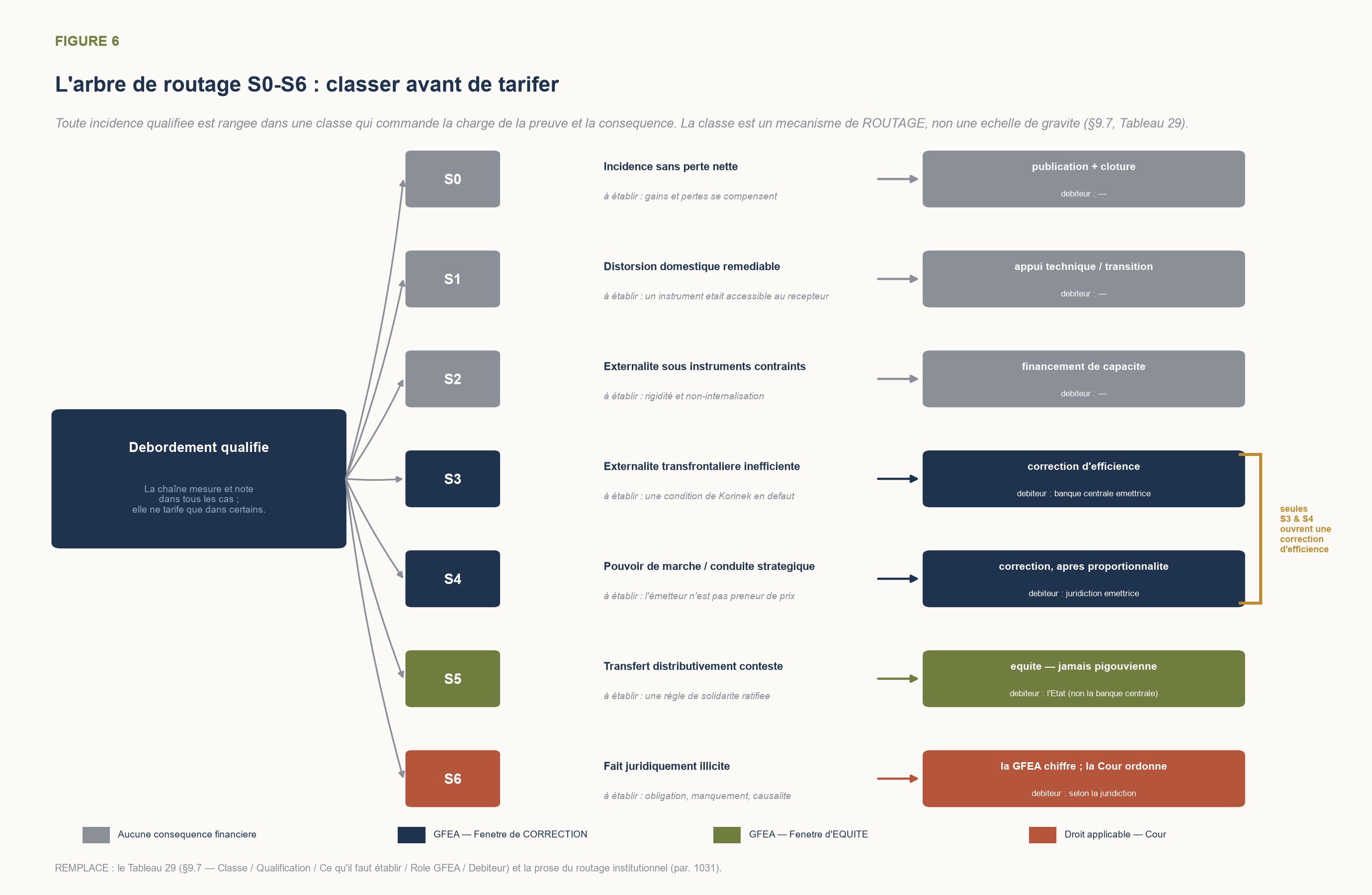
Legal lock of class S6. The classification of a case file as S6 cannot result from the gravity of the detriment alone, from its cross-border character or from a judgment of inequity. It requires the identification of a primary legal obligation applicable to the defendant, the attribution of a conduct, the finding of a violation, the establishment of a detriment and of a legally sufficient causal link, as well as the existence of a subject entitled to invoke responsibility before a competent forum (§5.8.1). Failing any one of these elements, the case file must be routed towards another class, a preventive measure, a consented solidarity or a reasoned closure.¶ 87
The two windows of the GFEA. The financial consequence does not fall under a single regime. The GFEA operates two normative windows, endowed with separate legal bases, scales, decisions, budget lines and avenues of redress. The correction window applies to classes S3 and S4: it requires an established causality, a net welfare loss after neutralisation of the transfers, a cross-border distortion not internalisable by the recipient, and a corrective gain exceeding its costs. The equity window applies to class S5: it presupposes no demonstration of inefficiency, but a risk-sharing rule explicitly adopted. Separating the two windows is not an administrative convenience: it is what prevents a distributive contribution from being presented as an efficiency correction that has not been demonstrated.¶ 88
The debtor follows from the ground. In the correction window, the debtor is the decision-maker itself — the source central bank, on its profits or its seigniorage — because the object of the remedy is that the cost should enter the decision function and weigh on the subsequent trade-offs. A payment discharged by the treasury would repair the detriment without altering a single future decision: it would indemnify without correcting. In the equity window, by contrast, no decision is corrected — a loss regularly incurred is shared — and the debtor is the State. The choice of debtor is therefore not discretionary: it is entailed by the nature of the claim.¶ 89
The consolidation objection. It will be objected that the central bank remits its profits to the treasury, so that charging it would amount to charging the taxpayer, and that the distinction would be immaterial. The incidence does indeed consolidate in part. But this consolidation does not weaken the device: it constitutes its second mainspring.¶ 90
The first mainspring is direct. The charge is entered on the balance sheet of the central bank, is published by it, attaches to its policy choices, and thus enters into its trade-offs. What matters is not where the money lands in the last resort, but on which set of books the cost is recorded, by whom it is published, and to which decisions it is imputed. A transfer discharged by the treasury would not produce this effect: it would indemnify without correcting.¶ 91
The second mainspring is indirect, and it is political. Because the central bank remits its profits to the treasury, a charge that reduces those profits reduces public revenue by the same amount. The fiscal authority — the very one before which the central bank renders account — thereby acquires in its turn a direct interest in the spillover diminishing. The device thus creates two monitors where there were none: the decision-maker, who sees the price of what it displaces, and its political principal, who sees the bill. Far from circumventing democratic control, the mechanism makes it effective — it inscribes in the budget of the source State the cost that its decisions displace onto third parties.¶ 92
This residual incidence is moreover entirely avoidable, and that is the ordinary property of a Pigouvian pricing: its yield decreases as it attains its purpose. An architecture whose corrective receipts diminished until they were extinguished would not have failed; it would have succeeded. Rajan (2015) formulates the same requirement from inside the institution when he writes that the major central banks could reinterpret their domestic mandate so as to take into account the reactions of other countries, and that the international rules of the game must be revisited.¶ 93
The architecture therefore does not ask a central bank to pursue foreign welfare, which would amount to entrusting it with a foreign policy mandate that only a legislature can give. It asks it to see the price of what it displaces, and leaves it the entire trade-off. The independence of the decision remains entire; only immunity to its externalities ceases.¶ 94
What remains to be demonstrated. Two burdens weigh on this reasoning, and the document holds them to be its own. The first is empirical: Annex G, announced in §9.5, must establish, mechanism by mechanism, the identified shock, the local projections, the counterfactual, the neutralisation of the transfers and the residual welfare loss; as long as it is not published, no correction may be levied on the strength of this section alone. The second is legal, and it is heavy: in designating the central bank as debtor, the architecture deliberately targets the class of assets best protected by international law. This is not an oversight, but an accepted consequence of the ground retained — a remedy that does not reach the decision-maker corrects nothing. Jurisdiction and consent are dealt with in §5.8, immunity in §5.4, and both fall within the legal memorandum announced in §14.¶ 95
Institutional routing of the classes. The S0–S6 classification does not constitute a scale of increasing gravity leading mechanically to a price. It constitutes a routing mechanism. S0 in principle calls for publication and closure without efficiency correction; S1 calls first for the examination of the instruments accessible to the recipient; S2 requires the analysis of domestic constraints and may justify assistance or prevention without an automatic charge on the source jurisdiction; S3 and S4 open only the possibility of an efficiency correction if the conditions of identification and proportionality are satisfied; S5 falls under an explicit choice of solidarity or equity, without being presented as the price of a demonstrated global loss; S6 falls under the norms, forums and remedies of the applicable law. One and the same case may comprise several components, but these remain separate and are never added together under a single qualification.¶ 96
9.8 The stacking of tightenings and the exhaustion of fiscal buffers
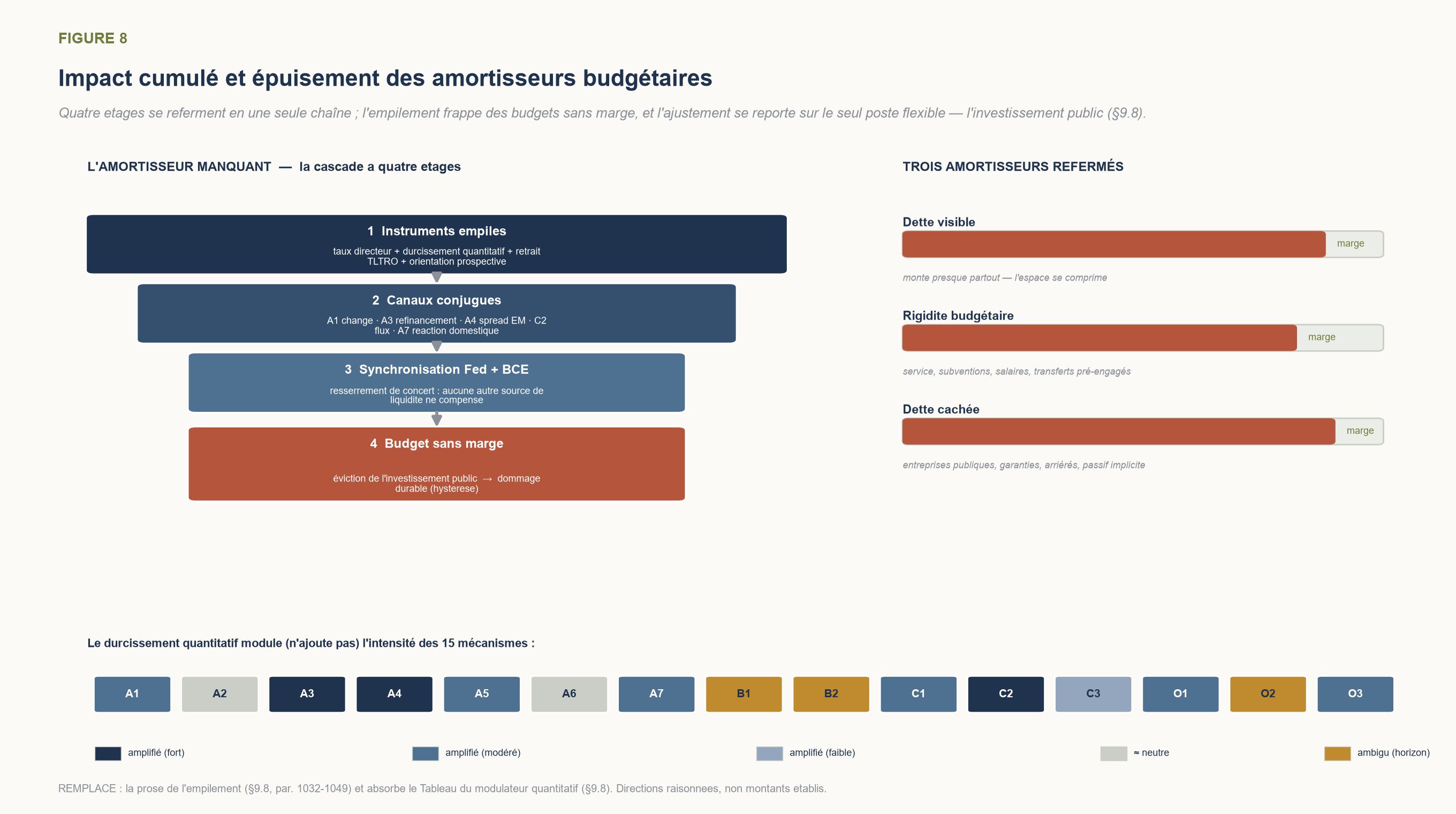
This subsection brings together three findings in a cumulative demonstration: the tightening instruments add up; the transmission mechanisms combine and weigh in the same direction; the synchronisation of the major central banks amplifies the whole. This stacking strikes budgets whose buffers have disappeared, and the adjustment falls back on the only flexible item — public investment —, so that the damage becomes lasting. The persistence of the damage through under-investment connects with the work on the non-reversibility of output losses (Cerra and Saxena, 2008).¶ 97
The instruments add up. Over the last two decades, tightening has no longer meant, for the Federal Reserve and the European Central Bank, loosening the balance sheet but contracting it: to the rise in policy rates was added, with a lag, quantitative tightening, then the withdrawal of the unconventional operations. These instruments work in the same restrictive direction but do not act on the same segment: the rate operates on the short end of the curve and on indexed credit (A2, A6, A7); quantitative tightening on the long end — through the term premium — and on global liquidity (A3, A4, C2); forward guidance tightens the whole curve by anticipation; the withdrawal of the targeted operations (TLTRO) reduces privileged bank funding. A tightening in 2022 is therefore not comparable with a tightening in 2005: mainly steered by the policy rate in the past, it today combines, far more visibly, the short end, the long end and expectations.¶ 98
The magnitude of this proper effect is not merely qualitative. The European Central Bank estimates that a reduction of about 1,000 billion euros in its holdings would raise the term premium on the ten-year rate by about 35 basis points, and more on the lowest-rated sovereigns — of the order of 45 basis points on Italian debt and 50 on Spanish debt (Akkaya et al., 2024). Transposed to the recipient economies, this gradient has a direct consequence: the increased cost of refinancing (A3) is concentrated on the most fragile borrowers, the very ones the present section intends to protect.¶ 99
One point of method conditions all attribution. The effect of quantitative tightening passes as much through anticipation as through the operation, and three objects must be distinguished: the flow of sales or non-reinvestments under way, the outstanding balance sheet inherited from the earlier easing — often still massive while rates are rising — and the announcement of the programme to come. The 2013 episode, in which the mere announcement of a future slowing of purchases triggered massive outflows from the emerging economies before any effective tightening, shows that the announcement can weigh more than the operation. A protocol that does not isolate the balance-sheet dimension from the rate dimension mis-attributes mechanically: the multidimensional decomposition of shocks — conventional rate, forward guidance, balance-sheet measures — retained by the protocol of Annex G (specified in §9.5) is the safeguard.¶ 100
The mechanisms combine, but do not add up. To treat them as a sum would amount to the double counting this document is at pains to proscribe; they combine — faced with a stacked shock, several channels are triggered together and weigh in the same direction, which concentrates the damage without their effect being the mere addition of their amounts; the overlap matrix and the residual exist precisely in order to keep them distinct. A stacked tightening simultaneously activates sovereign refinancing (A3, term premium raised by quantitative tightening), emerging market spreads (A4, tightening of global liquidity), capital flows (C2, amplified outflows), the exchange rate and debt service (A1, appreciation of the dollar) and the domestic monetary reaction (A7). Some offsets are reinforced too — return on reserves (O1), the later reflux of prices (O3) — but they accrue later and to other agents: the net result is not a cancellation, it is a concentration of the cost on the most fragile borrowers, at the moment of the shock.¶ 101
Quantitative tightening, a cross-cutting modulator. Quantitative tightening is not a sixteenth mechanism: it is a factor that modulates the intensity of the fifteen already set out. Its large-scale episode being recent and its proper effect still poorly identified, the table below proceeds by reasoned directions, not by established amounts; it belongs to the design proposal, not to the verifiable rung of the epistemic ladder (Box 10).¶ 102
Direction of the effect of quantitative tightening, mechanism by mechanism — reasoned directions, not measured effects.¶ 103
The table is wider than the screen: drag it sideways.
| Mech. | Name | Effect of quantitative tightening | Main channel |
|---|---|---|---|
| A1 | Exchange rate and debt service | Amplifies (moderate) | Withdrawal of dollar liquidity → appreciation; exchange-rate effect debated. |
| A2 | Floating-rate debt | ≈ neutral | Indexed to the short rate (SOFR, Euribor); driven by the policy rate. |
| A3 | Refinancing — risk-free curve | Amplifies (strong) | Direct channel: tightening raises the term premium. |
| A4 | Global emerging-market spread | Amplifies (strong) | Tightening of global liquidity → common spread factor. |
| A5 | Idiosyncratic premium | Amplifies (moderate) | The amplification component grows with global tightening. |
| A6 | Sterilisation of reserves | ≈ neutral | Operates through the domestic rate; indirect link to the foreign balance sheet. |
| A7 | Domestic monetary reaction | Amplifies (moderate) | Tighter global conditions → increased pressure on the local central bank. |
| B1 | Import prices — cereals | Ambiguous (horizon) | Exchange rate (higher local bill) against demand (lower dollar prices); see the example. |
| B2 | Import prices — energy | Ambiguous (horizon) | The same, modulated by the domestic price regime. |
| C1 | Export demand | Amplifies the damage | Slowed partners → increased export losses. |
| C2 | FDI, portfolio, banking | Amplifies (strong) | Tightening drains liquidity: amplified capital outflows. |
| C3 | Tourism | Amplifies (weak) | Income in the countries of origin compressed; the recipient's tourism receipts falling. |
| O1 | Return on reserves (gain) | Amplifies the gain | Higher returns on reserve assets → increased offset. |
| O2 | Diaspora remittances | Ambiguous | Reduced income in the host countries against a favourable exchange-rate effect. |
| O3 | Price retreat (gain) | Amplifies the gain | Reinforced demand slowdown → subsequent price decline. |
An example makes this non-additivity tangible. Under quantitative tightening, a recipient country’s cereal or energy bill appears to rise as a single block, whereas three forces of differing sign and horizon are superimposed within it: the appreciation of the dollar increases the local bill immediately (A1), while the slowdown of global demand causes the price in dollars to recede later (O3), and any supply shock remains external to the monetary sphere. In the short term, the exchange rate effect dominates; the net sign therefore depends on the horizon.¶ 104
Why this is not a “commodities” channel. The increased cost of the cereal bill under quantitative tightening does not open a new mechanism: it is the conjunction of three effects belonging to three distinct registers. The exchange rate effect falls under mechanism A1; the reflux of the price in dollars through global demand falls under offset O3, at an explicit horizon; any supply shock on the world price remains a competing factor, never imputed to the monetary sphere. Adding them together as “tightening raises the price of cereals” would over-attribute and would count twice the exchange rate effect already carried by A1. This is the programme’s rule of non-additivity: one and the same event propagates by several routes belonging to separate registers, and the overlap matrix exists precisely in order to keep them distinct.¶ 105
Synchronisation amplifies. The two major central banks tighten almost simultaneously on two occasions over the period: in 2005-2008, a transatlantic rate tightening (Federal Reserve +425 basis points, European Central Bank +225) bearing mainly on the exchange rate and the short end (A1, A2); in 2022-2023, a complete stacking — Federal Reserve +525 basis points and more than 2,200 billion dollars of reduction in its securities holdings, European Central Bank +450 points with quantitative tightening and the withdrawal of the targeted refinancing operations —, activating A1, A3, A4 and C2 on both sides, in an unprecedented withdrawal of global liquidity: with the principal central banks issuing reserve currencies tightening in concert, the possibility that another major source of international liquidity might offset the shock is greatly reduced. A fine desynchronisation subsists — the Federal Reserve began its quantitative tightening earlier and halted the contraction of its balance sheet earlier (December 2025), the European Central Bank following one to two years behind — and this lag within a common movement offers variation exploitable for empirical identification, without breaking the underlying concordance.¶ 106
A disciplined analogy. In an electricity network, a disturbance becomes systemic only if it modifies the flows borne by the other components: the current redistributes itself over the remaining paths, and if some were already close to their limit, the overload may move towards a distant component; propagation is non-local and may become discontinuous when thresholds are crossed (Korkali et al., 2017; Schäfer et al., 2018). The monetary parallel lies in the interaction between local protection and systemic load: a source central bank raises its rates for a legitimate domestic objective; the recipient central banks raise theirs in order to contain depreciation, imported inflation or capital flight. Each protects a legitimate objective; together, they add tightening to tightening. The cascade therefore does not necessarily result from an individual error: it may emerge from the interaction of rational responses taken separately.¶ 107
Quantitative tightening reduces the margins of absorption. It is not added on like a second rate rise: it returns duration to private portfolios and tightens liquidity, so that the remaining paths operate closer to their capacity. The order of magnitude is real: in the Federal Reserve’s models, a reduction of about 2,500 billion dollars relative to holding the balance sheet at its peak would be equivalent to a little more than 50 basis points of sustained policy rate (Crawley et al., 2022); on the European side, the effect on the term premium is of the same order (supra, §9.8). The analogy bears, however, on the fall in margins and the reallocation of the load, not on a physical identity: central bank reserves are not a “global electrical reserve”, and a gradual and predictable runoff may unfold without major strain.¶ 108
What the analogy establishes — and what it does not establish. It establishes a possibility of composition: a domestically justified decision may modify the load on the network, local responses may amplify it, and the systemic result may correspond to the mandate of no decision-maker — which justifies measuring the interaction of policies, not the impulse of the first source jurisdiction alone. It does not establish that every tightening triggers a cascade, nor that the initial decision is at fault: unlike an electricity network, monetary actors anticipate, choose their instruments and have buffers. Qualification therefore requires the counterfactual, the identification of the shock, the instruments accessible to the recipient, the offsets and the classes S0–S6.¶ 109
The institutional conclusion is narrow. The system has local protections, but no operator charged with keeping the distributive and cross-border account of the cascade. The GAF does not propose a “global network manager” setting national rates: it proposes that the HuIB measure the impulses, exposures and thresholds; that the GIRA (Global Impact Rating Authority, §5.3) distinguish the initial shock from its amplification; and that the GFEA attach a consequence only where the conditions of efficiency or of equity are crossed. The object is not to prevent each relay from protecting its network, but to prevent the load displaced by the whole set of protections from disappearing from the set of books.¶ 110
Analytical correspondence between electrical cascade and monetary tightening.¶ 111
The table is wider than the screen: drag it sideways.
| Electricity network | Monetary and financial network | Analytical scope |
|---|---|---|
| Node or line of high centrality | Central bank issuing a reserve currency; safe-asset market; global banking system | A change at the centre affects many jurisdictions even without a direct bilateral relationship. |
| Initial disturbance or removal of a component | Policy rate increase, revision of the expected path, halt to asset purchases | The reference price and financing conditions shift before all actors can adjust their balance sheets. |
| Redistribution of flows over the remaining paths | Portfolio reallocation, appreciation of the dominant currency, capital outflows, rising spreads and refinancing costs | The shock travels through several channels; the next economy affected is not necessarily the geographically closest. |
| Protective relays and local tripping | Defensive rate increases, foreign-exchange intervention, credit restriction, fiscal or macroprudential adjustment | The response locally protects the currency, reserves or inflation, but may shift the cost onto activity, credit or other countries. |
| Reserve margin and unused capacity | Foreign-exchange reserves, fiscal space, bank capital, access to refinancing, market depth and monetary credibility | The thinner the margins, the more a moderate shock can push past a liquidity, solvency or sustainability threshold. |
| Cascade or load shedding | Synchronised tightening, credit rationing, forced deleveraging, defaults, contraction of investment and trade | The aggregate damage may be non-linear and disproportionate relative to the initial decision. |
Budgets without a buffer. This synchronous stacking does not strike intact budgets, but States whose margin of absorption has closed up for three cumulative reasons: visible debt has risen almost everywhere, compressing the space available to absorb an increased refinancing cost; budget rigidity makes the adjustment mechanical — when debt service, subsidies, the wage bill and the social transfers due are pre-committed, public investment is not chosen as the adjustment variable, it is the only item left; and hidden debt saturates a margin that the official accounts do not show — liabilities of state-owned enterprises, sovereign guarantees, arrears, the implicit liabilities of the social security funds —, the scale of which more than half of the reporting countries have had to revise upwards over the recent period. A finance minister confronting an external tightening therefore does not make his trade-off in the abstract between debt and investment: he makes it under a partially invisible constraint, often already saturated.¶ 112
The missing buffer. The four storeys close into a single chain: stacked instruments → combined channels (A1, A3, A4, C2, A7) → synchronisation of the major central banks → budget without margin → crowding-out of public investment → lasting damage through hysteresis. Investment is cut not by choice, but by elimination, and with it future capital. The attribution precaution remains: the mechanism is not imputed by direct deduction but by differential identification — not the fall in investment as such, but the difference in the fall across countries according to their pre-existing budget rigidity, hidden debt included. This precaution does not dilute the field observation: it makes it measurable, and the space of choice itself becomes a magnitude whose closing is measured. What this subsection establishes — instruments added together, central banks synchronised, margins closed up — is documented; that the stacking concentrates the cost on refinancing and flows, and that the crowding-out of investment is the consequence of it, is a reasoned direction to be confirmed; the differential magnitude of that crowding-out is the object of the induced mechanism of the protocol of Annex G (specified in §9.5) and of its identification plan.¶ 113
Qualification itself has received an explicit form: every incidence is placed in one of the seven classes S0 to S6, which command the burden of proof and the admissible consequence — only two of them being able to justify an efficiency correction, others falling under solidarity or under law, others calling for no pricing at all. This classification, its definitions and its attribution bounds are established in Annex F.¶ 114
9.9 Three failures, one and the same cause: what international monetary reform has already attempted
An architecture that claims to organise the accountability of monetary spillovers must say why the earlier attempts failed — and, if it does not say so, a reader will remind it of it. The record is instructive, and it does not run in the direction one supposes: the three best-documented failures of international monetary reform are not failures of financial engineering. They are failures of a link in the chain.¶ 115
The substitution account. Technically complete as early as the end of the nineteen-seventies, it allowed holders of dollar reserves to convert them into claims denominated in special drawing rights. It has been blocked for forty years on a single question: who bears the loss if the value of the asset deposited diverges from that of the claim issued. That is not a monetary problem. It is a problem of attribution — precisely what an accountability chain is made to settle, by establishing who owes what, on what ground, before which forum.¶ 116
The rating of monetary policies. In 2016, a G20 central bank governor and an economist of the International Monetary Fund publicly proposed classifying monetary policies according to their spillover effects — green where the effects are domestic or positive, orange in case of uncertainty, red where adverse effects dominate —, on the basis of analyses entrusted to independent panels. The proposal was never instituted, and its causes of failure are documented: the rater would have been judge in its own cause, since the same institution measures, qualifies and advises the same States; no adversarial procedure was provided for before publication; no consequence was attached to the rating, so that there was an incentive neither to comply with it nor to contest it; and no coalition of States carried it. These four causes correspond term for term to four design choices set out in §5.2, §5.3, §9.7 and §6.3.¶ 117
The spillover reports. Published at the beginning of the 2010s, they constituted an embryo of a dedicated measurement function. They were reabsorbed into ordinary surveillance within a few years, without any consequence ever having been attached to their findings. This case establishes a proposition that holds beyond the monetary sphere: a measurement function isolated from the rest of the chain is not merely incomplete — it is reversible. It disappears without anyone having to decide to abolish it, because nothing depends on it. This is the strongest argument against a strategy that would consist in obtaining measurement first in the hope that the rest would follow, and it supports the principle of functional completeness (§1.4).¶ 118
What these precedents establish, and what they do not establish. They do not establish that the architecture proposed here would succeed where others have failed: that demonstration belongs to the three-arm comparative pilot (§12.5). They establish that the breaking point, in all three cases, lies exactly where the chain places its safeguards — the separation of functions, the adversarial stage before publication, the graduated consequence and the political vehicle. A counter-argument must be kept visible: these failures may also be explained by the balance of power, and nothing proves that a better design would have prevailed. The defensible proposition is narrower — each of these failures had an identifiable design cause, and that cause is addressed.¶ 119
Cite this section
Yaïche, Nizar (2026). 9. Monetary spillovers: from incidence to bounded attribution. In The Humanity Compact (v2.3). Zenodo. https://doi.org/10.5281/zenodo.22746533
@incollection{yaiche_hc_chapitre_9,
  author    = {Yaïche, Nizar},
  title     = {9. Monetary spillovers: from incidence to bounded attribution},
  booktitle = {The Humanity Compact},
  year      = {2026},
  version   = {2.3},
  doi       = {10.5281/zenodo.22746533},
  publisher = {Zenodo},
  url       = {https://humanitycompact.org/ouvrage/chapitre-9/}
}A book by Nizar Yaïche, former Minister of Finance of the Republic of Tunisia. Who is the author?