3. A dense international system that stops along the way
Chapter 3 of 15 · ≈ 30 min read · 73 paragraphs · section 9 of 40 · search the book
Over the past three years, the United Nations has produced the most complete diagnosis of this problem ever drawn up — and has stopped, with remarkable consistency, at the threshold of binding implementation.
3.1 The United Nations level: a diagnosis without means of constraint
Over the past three years, the United Nations has produced the most complete diagnosis of this problem ever drawn up — and has stopped, with remarkable consistency, at the threshold of binding implementation. The Pact for the Future commits Member States to “develop a framework on measures of progress on sustainable development to complement and go beyond gross domestic product” (United Nations General Assembly, 2024, action 53). The Secretary-General’s high-level expert group has since proposed a compass of some thirty indicators — the report “Counting What Counts” (United Nations, 2026). The General Assembly has launched negotiations towards a framework convention on international tax cooperation (United Nations General Assembly, 2023, resolution 78/230) — a genuine step towards bindingness, the reach of which nevertheless remains confined to taxation. The International Court of Justice, in its 2025 advisory opinion on climate obligations, affirmed that “a responsible State is under an obligation to make full reparation for the injury caused by the internationally wrongful act” (International Court of Justice, 2025; ARSIWA, art. 31) — an advisory pronouncement that is not binding as such; article 94 concerns compliance with judgments, for which recourse to the Security Council may be contemplated. An Independent International Scientific Panel on Artificial Intelligence has been established (United Nations General Assembly, 2025, resolution 79/325) — expressly advisory. The Secretary-General himself has stated on several occasions that the international financial architecture was “outdated, dysfunctional and unfair” (Guterres, 2024) and has called for a “new Bretton Woods moment” (Guterres, 2023). By the end of 2025, the tone had hardened further — the least developed countries facing tariffs of forty per cent while accounting for barely one per cent of global trade flows (Guterres, 2025).¶ 1
To move beyond anecdote, the research programme behind this document assembled 136 United Nations source documents at pillar level bearing on externalities, measurement, financing and accountability, then de-duplicated them so as to arrive at 99 distinct primary instruments — resolutions, outcome documents, expert group reports, advisory opinions — verifying the classification and, for the most sensitive, the exact wording. According to the closed-coding register, 6 of the 99 distinct instruments are binding on identifiable subjects, 8 are advisory, and 85 are political or non-binding; the earlier range of 17-20/136 reflected documents duplicated at pillar level and is superseded by the de-duplicated count. The finding is unambiguous: the United Nations has the diagnosis and the language; it stops at dashboards. This is not a criticism of the organisation — it reflects the limits its members have set for it — but it is a fact as to where the world’s most legitimate deliberative body stops today, and where something else must begin. The critique is a generation old — the governance of globalisation has lagged behind its integration at least since Stiglitz (2002) named its discontents; what is new is the precision of the diagnosis that the United Nations now makes itself. In the words of the FACTI Panel (2021): “there is no single body responsible for global coordination, which allows incoherence and duplication”.¶ 2
The category “binding” calls for a clarification. It means neither that these instruments bind all States, nor that all their provisions are directly invocable before a court, nor that coercive enforcement is automatically available. It means that, within a determined personal, material, territorial and temporal scope, the instrument or certain of its provisions produce a legal obligation for an identifiable subject by virtue of a title recognised by the applicable law — one of the six routes set out in §3.1.1.¶ 3
The coding was taken up again on 27 July 2026 in the light of this grid, and the earlier count of twelve binding instruments was brought down to six: two General Assembly resolutions appeared there as binding, which §3.1.1 contradicts; three further lines coded a mechanism, a press release or a decision of a conference of the parties whose cited source was not the legal text itself; one ministerial decision of the World Trade Organization fell outside the corpus’s United Nations scope. The symmetrical check for false negatives found nothing: no treaty instrument had been wrongly classified as non-binding. The complete nominative register, the coding rule and the line-by-line justification are published in the evidence pack (EP2, version of 27 July 2026).¶ 4
The finding must therefore be graduated rather than absolute: binding instruments exist — some among the most effective in international law — but they are sectoral, limited to their parties and to their subject matters, and no procedure links them from the measurement of an effect to its qualification, to consequence, to financing and to remedy. Legally strong within their scope, functionally discontinuous end to end: it is this discontinuity, and not a normative void, that the Global Accountability Chain calls the accountability deficit.¶ 5
Where constraint is missing. The aggregate count indicates how many instruments bind; it does not say which of the chain’s functions they cover. The projection of the register onto the components of the architecture — each binding instrument attached to the function it touches — is more instructive than the count itself. The table that follows is not numbered: it is a reading of the register, published with it in the evidence pack, and not a design result of the present work.¶ 6
The table is wider than the screen: drag it sideways.
| Chain function | Binding instruments in the corpus | Reading |
|---|---|---|
| Humanity Court — adjudicate (§5.8) | Statute of the International Court of Justice; Rome Statute | Covered |
| Call of Carthage — participate (§6.3) | CRPD, art. 29; ICCPR, art. 25 | Covered |
| Carthage Charter — found and revise (§6.1) | Charter of the United Nations, arts. 108-109 | Covered |
| BFM — adjust (§5.5) | Paris Agreement, arts. 2 and 4 | Covered indirectly: a procedural obligation, not a border obligation |
| HuIB — measure (§5.2) | none | Silence |
| GIRA — rate (§5.3) | none | Silence |
| GFEA — price (§5.4) | none | Silence |
| GSF — finance (§5.6) | none | Silence |
| IPDA — certify (§5.7) | none | Silence |
| Preventive loop — prevent (§15) | none | Silence |
Six functions out of ten are covered by no binding instrument in the corpus, and they are exactly those that this document designates as the core of the deficit: measure, rate, price, finance, certify, prevent. Constraint exists where the system knows how to adjudicate and how to secure participation; it disappears as soon as it is a matter of measuring an effect and of drawing a consequence from it.¶ 7
The most significant silence is the one that activity conceals. Before the legal recoding of the register, the pricing and financing functions appeared to be covered: attached to them were two General Assembly resolutions on international tax cooperation and the decision of the twenty-eighth conference of the parties establishing the loss and damage fund. These texts have been recoded as non-binding — they open negotiations, create funds fed by voluntary contributions, but impose no identifiable obligation on any determined subject (§3.1.1). It is precisely where the system has produced the greatest amount of recent activity that it has produced no obligation: normative density is there taken for constraint, and the deficit is there all the harder to see.¶ 8
The International Monetary Fund describes its own mission in terms that cover the whole chain. Its External Sector Report of July 2023 presents itself as forming part, together with the World Economic Outlook and Article IV consultations, of “an ongoing effort to assess and address the possible spillover effects of members’ policies on global stability” (p. viii). Assess and address: the claimed mandate is complete.¶ 10
The “measure” link works, and remarkably well. Chapter 2 of the report, wholly devoted to the implications of the global dollar cycle, “finds large negative spillovers to emerging markets” (p. ix). The Executive Board endorses this: dollar appreciations “had large negative cross-border spillovers, disproportionately affecting emerging markets” (p. x).¶ 11
It is at the next sentence that the chain breaks. The Board “stresses that more flexible exchange rates and better-anchored inflation expectations can mitigate negative spillovers to emerging market economies” (p. x). The harm is recognised, attributed, quantified — and the consequence drawn from it is addressed to the one who suffers it. Not a line, in the Board’s summary, attaches the slightest obligation to the jurisdiction whose policy produced it. “Address” means, in the end: that the victim adjusts.¶ 12
The break, moreover, precedes the conclusion: it is already in the method. To estimate spillovers, the chapter adopts a trade-weighted dollar index against advanced currencies, on the ground that such an index is more plausibly exogenous for the study of spillovers to emerging markets, and it identifies the shock by exclusion — as the residual that the established determinants of the exchange rate do not explain. These are legitimate econometric choices in view of the question posed, which is that of the impact suffered. But they have a consequence: the shock, so constructed, has no author. It is a price, not a decision. The measurement is therefore, by construction, incapable of carrying a consequence — not because it would be imprecise, but because it was designed without an addressee.¶ 13
It would be wrong to see in this a deficit of knowledge. The prescribed remedy — exchange rate flexibility — is precisely the one that research establishes does not insulate in the presence of a global financial cycle (Rey, 2015) and that loses most of its expenditure-switching power under a dominant-currency pricing regime (Gopinath et al., 2020) — work conducted in part by the Fund’s own economists, and under whose general direction this report was prepared. The knowledge is in-house. What is missing is not knowledge: it is the force of what carries it.¶ 14
It will be objected that an institution is nonetheless charged with this conversion, and the objection would be well founded: the Fund built, after the crisis, a spillover surveillance apparatus that did not previously exist — spillover reports devoted to the five systemic economies, external sector reports, Article IV consultations. The deficit is therefore not a defect of mandate, and it would be inaccurate to present it as such. Ocampo (2017) establishes its exact nature, in two steps. On the one hand, the Fund’s surveillance “has always been considered not only a weak mechanism but also an unbalanced one” (p. 79); it remains “largely ineffective in relation to developed countries” (p. 29) and without “traction” on the policies of the major economies (p. 93). On the other hand — and this is the decisive point — “conditionality does exercise a strong influence on countries that use Fund resources; but it is obviously exercised only in relation to deficit countries, and it therefore constitutes one of the asymmetric features of adjustment processes” (p. 79).¶ 15
The only genuinely binding instrument of the system thus points in one direction only: that of the recipient country. The source jurisdiction is monitored without being obliged; the recipient country is obliged without being heard. The asymmetry is not a void in the architecture: it is its structure.¶ 16
This is the clearest illustration of the functional accountability deficit defined in §2.5. And it comes from no adversary of the financial order: it comes from the most authoritative institutional document on the subject, endorsed by the organ that represents the member States themselves.¶ 17
In 2008, the President of the sixty-third session of the United Nations General Assembly constituted a commission of experts on the reform of the international monetary and financial system. Chaired by Joseph Stiglitz, it counted among its members José Antonio Ocampo, Jean-Paul Fitoussi, Charles Goodhart, Jomo Kwame Sundaram, Avinash Persaud — and three monetary officials from the South: Yaga Venugopal Reddy, former Governor of the Reserve Bank of India; Zeti Akhtar Aziz, former Governor of Bank Negara Malaysia; Yu Yongding, former member of the monetary policy committee of the People’s Bank of China. Its final report is dated 21 September 2009 (United Nations, 2009).¶ 19
What it proposed. An intergovernmental panel of experts charged with assessing and monitoring systemic risks, whose organisation would follow the model of the Intergovernmental Panel on Climate Change, and which would act in support of a Global Economic Coordination Council — itself “at a level equivalent to that of the General Assembly and the Security Council”. A global financial authority charged with coordinating regulation. A financial products safety commission. A global reserve system. And an International Debt Restructuring Court.¶ 20
What it saw. The report names the externality thirty-eight times, and it names it well: “the actions of any one country have effects on others; too often, these externalities are not taken into account in national policy decisions — developed countries in particular”. Propagation, it did identify.¶ 21
What it built — and it did indeed build. On debt, the Commission did not produce a wish: it produced a chain. It recommends “the creation of an ‘International Debt Restructuring Court’, similar to national bankruptcy courts”; this court would enforce “the agreed international principles as to the priority of claims”; “creditors and debtors will therefore follow its decisions”; and an International Mediation Service would form, as an intermediate step, the preparatory soft law. A harm, a debtor, a rule, a judge, enforcement. All the links are there.¶ 22
Where it stopped. Paragraph 34 of the same report notes that the bank rescues of the advanced economies “aggravate long-standing asymmetries in the functioning of global financial markets”, and writes: “unless measures are taken […] to provide developing countries with compensatory payments intended to offset the distortions liable to result from bailouts, guarantees and asymmetric expansionary fiscal policies, there is a risk that the global inequalities that contributed to the crisis will increase.” The asymmetry is named. The harm is named. The remedy is named. And no one is designated to carry it.¶ 23
The difference is not one of quality: it is one of object. The Commission was answering a contractual question — in a debt crisis, who owes what to whom, and in what order? That question already possesses a creditor, a debtor and a claim; all it lacked was a judge, and the Commission proposed one. The present document answers another question: what stops a harm that has no counterparty? A policy spillover is not a contract. It has neither creditor, nor debtor, nor claim. It has only a path. And one cannot attach a consequence to what has only a path without first measuring it, rating it, pricing it, and making it enforceable somewhere.¶ 24
This is why that report, which names the externality thirty-eight times, does not contain even once the words price of the externality, border adjustment, negative mandate or interface. Not through negligence on its authors’ part — because its question did not call for them. It built a court where the harm already had a debtor; it stopped at the wish where the harm had only a path.¶ 25
The functional accountability deficit (§2.5) is therefore not an oversight. It is the property of a harm that propagates without a counterparty: where there was no contract, there has been no institution. And it is this void that the chain undertakes to fill — not by prohibiting propagation, but by endowing it with a meter, a price and a remedy.¶ 26
This document therefore claims novelty for none of its organs taken in isolation. A global scientific panel, an international court, a reform of the reserve system were all proposed in 2009 — by better-placed authors, at a more favourable moment, and nothing came of it. What it does claim is to supply the 2009 sentence with the addressee it lacked: a chain in which “compensatory payments” cease to be a wish and become a claim that is measured (§5.2), rated (§5.3), priced (§5.4), made enforceable (§5.5) and contestable before a judge (§5.8).¶ 27
Finally, the signature must be read. Paragraph 34 was subscribed to by a former Governor of the Reserve Bank of India, a former Governor of Bank Negara Malaysia and a former member of the monetary policy committee of the People’s Bank of China. The idea that a consequence might be attached to the spillovers of monetary policy is not an outsider’s thesis: it has been carried, since 2009, by central bankers themselves. And the Commission had, moreover, disarmed the commonest objection in advance, writing: “we understand the concern about the proliferation of international institutions and the reluctance to create new ones; the need for such a Council is no less compelling”. The objection is sixteen years old. The most authoritative commission there ever was faced it head-on — and went ahead regardless.¶ 28
3.1.1 How does an international norm become legally binding?
International legal constraint does not proceed from a general world authority that would turn every resolution into a binding order. It results from a title of competence and a rule of attachment. Before qualifying an instrument as binding, one must identify: the source of the obligation; the subject bound; the scope of the obligation; the date of its applicability; the organ competent to find a breach; and any mechanisms of recognition or enforcement.¶ 29
First route: the treaty. A State is bound when it has validly expressed its consent — ratification, accession, acceptance — and the instrument has entered into force in respect of it. The principle pacta sunt servanda requires performance in good faith; internal law cannot, in principle, be invoked to justify non-performance. A treaty creates no obligations for a third party without its consent, subject to customary law and to peremptory norms.¶ 30
Second route: the decision adopted on the basis of a constituent instrument. The members of the United Nations have accepted, by article 25 of the Charter, to carry out the decisions of the Security Council that conform to it. More generally, an organisation may adopt acts binding on its organs, its agents or its members where its constituent treaty so provides — including, in a remarkable case, by tacit acceptance: the regulations adopted under articles 21 and 22 of the Constitution of the World Health Organization bind all members that do not reject them within the prescribed time limit, which makes the International Health Regulations an instrument binding on 196 States without ratification.¶ 31
Third route: the judicial decision. In contentious matters, the judgment of the International Court of Justice binds the parties for the case decided; article 94 of the Charter commits each member concerned to comply with it. This inter partes authority is distinct from the advisory opinion, which is not binding as such but which may set out with particular authority the state of the applicable law (§5.8.1).¶ 32
Fourth route: contractual and arbitral consent. States, organisations or private actors may accept an arbitral jurisdiction in a treaty, a contract, statutes or a pilot agreement. The award binds the parties according to the arbitration agreement and the applicable law; its recognition and enforcement are facilitated by the New York Convention of 1958, subject to the limited grounds of refusal and to immunities.¶ 33
Fifth route: domestic or regional incorporation. A non-binding standard acquires legal force when a legislature, an administration or a regional organisation integrates it into a law, a regulation, an authorisation, a public procurement contract, a financing condition or a decision. The immediate source of the obligation becomes the legal order that has incorporated it.¶ 34
Sixth route: international custom and peremptory norms. A resolution, a set of draft articles or an opinion may constitute an element of evidence of practice and of opinio juris without itself being the source of the obligation. The 2001 Articles on State Responsibility are not a treaty; several of their provisions are nevertheless frequently treated as reflecting customary law. The qualification bears on the rule applied, not on the title of the document that formulates it.¶ 35
The Global Accountability Chain takes up this discipline: no act of measurement, of rating, of pricing, of financing or of adjudication is presented as binding without identifying its legal vehicle, its duty-holder, its addressees, its scope, its avenue of remedy and its enforcement regime.¶ 36
Matrix of the routes to binding force. Deliberately unnumbered: it sets out a typology of sources, not a result of the present work.¶ 37
The table is wider than the screen: drag it sideways.
| Pathway | Basis | Subjects bound | Principal limit |
|---|---|---|---|
| Treaty in force | Consent to be bound; entry into force | States or organisations parties | Scope of the treaty; reservations and withdrawal possible |
| Security Council decision | Charter, in particular art. 25 | Members targeted by the decision | Competence and terms of the decision; articulation with art. 103 |
| Organisational regulation subject to tacit acceptance | Constituent instrument (e.g. WHO Constitution, arts. 21-22) | Members that have not exercised the opt-out | Power of refusal or reservation within the time limit; scope of the mandate |
| ICJ judgment | Statute, art. 59; Charter, art. 94 | Parties to the case | Inter partes; enforcement not automatic |
| Internal act of an organisation | Constituent treaty, delegated competence | Organisation, organs, agents, members | Mandate, procedure, review of legality |
| Contract or arbitration | Written agreement, arbitration clause | Consenting parties | Arbitral mandate, applicable law, public policy, immunities |
| National or regional incorporation | Statute, regulation, authorisation, public contract | Addressees of the domestic legal order | Constitutional, administrative or judicial review |
| Customary or peremptory rule | General practice accepted as law; jus cogens | Subjects covered by the rule | The instrument cited records or codifies; it does not create |
The legally binding instruments of the international system do not merely circumscribe the diagnosis: they supply, piece by piece, the techniques the chain needs. The Paris Agreement (art. 4.2, 13 and 15) and the International Health Regulations (art. 6) demonstrate that a procedural obligation — to communicate, to notify within a fixed time limit, to submit to review — can bind in a quasi-universal manner precisely because it does not dictate the substance of policies: this is the structure of the preventive loop’s duty of prevention (§15). The WHO Constitution (art. 21-22) shows that a technical content can bind all the members of an organisation by tacit acceptance.¶ 39
The Montreal Protocol brings together on its own four techniques: the adjustment of parameters without re-ratification (art. 2.9), the border as a multilateral incentive to accession (art. 4), compliance facilitated before being sanctioned (art. 8) and the financing of compliance for the least well-endowed (art. 10, Multilateral Fund). The Basel Convention makes the case file travel with the flow (prior informed consent); the Espoo Convention makes transboundary impact measurement, notification and consultation before decision mandatory; the Aarhus Convention makes information, participation and remedy justiciable, and opens its compliance committee to communications from the public; the United Nations Convention on the Law of the Sea makes compulsory jurisdiction acceptable through the choice of forum (art. 287) and declarable exclusions (art. 298); the New York Convention provides the enforcement of awards in more than 170 States.¶ 40
None of these techniques needs to be invented; none is today linked to the others. The proposed architecture does not invent constraint: it links its proven forms along a single chain — and each borrowing remains subject to the limits of its precedent, reservations, opt-outs, immunities and consent included.¶ 41
3.2 The instrument level: one link each
Outside the United Nations, a family of celebrated instruments each solves one link of the chain, then stops. Table 5 offers a synthesis of them.¶ 42
The table is wider than the screen: drag it sideways.
| Instrument | What it covers | Where it stops | What the 7+3 adds |
|---|---|---|---|
| Financial transaction tax (Tobin, 1978; debates on the European FTT) | Pricing of speculative flows | Never implemented at scale; no link to measured harm or to redistribution | A rating-based coefficient links the levy to measured impact; the proceeds feed a dedicated fund |
| OECD BEPS Pillar Two (OECD, 2021) | A floor on corporate tax competition | Tax only; no grounding in externalities; costly adoption for developing countries | A general doctrine of fiscal equity covering all classes of externality |
| EU CBAM (European Union, 2023) | Carbon embodied in imports, a single jurisdiction | A single externality, a single border, no redistribution of the proceeds | Border adjustment generalised to measured human externalities, proceeds earmarked for solidarity |
| Loss and damage fund (UNFCCC, 2022) | Ex post climate compensation | Voluntary pledges; no causal pricing; no adjudication mechanism | Financing tied to harm that is measured, rated and justiciable |
| Bridgetown Initiative / MDB reform | Volume and terms of development financing | More funds at lower cost; the production of harm remains unchanged | Corrects the flow and prices the source |
| United Nations framework convention on tax (UNGA resolution 78/230) | Binding tax cooperation | Tax only; negotiations 2025-2027 | A model — and a future vehicle of incorporation — for the wider architecture |
| Climate clubs (Nordhaus, 2015) | Incentive-compatible coalitions | Carbon only; club design, no institution | The coalition logic, generalised and institutionalised |
| ESG ratings and credit ratings | Private assessment of impact | Conflicts of the issuer-pays model; investor risk, not harm to humanity; unregulated | A public and transparent authority rating harm, never paid by the rated entity |
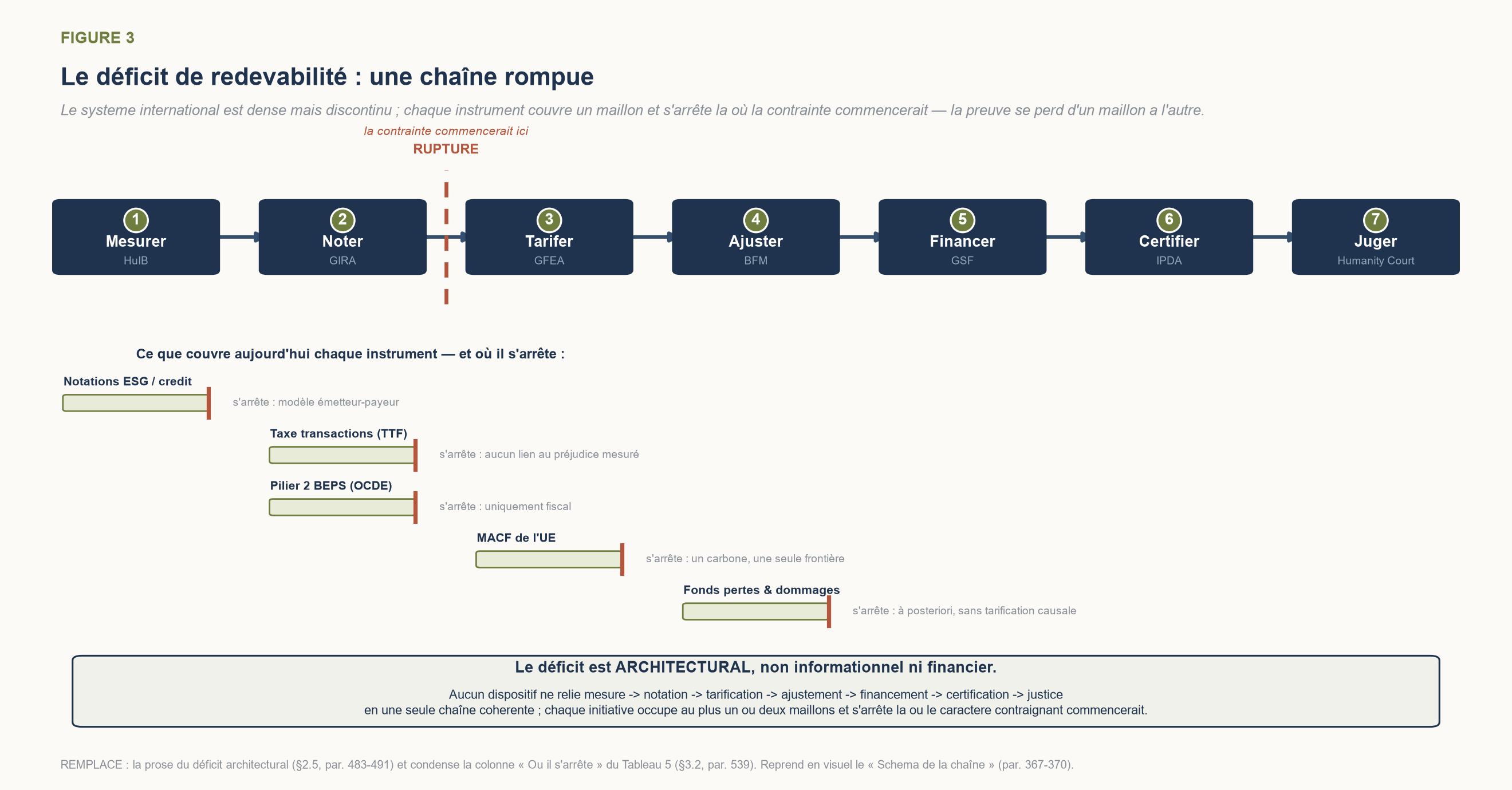
Each row constitutes a success — several have directly inspired components of Section 5 — and each row stops short of bindingness, of generality or of redistribution. The finding of Section 3.1 repeats itself at the level of instruments.¶ 43
3.3 The financing level: Sevilla, mapped
The fourth International Conference on Financing for Development (Sevilla, June-July 2025) produced the Compromiso de Sevilla and a Platform for Action — the largest gathering of the decade on financing for development (United Nations, 2025a). Mapped one by one onto the functional chain of Section 2.5, its 130 initiatives trace a striking distribution: seventy-one — more than half — bear on financing, but only three on rating, none on adjudication, and none creates a binding instrument. This is a count of initiatives — of institutional attention — not of funds mobilised, which remain far below needs: the system masses its initiatives on financing without managing to close the deficit; in this voluntary corpus, rating remains rare, no initiative is principally jurisdictional and none by itself creates a binding obligation — the genuinely binding instruments belong to the United Nations corpus examined separately (Annex / EP2), not to the Sevilla Platform, voluntary by construction. This distribution is not a failure of the conference: it is a revealed preference of the current system — and the precise specification of the functional and interface deficit that the 7+3 architecture is designed to fill.¶ 44
Sevilla did not lack for advice. The conference was prepared by an International Commission of Experts on Financing for Development, constituted for it, whose report — Financing a Sustainable Future — was delivered on 11 February 2025, in the margins of the third preparatory committee, in order to inform the negotiation of the outcome document. It was chaired by José Antonio Ocampo, a member, sixteen years earlier, of the 2009 Commission of Experts (Box 7); and it counted, among its fourteen members, Joseph Stiglitz, who had chaired that one (United Nations, 2025b). The authors of the 2009 proposal thus advised the 2025 conference.¶ 45
And the 2025 conference produced seventy-one financing initiatives, three rating initiatives, none on adjudication, and no binding instrument.¶ 46
The immediate temptation is to set the magnitude of spillovers against the amount of official development assistance — 214.6 billion dollars in 2024 according to the OECD, in decline, and a contraction of 23% in 2025, against displacements of an altogether different order. The juxtaposition is striking, but it is misdirected, and for two reasons. The two magnitudes are not of the same nature: aid is a voluntary, annual and revocable transfer, decided downstream; the spillover is a structural, continuous and automatic effect, produced upstream by the architecture itself. One does not correct a permanent slope by a discretionary gift. And above all, the shortcut leads to the wrong conclusion: it invites a demand for more aid, when the problem is not the volume of the ex post correction but the absence of a mechanism that measures, prices and adjusts at source. The mapping has already shown it — the bulk of the effort bears on financing, very little on rating, nothing on adjudication. The contrast with aid therefore does not plead for more aid: it pleads for a displacement of the correction, from the discretionary downstream towards the structural upstream. It is precisely the function of the chain proposed here — measure, price, adjust — to make that correction systematic where today it is merely solicited.¶ 47
Financing is the fifth link of the chain. It comes after measurement, rating, pricing and adjustment; it precedes certification and adjudication. Sevilla thus concentrated its institutional attention on the fifth link of a chain whose first four do not exist, and whose seventh has no duty-holder. This is not a failure of generosity: it is a failure of architecture. One does not finance the reparation of a harm that nothing has measured, that nothing has rated, that nothing has priced, and for which no one answers.¶ 48
The imbalance noted above is therefore not a statistical curiosity. The best-endowed link of the chain is precisely the one that can produce nothing so long as the others are missing — and the corpus says so bluntly: seventy-one financing initiatives, zero obligations.¶ 49
The Commission of Experts that prepared Sevilla (§3.3) delivered its report in February 2025. It recommends there, among other things, to “Create a United Nations Global Economic Coordination Council: In line with the proposal made in 2009 by the Commission of Experts on Reforms of the International Financial and Monetary System (Stiglitz Commission), create a Global Economic Coordination Council as part of the United Nations system to help coordinate different organizations and identify existing gaps in the current cooperation system” (United Nations, 2025b). The same institution, the same mandate, the same verbs of coordination — sixteen years later. Sevilla did not take it up.¶ 51
The same report devotes an entire section — “Managing the international impacts of the macroeconomic policies of the major economies” — to spillover. The diagnosis it makes is that of the present document, and it is formulated in terms that the latter could not surpass. The monetary, fiscal and trade policies of the developed countries, one reads there, “have important spillover effects on developing countries. These effects are not sufficiently taken into account when these policies are adopted, the economic authorities of those countries considering only their domestic impact.” The source jurisdiction is named: “a clear example is that of the spillover effects of United States monetary policy”. And the insufficiency of the recipient country’s instruments is noted: its capacity to lower its rates “is constrained” by the differential with US rates.¶ 52
There remain the remedies. The section proposes three of them. The first asks the International Monetary Fund to “deepen its surveillance” of the policies of the major economies “in order to analyse their spillover effects”, these assessments potentially constituting “an important element of Article IV consultations”. The second recommends “a broader use of capital account management techniques by developing countries”. The third calls for a re-examination of the effects of Basel III on poor countries.¶ 53
The section is entitled “Managing the international impacts of the policies of the major economies”. None of its three remedies reaches the major economies. The first entrusts an analysis to a third party; the second refers the adjustment back to the country that suffers it; the third bears on another object. The harm is recognised, attributed, named — and the consequence is still addressed to the one who suffers it.¶ 54
Two texts must then be brought together. In 2009, this body, chaired by Joseph Stiglitz and counting José Antonio Ocampo among its members, called for “compensatory payments” in favour of developing countries (Box 7). In 2025, the same body, chaired by José Antonio Ocampo and counting Joseph Stiglitz among its members, calls for an analysis. The 2025 report does not contain a single occurrence of the word compensation. In sixteen years, the demand has moved from a payment to an assessment — and the assessment is entrusted to the apparatus that its own chair describes elsewhere as “weak”, “unbalanced” and devoid of “traction” over the major economies (Ocampo, 2017, pp. 79 and 93).¶ 55
There is here neither inconstancy nor renunciation. The authors of 2025 are those of 2009; they have not changed their minds, and their diagnosis is more precise than ever. What has changed is that they now know that there is nowhere to lodge the remedy. No institution measures the spillover with authority, rates it, prices it, designates its debtor, or hears the challenge to it. Confronted with this void, they write the only thing that an order without a link can receive: a request for surveillance.¶ 56
Deprived of a duty-holder, a remedy does not keep: it degrades. From a claim it becomes a wish; from a wish, a request for analysis. The rupture of the chain therefore impoverishes not only those who suffer it: it impoverishes even the idea of the remedy. This is the most complete demonstration of the functional accountability deficit defined in §2.5 — and it is supplied, with no polemical intent whatsoever, by those very people who have best diagnosed it.¶ 57
3.4 Mapping protocol, time-stamping and rules of legal status
The counts relating to Sevilla refer to the initial coding of the 130 initiatives of the official register (version 0.2 of the dataset, as at 12 July 2026). An earlier snapshot, frozen at 16 April 2026, covered 129 items; the recoding has since incorporated the 130th initiative, and the functional profile has remained unchanged (§3.5). Each publication of the dataset states its cut-off date. Each initiative is assigned a principal function according to its operational mechanism, the secondary functions being recorded separately. Ambiguous cases are referred to an adjudication log rather than being silently forced into a category. This count is a programme result: the independent double coding and the inter-coder agreement coefficient remain to be produced.¶ 58
3.5 Reconciliation of the 129 profile and the coding of the 130
The mapping of Section 3.3, broken down by institutional function, assigns 115 initiatives to the seven institutions (presented in §5) — HuIB 18, GIRA 3, GFEA 7, BFM 11, GSF 71, IPDA 5, Court 0 — and 15 to the three instruments: Global Accountability Framework 14, Call of Carthage 1, Charter 0. Thus 115 + 15 = 130. The initial coding of the 130 reproduces exactly the profile of the earlier 129-item snapshot: the seven institutions and the two other instruments are unchanged, and the only variation lies in the 130th initiative, of GAF type (13 → 14). The argument of §3.3 is therefore independent of it: the breakdown — seventy-one financing initiatives, three rating initiatives, none on adjudication, no binding instrument — is identical across the two corpora. The workbook contains one row per initiative and preserves the secondary links. This reconciliation is an accounting one and not a substantive one: the confirmation of each row’s function against its official description, the independent double coding and the agreement coefficient remain to be produced.¶ 59
LIMIT OF INTERPRETATION A count of initiatives measures institutional attention, not the volume of financing, disbursement, quality or effectiveness. “Financing-dominant” replaces “the world is not short of money” as the defensible inference.¶ 60
Bindingness is not binary. The coding protocol should distinguish a treaty obligation for the parties; a binding act falling within the competence of an organisation; a contractual obligation; national law; a conditional financing commitment; a political commitment; a technical standard; and advisory output. “Zero binding instrument” in the mapped snapshot means that no initiative by itself creates a legal obligation generally applicable across the proposed accountability chain; it does not mean that the initiatives are devoid of operational, financial or political consequence.¶ 61
LEGAL CODING RULE Binding force, justiciability and enforceability are not to be confused. An instrument is coded as binding only where an identifiable legal basis imposes conduct on a determined subject within a defined scope. Bindingness is coded provision by provision where the instrument combines obligations, permissions, recommendations and programmatic clauses.¶ 62
Justiciability is the object of a distinct code: it exists where a tribunal, a supervisory body, an arbitrator or an internal procedure has the competence necessary to examine the conformity of the conduct. The absence of an automatic judge does not turn an obligation into a recommendation.¶ 63
Enforceability is coded separately: it describes the avenues by which a decision or an obligation may be recognised, implemented, suspended, annulled or enforced. It depends on national rules, on immunities, on institutional mechanisms and, where applicable, on conventions on the recognition of judgments or awards.¶ 64
For each instrument classified as binding, the register publishes at a minimum: the source provision; the subject bound; the scope ratione personae, materiae, temporis and loci; the date of entry into force; the relevant reservations or exclusions; the competent forum; the remedies; and the enforcement mechanism. Failing that, the qualification remains provisional.¶ 65
LEGAL CLARIFICATION ON THE ICJ The 2025 advisory opinion on climate is authoritative but is not binding qua advisory opinion; article 94 of the Charter of the United Nations concerns compliance with judgments in contentious cases. The institutional argument of the present work withstands this distinction: authoritative interpretation, compulsory jurisdiction, access and enforcement are distinct functions. The exact reach of the opinion, its conditions of application and its consequences for class S6 are dealt with in §5.8.1.¶ 66
3.6 Robustness of the diagnosis to the coding grid
Risk of framework dependence. The functional mapping is constructed from the categories of the Global Accountability Chain. This coherence is necessary in order to test the hypothesis, but it creates a risk of descriptive endogeneity: a grid designed to detect breaks in the chain may accentuate the breaks it seeks. The counts presented therefore support a provisional diagnosis; they do not demonstrate, on their own, that the nomenclature adopted is the only or the best representation of the international system.¶ 67
Independent validation. The diagnosis must be submitted to four checks. First, an independent double coding on a pre-registered sample, then on the most sensitive categories, with publication of the inter-coder agreement and of the disagreements. Second, a blind coding: the coders receive the codebook and the documentary units, but not the expected conclusion. Third, the application of at least two competing nomenclatures — for example a legal grid and a project-cycle grid — in order to verify whether the functional asymmetry persists. Fourth, an analysis of negative cases: instruments that already link several functions and might contradict the discontinuity hypothesis.¶ 68
Publication rule. The principal result must be reported in the form of ranges and of confusion matrices where the classifications diverge. The document publishes the coding decisions, the ambiguous cases, the merging rules and the versions of the corpus. A high agreement statistic does not validate the theory; it establishes only that the grid is sufficiently reproducible for the discussion to bear thereafter on its relevance.¶ 69
Revision criterion. If a competing nomenclature strongly reduces the observed asymmetry, or if independent coders classify the central functions in a systematically different manner, the diagnosis must be reformulated as a property of the grid and not as a general property of the international system.¶ 70
“When effects cross borders, responsibility cannot remain confined within the scope of the decision.”¶ 71
PART II — THE GLOBAL ACCOUNTABILITY CHAIN¶ 72
This part sets out the central contribution of the present work: the theory of the accountability chain and its design principles, the seven functions that compose it, the three instruments that bind it, and the circumscribed role that artificial intelligence plays within it.¶ 73
Cite this section
Yaïche, Nizar (2026). 3. A dense international system that stops along the way. In The Humanity Compact (v2.3). Zenodo. https://doi.org/10.5281/zenodo.22746533
@incollection{yaiche_hc_chapitre_3,
  author    = {Yaïche, Nizar},
  title     = {3. A dense international system that stops along the way},
  booktitle = {The Humanity Compact},
  year      = {2026},
  version   = {2.3},
  doi       = {10.5281/zenodo.22746533},
  publisher = {Zenodo},
  url       = {https://humanitycompact.org/ouvrage/chapitre-3/}
}A book by Nizar Yaïche, former Minister of Finance of the Republic of Tunisia. Who is the author?