2. The accountability deficit
Chapter 2 of 15 · ≈ 33 min read · 45 paragraphs · section 8 of 40 · search the book
The scale of the accountability deficit is not a matter of scarce means.
The scale of the accountability deficit is not a matter of scarce means. Over two centuries, world income per capita has risen roughly fourteenfold — an increase of more than 1,200 % between 1820 and 2020 (Bolt and van Zanden, 2023); the share of humanity living in extreme poverty has fallen from around 80 % at the beginning of the nineteenth century to less than 10 % today (Roser and Ortiz-Ospina, 2023; World Bank, 2022), and life expectancy has more than doubled (Dattani et al., 2023). Never has humanity produced so much, nor accumulated so much knowledge. And yet some 735 million people were still suffering from hunger in 2022, according to the 2023 edition of The State of Food Security and Nutrition in the World (FAO et al., 2023), while, since 2020, the richest percentile is reported to have captured close to two thirds of newly created wealth, according to the analysis by Oxfam (2023) — a non-governmental organisation estimate, based on its own sources and methodological choices, and not an institutional statistic. The problem this architecture sets out to address is therefore not scarcity, but allocation and accountability — the capacity to make costs fall on those who cause them, and to measure what, so far, is not measured.¶ 1
2.1 A practitioner’s vignette
A documented episode illustrates how these abstractions combine in a lower-middle-income country. The monetary tightening undertaken by the major central banks from 2022 onwards — a legitimate response to inflation, falling within a domestic mandate — mechanically raised debt-service and refinancing costs for countries that had no say in the decision. For Tunisia, I estimated this imported cost at 4.2–4.5 billion dinars (approximately 1.3–1.4 billion euros; illustration, §F.16) at that stage of the cycle (first estimate 2023, refined and decomposed in §9.3) — the same order of magnitude as the IMF programme of approximately 1.9 billion US dollars that the country was then negotiating (Yaiche, 2023). The external assistance under discussion and the external cost imposed were, in effect, offsetting entries — except that one came with conditionality and the other with no address to which the invoice could be sent. Nothing in this observation implies bad faith on the part of any actor; the central banks were executing their mandates. That is precisely the point: the harm is systemic, lawful, measurable — and with no identified party responsible. No claim in this book depends on the Tunisian case; the reader may substitute any one of the twenty families of externalities modelled. But the vignette pins down the phenomenon: real costs, identifiable transmission channels, no mechanism of visibility, and still less of redress.¶ 2
I did not arrive at this architecture through theory; I arrived at it through a ledger. As Minister of Finance of Tunisia, I watched costs that I had not chosen and on which I could not vote land in my country’s accounts — lawful, measurable, and with no address to which the invoice could be sent. The lesson was not about managing a crisis. It was that taking account of one’s effect on others cannot be left to goodwill, because goodwill runs against the short-term interest of the actor who would have to exercise it: what a structure does not require does not survive contact with incentives. The answer could not therefore be better conduct; it had to be one of design.¶ 3
2.2 Invisible externalities, a definition
An externality, in the classical Pigovian sense (Pigou, 1920), is a cost or a benefit imposed on parties that did not choose it and are not compensated for it; Coase (1960) recast this framework by emphasising the reciprocal character of harm and the role of property rights (see note 4 and §9.6). This document is concerned with a specific and growing sub-category: cross-border externalities (the harm lands outside the jurisdiction whose actors generate it), intergenerational externalities (a material share of the cost falls on people not yet born), or both at once. Such externalities arise when decisions optimise a local or private benefit while shifting costs, risks or harms onto other societies, other countries or future generations (Yaiche, 2025).¶ 4
The foregoing definition generalises a sequence of proposals developed and publicly tested between 2022 and 2025: four instruments put forward at a joint ERF-IMF panel in December 2022, together with a call for a systematic study of the cross-border costs of monetary tightening in the advanced economies (Yaiche, 2022); their quantification in 2023 (Yaiche, 2023); then, at IEEE TSYP13 in December 2025, their maturation into two complementary objects — a diagnostic, the Humanity Test, and four mechanisms (Yaiche, 2025). The four mechanisms of 2025 prefigure four links in the chain — adjudicate, adjust, finance, price — that Section 5 establishes and separates. The full genesis, with the detail of the instruments and the five questions of the Humanity Test, is given in §4.1.¶ 6
A word on terminology. A technological externality is a genuine market failure: no price exists for a harm that ought to have one. A spillover effect is broader and more neutral: an effect that propagates from one jurisdiction to another, whether through market failure or through ordinary functioning. The hardest cases addressed here — the cross-border transmission of monetary and regulatory policies — are for the most part pecuniary spillover effects, carried by prices; and standard theory is right to say that such an effect is not, in itself, a market failure (§9.6, §11). This document therefore uses “externality” as an umbrella term for any uncompensated cross-border and intergenerational harm reaching parties with no forum in which to contest it, and reserves “spillover effect” for policy transmission. Its thesis goes beyond the welfare-economics thesis of missing prices: a harm that crosses borders and generations without any institution being mandated to account for it, to price it or to answer for it is not governed — whether or not it is a market failure in the textbook sense (first welfare theorem: Arrow, 1951a).¶ 7
These externalities are “invisible” by three distinct mechanisms, and the distinction matters institutionally because each mechanism calls for a different remedy. Some harms are not measured at all: no shared taxonomy, no accepted metric, no institution mandated to account for them. Some are measured but not priced: the science exists, but no fiscal or market consequence attaches to the figure. And some are priced somewhere but are justiciable nowhere: a cost is recognised, sometimes even paid, but there is no forum in which the injured party — a State, a community, a generation — can contest it, claim it or have it enforced. Measurement failures call for a scientific institution; pricing failures, for fiscal and customs institutions; justiciability failures, for a court. The architecture of section 5 follows directly from this triage.¶ 8
This intuition is an old one. Writing in Tunis six centuries ago, Ibn Khaldūn argued that appropriating the fruits of another’s labour without compensation removes the incentive to produce and, if it spreads widely enough, ruins civilisation itself (Ibn Khaldūn, 1377). The externality, in the sense understood here, is that appropriation become systemic, cross-border and intergenerational — an ancient moral intuition recast as a problem of measurement and governance. Two contemporary forms of this appropriation deserve to be named at the point of definition: unconsented risk transfer — exposing others to a potential loss without their agreement or compensation, an expected cost even before the loss materialises — and value capture without productive counterpart, of which the speed race of high-frequency trading offers the documented example: real resources are consumed there to capture a transfer with no corresponding creation of wealth (Budish, Cramton and Shim, 2015); apparently zero-sum, such transfers are net losses for those who bear them (Box 2, category C).¶ 9
2.1.1 Boundary conditions and exclusions.
A phenomenon enters the architecture only if five conditions are met: an identifiable third party bears a material cost or risk; the affected party did not genuinely choose that exposure; a defensible causal chain links the originating decision or flow to the observed effect; the cost is not properly internalised or redressed; and the chain is cross-border, intergenerational, or both. A financing need, an inequality, a loss of market, an unpopular policy or a harmful outcome does not automatically constitute an externality. Nor does qualification as an externality establish illegality, fault or a right to compensation.¶ 10
The table is wider than the screen: drag it sideways.
| Category | Core question | Default consequence | What must not be inferred |
|---|---|---|---|
| Economic externality | Is a cost or a risk shifted onto a non-consenting third party? | Measurement and possible internalisation | Illegality or fault |
| Internationally wrongful act | Has an applicable legal obligation been breached? | Responsibility and avenues of redress under the applicable law | That every externality is wrongful |
| Cross-border transfer | Has value moved between jurisdictions without altering the global total? | Distributive visibility and policy response | A net loss of global welfare |
| Systemic risk | Does an action increase correlated tail risk at the scale of the system? | Surveillance, buffers and preventive governance | A realised loss or an attributable responsibility |
| Financing gap | Are the available resources below an agreed target? | Mobilisation and prioritisation of resources | An externality without a causal shifting mechanism |
2.3 Modes and sectors: a working taxonomy
Externalities differ not only in their scale but also in their mode of transmission — and that mode determines which institutional link can take hold of them. Five modes organise this landscape (Table 4).¶ 11
The table is wider than the screen: drag it sideways.
| Mode | What propagates | Typical examples | Indicative orders of magnitude for third parties | Who bears the burden |
|---|---|---|---|---|
| Market-mediated | Prices, volatility, contagion | High-frequency trading rents; speculation on commodity derivatives; shadow banking risk | Tens to hundreds of US$ bn per family, annually (Bank for International Settlements, 2023; International Monetary Fund, 2020) | Savers; food- and energy-importing countries; future crisis payers |
| Policy spillovers | Interest rates, exchange rates, standards | Monetary tightening in advanced economies; unilateral climate regulation; tax competition | Debt-service shocks of several tens of US$ bn per episode in LMICs (UNCTAD, 2023) | Countries with no seat in the decision room |
| Technology-mediated | Algorithms, data, content | Algorithmic credit exclusion; cross-border data extraction; disinformation; e-waste exports | 10-120 US$ bn per family, annually (International Labour Organization, 2023; order of magnitude derived from the programme for the components not covered by that source — see Box 2) | Users, workers, destination communities |
| Embedded in flows | Goods, capital, services | Goods embodying forced labour; illicit financial flows; profit shifting | ~1,000 billion US dollars annually for illicit flows alone (Global Financial Integrity, 2021; FACTI Panel, 2021) | Public treasuries and populations of source countries |
| Commons and intergenerational | Climate, biodiversity, air, health | Greenhouse gas accumulation; habitat loss; air pollution; antimicrobial resistance | Several trillions annually (IPCC, 2023; Dasgupta, 2021; Black, Parry and Vernon, 2023) | Everyone — disproportionately the poorest, and the generations yet to be born |
Three features of this taxonomy carry institutional weight. First, policy spillover effects deserve separate treatment, because they are the least theorised institutionally and the most delicate politically: the harm follows from legitimate exercises of national mandates. When the major central banks tightened policy from 2022 onwards, the resulting debt-service and refinancing shock struck dozens of countries that had neither a say nor a hedge. When a large bloc regulates carbon at its border, exporters from low-capacity countries face compliance costs they had no part in designing — a spillover effect of the corrective policy itself, which is why the border institution of section 5.5 couples adjustment with special and differential treatment rather than reproducing the asymmetry it corrects — and routes the proceeds of the adjustment to the solidarity fund, not to the budget of the jurisdiction that applies it (§5.5). And when jurisdictions engage in tax competition, the eroded base benefits all the others. The response to a policy spillover effect cannot be prohibition — these policies are lawful, mandated and often necessary — but it can consist in measurement, visibility and a consequence in terms of equity: exactly the chain this document proposes. Second, technological externalities converge with financial externalities — data extraction functioning as an unpriced capture of behavioural value (Zuboff, 2019) — : algorithmic credit rating, data extraction and high-frequency trading are single phenomena appearing in two registers, which is why this architecture treats finance and technology within a single framework rather than two. Third, sectoral concentration is extreme: the programme synthesis behind Box 2 ranks climate (~6,400 billion US dollars), air quality (~5.3), industrial health damage (~2.4; the human toll documented by the World Health Organization, 2023), chemicals (~2.0) and biodiversity (~1.5) as the five largest families in annual terms including welfare (gross magnitudes, potentially overlapping, whose sum by construction exceeds the net envelope of Box 2 and does not add up to it) — with the caveat, developed in Box 2, that these amounts fall predominantly under type (B) “welfare” and must never be read as market flows. A living taxonomy of precisely this kind — contestable, versioned, public — is what the measurement institution of section 5.2 is mandated to keep up to date.¶ 12
This climate figure is conditional, and the document flags that dependence rather than concealing it: an aggregate close to 6,400 billion US dollars presupposes a particular discount rate and a particular social cost of carbon, and it varies appreciably with both — established estimates range from about 50 US dollars to values above 180 US dollars per tonne of CO2 as damages are accounted for more fully (Rennert et al., 2022). The mandate of the Human Impacts Board (HuIB, the measurement stratum of the architecture — §5.2) consists precisely in publishing such magnitudes as ranges tied to stated assumptions, and not as single points; this figure is an order of magnitude, not a settled total.¶ 13
2.4 Orders of magnitude
The scale of the phenomenon can be established from third-party sources alone, while remaining deliberately conservative. The International Monetary Fund estimates fossil-fuel subsidies — explicit and implicit, the latter being precisely a measure of the unpriced externality — at approximately 7.4 trillion dollars for the year 2024 alone — 725 billion in explicit subsidies and 6,700 billion in implicit subsidies, the latter measuring the under-pricing of environmental and health damages (Black et al., 2025). Illicit financial flows drain on the order of one trillion dollars a year out of developing countries (Global Financial Integrity, 2021; Tax Justice Network, 2023; FACTI Panel, 2021). The financing gap for the sustainable development goals is officially assessed at four trillion dollars a year (United Nations, 2025a). Sovereign credit assessment reveals a structural asymmetry: in mid-2024, sixty-eight developing countries carried ratings below investment grade, against only twenty-four at investment grade, with documented consequences for the cost of capital (UNCTAD, 2024). Sectoral syntheses of financial and technological mechanisms — high-frequency trading rents, revenue losses linked to tax havens, the costs of algorithmic bias, data extraction — each yield tens to hundreds of billions of dollars a year (BIS, 2023; UNCTAD, 2023; OECD, 2023; ILO, 2023). These magnitudes measure different objects and do not add up; but each lens, independent of the others, arrives at the same scale: trillions of dollars a year. Legitimate debate bears on the methods; the scale, for its part, depends on none of them in particular.¶ 14
Economic interpretation. Reading the three sub-aggregates separately is what makes the estimate honest: a cost is corrected by a price (A); a welfare loss is counted first in lives and in health (B); a transfer is judged in terms of equity (C). From this follows an aggregation rule that must not be broken: since implicit fossil-fuel subsidies are already a measure of the unpriced climate and health externality, one cannot price both the subsidy and the underlying damage without counting the same harm twice — only explicit subsidies, direct budgetary transfers, constitute a distinct target. The limits of the synthesis are acknowledged — aggregation, overlaps, causal attribution — and its external replication remains a condition of publication (Table 1). This caution converges with that of the capabilities approach, reluctant to reduce human harm to a single monetary index (Sen, 1999).¶ 16
Disaggregated, this same synthesis distributes the twenty families across three broad orders-of-magnitude tiers; these tiers carry more information than a single figure.¶ 17
The table is wider than the screen: drag it sideways.
| Family / form of externality | Sector | Order of magnitude, US$ / year | Indicative third-party anchor |
|---|---|---|---|
| Climate change (greenhouse gases) | Climate | several trillions | IPCC 2023; Rennert 2022 |
| Air pollution (particulate matter) | Environment / health | several trillions | World Bank 2022 (~8,100 billion) |
| Industrially caused health harms | Health | ~1,000–3,000 billion | WHO & ILO 2021 |
| Persistent chemical pollution | Environment / health | ~1,000–3,000 billion | Fuller et al. 2022; Larsen & Sánchez-Triana 2023 |
| Biodiversity loss and deforestation | Environment | ~1,000–3,000 billion | World Bank 2021; Dasgupta 2021 |
| Systemic financial instability | Financial | ~1,000–3,000 billion | Laeven & Valencia 2020 |
| Military spending and conflict | Geopolitics | ~1,000–3,000 billion | SIPRI 2024 |
| Antimicrobial resistance | Health | hundreds of billions | World Bank 2017 |
| Concentration of market power | Economic | hundreds of billions | De Loecker, Eeckhout & Unger 2020 (mechanism) |
| Water overuse and pollution | Environment | hundreds of billions | World Bank 2016; 2019 |
| Pandemics and zoonoses | Health | hundreds of billions | G20 HLIP 2021 |
| Fossil fuel subsidies | Financial / climate | hundreds of billions | Black et al. 2025 (explicit) |
| Illicit financial flows and evasion | Financial | hundreds of billions | GFI 2021; Tax Justice Network 2023 |
| Social and environmental costs of trade | Trade | hundreds of billions | derived from the programme (no third-party anchor) |
| Unregulated AI and algorithmic bias | Digital | hundreds of billions | derived from the programme (no third-party anchor) |
| Digital platform externalities | Digital | hundreds of billions | derived from the programme (no third-party anchor) |
| Monetary policy spillovers | Financial / monetary | hundreds of billions | Yaiche 2025 (§9) |
| Global talent capture (brain drain) | Human | hundreds of billions | derived from the programme (no third-party anchor) |
| Plastic pollution and waste | Environment | hundreds of billions | UNEP 2021; OECD 2022 |
| Overfishing and ocean degradation | Environment | tens to hundreds of billions | World Bank 2017 (Sunken Billions) |
These ranges are deliberately coarse. They are programme-derived order-of-magnitude estimates, not measurements: the cost of each family is extremely sensitive to method — discount rate, value of a statistical life, attribution share and baseline scenario — and the three categories A, B and C above are non-additive. What survives this uncertainty is not a single figure but a shape: the burden is real, it spreads across some twenty forms and sectors, and it concentrates in a handful of environmental and health families. Two consequences follow. First, no figure here should be cited as precise, and the total is never a sum. Second, the most extensive treatment in this book (Section 9) is not reserved for the largest of these families but for one of the smallest and least theorised institutionally — the monetary policy spillover effect — precisely because the existing literature has treated it least. Small in the nomenclature, this family is not small in the system: it is through finance that the others are financed, priced and propagated — and the International Monetary Fund itself puts the spillover of a dollar appreciation cycle at close to two per cent of the output of the emerging economies (§9.3). The largest families are already well quantified in the third-party sources cited above, and a fuller family-by-family treatment is reserved for separate work.¶ 19
The cost of externalities is not measured in dollars alone. Air pollution alone — ambient and household — is associated with approximately seven million premature deaths a year (World Health Organization, 2024); to which are added the losses linked to hunger, to lack of access to care and to conflict. Reducing these harms to their monetary expression alone would be a fault of method as much as of morals: their ultimate measure is counted in lives (Yaiche, 2026). This figure is not invoked as a total — the present document forbids itself to add heterogeneous magnitudes (§9) — but as a floor order of magnitude that grounds the urgency of a shared diagnosis.¶ 20
2.5 The deficit, stated
The deficit is therefore not primarily informational. The IPCC exists; the System of National Accounts has just been revised — the 2025 SNA, adopted in March 2025, succeeds the 2008 SNA — the better to capture well-being and sustainability (United Nations Statistical Commission, 2025); the United Nations Secretary-General’s expert group has proposed a “beyond GDP” dashboard (United Nations, 2026). Nor is the deficit principally financial: Section 3.3 shows that financing is the most crowded function in the present landscape. In the vocabulary of global public goods (Kaul, Grunberg and Stern, 1999), what is missing is not the goods themselves but their architecture of provision. The deficit is architectural: no arrangement identified today brings together measurement → rating → pricing → border adjustment → financing → certification → justice in a single mutually coherent chain. Every existing initiative occupies at most one or two links and stops — as the following section documents — precisely where bindingness would begin.¶ 21
This deficit is both functional and relational. It is functional when a necessary transformation — rating, pricing or recourse — is performed by no competent actor. It is relational when a function exists, but its holder is required neither to explain its choices before an identifiable forum, nor to answer the questions of affected parties, nor to bear a consequence in the event of error or default. In the sense of Bovens (2007), an architecture may thus be rich in institutional capacity while remaining poor in accountability.¶ 22
Definition. — A functional accountability gap exists when a necessary function is assigned to no actor possessing simultaneously a mandate, a capacity, an obligation to justify, a forum of judgement and a regime of consequences.¶ 23
This deficit is also a deficit of representation. Global institutions may answer to the actors that have entrusted them with powers or resources without answering to the outsiders who bear the effects; conversely, powerful actors that have received no global delegation — States, corporations or private networks — may escape the classical principal-agent mechanisms even as their decisions produce cross-border harms. The holders of the right to demand accounts therefore coincide neither with those who delegate power nor with those who possess the means to sanction its abuse.¶ 24
Definition. — An accountability deficit towards affected parties exists when the persons bearing the effects of a decision have no effective avenue of information, representation, contestation or consequence with respect to the holder of the power.¶ 25
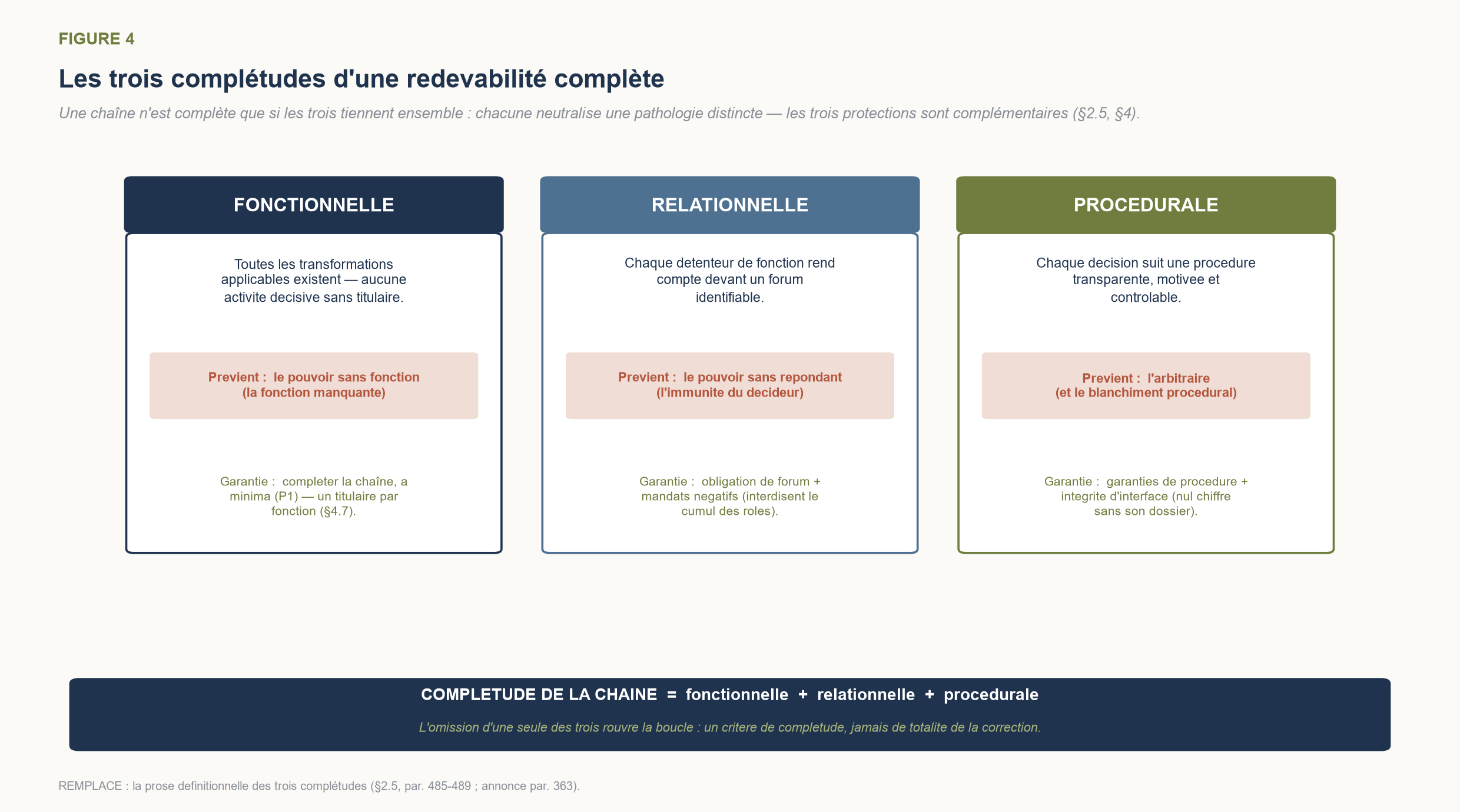
Three forms of completeness are distinguished, developed in chapter 4: functional completeness (all applicable transformations exist), relational completeness (every function-holder accounts before an identifiable forum) and procedural completeness (every decision follows a transparent, reasoned and reviewable procedure; Kingsbury, Krisch and Stewart, 2005). The forum obligation prevents unanswerable power, negative mandates prevent the conflict of functions, procedural guarantees prevent arbitrariness — the three protections are complementary.¶ 26
This deficit is not fragmentation in itself. All global governance is fragmented to some degree: regimes, public and private institutions, territorial levels and procedures coexist within it (Biermann et al., 2009). The deficit arises when this plurality becomes functionally incomplete, institutionally disconnected or normatively conflictual — when the outputs of some do not become the traceable and contestable inputs of others. The 7+3 does not therefore claim to eliminate fragmentation or to replace existing regimes: it seeks to transform a largely conflictual and incomplete fragmentation into a synergistic fragmentation — separate but interoperable functions, linked by shared standards, explicit interfaces and conflict rules.¶ 27
The architecture proposed below answers this deficit in the form of a closed chain — measure, rate, price, adjust, finance, certify, adjudicate. Its structure echoes the classical circle of equity — no authority without wealth, no wealth without prosperous subjects, no prosperity without justice — which Ibn Khaldūn transmits and systematises (Ibn Khaldūn, 1377): a loop in which the omission of a single link breaks the whole, and which, like the chain proposed here, ends in justice as the condition of the rest.¶ 28
Closed, that is to say: closed back upon the decision. The chain does not end at adjudication — its worth lies in its feedback point: its outputs — the account, the rating, the price, the prospect of recourse — are designed to enter the decision of those whose choices generate the spillovers: their risk models, their impact assessments, their deliberative fora. A chain that measured, rated, priced and adjudicated without anything returning to the decision table would reproduce the open loop that the IPCC has been documenting for six cycles (§5.2). It is by this feedback that the justice of the architecture is judged, in the end: not in redress afterwards, but in the decision beforehand — when the displaced cost ceases to be invisible to the one who displaces it.¶ 29
2.6 Two rival explanations of the deficit — and how to decide between them
The deficit just defined admits of two competing explanations, and this document’s thesis is admissible only if it confronts the second instead of circumventing it. The first — the design hypothesis, defended here — holds the incompleteness of the chain to be a failure of architecture: the missing functions are carried by no one because no arrangement was ever conceived to connect them, and completing the chain would alter outcomes. The second — the power hypothesis — holds incompleteness to be an equilibrium: the links are missing precisely because the actors that dominate institutional creation have no interest in their existence. On this reading, international institutions are not independent variables but the reflection of the distribution of power (Mearsheimer, 1994); supranational organisations are created by the powerful in order to impose on others outcomes they would obtain in any case, so that abstention costs them more than membership (Gruber, 2000) — this is, in its theoretical form, the law of attrition stated below; and when their interests are at stake, dominant States exercise, within the formal institutions themselves, an informal control that the statutes do not describe (Stone, 2011) — so that what would be added in the design would be taken back in practice. The conclusion is final: completing the chain resolves nothing, since every attempt will be blocked upstream, captured along the way, or hollowed out at the interfaces.¶ 32
This document is in no position to treat the power hypothesis as an external objection: it has itself formulated a version of it. The law of attrition stated in Box 9 (infra, §3.3) — what survives is what obliges no one; what disappears is what obliges someone who has not consented to it — is a law of power. It asserts that the selection criterion applied by international negotiation is neither rigour, nor urgency, nor the quality of the proposal, but the incidence of the constraint. Keynes’s charge, the 2009 compensatory payments, the Palais-Royal penalties: all of them obliged someone; none survived. To reject the power hypothesis after having written that would be incoherent. The question is therefore not whether it is true — it is in part, and the document takes that as given. It is whether it is sufficient.¶ 33
It is not, and three trajectories suffice to show it. Where the harm possesses a contract — sovereign debt —, the chain was drawn in full: the 2009 Commission proposes a restructuring court whose decisions are legally binding, and which obliges creditors, that is to say the powerful. It was not adopted; but it reached the table. Where the harm possesses a rule and a science of attribution — climate —, the chain was built as far as the fifth link, then amputated: decision 1/CP.21, at its paragraph 51, “agrees that Article 8 of the Agreement” — the one on loss and damage — “does not involve or provide a basis for any liability or compensation”, and this clause was obtained by the United States as the price of its adherence (§13). There is the power hypothesis, observed: the wound is dated, it is attributed, it is visible. Where the harm possesses only a pathway — the policy spillover, which has neither creditor, nor debtor, nor breach —, there is no wound of that kind. No dead treaty. No rejected clause. No paragraph 51.¶ 34
One does not veto what no one has proposed. The absence of this chain is not an amputation: it is a blank — and this blank, so far as the survey conducted by this programme allows one to assert it, is not the residue of a balance of power, but that of an absence of concept. Power explains why the links that were proposed die; it does not explain why this one was never proposed. Nor, moreover, can it be the variable that distinguishes the three trajectories, since the same dominant States are present in all three: they set aside the debt court, they amputated climate liability, and they had nothing to set aside in the third case, because no one ever asked them for anything. The distinguishing variable is the existence of a duty-holder. What would refute this reading can be stated: if interface breaks were likewise concentrated where the distributive threat is strong — if existing measurements fed no rating only where the rating would cost someone —, design would add nothing, power would be the whole explanation, and the document would hold its thesis to be disproved.¶ 35
A serious objection arises, and it must be confronted. The law of attrition that this document defends itself predicts anticipatory self-censorship: authors knowing that a proposal obliging the powerful will not survive may refrain from formulating it, and Box 9 (infra, §3.3) records the trace of this. The blank would then be overdetermined — compatible with the design hypothesis as much as with the power hypothesis. The answer is not to deny this mechanism, but to note what the duty-holder changes in it: it shifts the game of anticipation. Where every earlier proposal presupposed obtaining the issuer’s consent at the outset — and died of not obtaining it —, a chain whose first links oblige no one (measuring, rating, publishing) can exist before that consent, and therefore makes formulable what the anticipation of a veto used to discourage. The condition of refutation is thereby made more precise: if, with the duty-holder available and the first links laid without obligation, the complete chain still proved impossible to bring to life, the design hypothesis would yield to the power hypothesis.¶ 36
An objection arises here, and it must be put at its full force: the system did indeed attempt, once, to endow itself with a binding jurisdiction over capital movements. As early as 1994, the management of the International Monetary Fund — Michel Camdessus foremost among them — proposed amending the Articles of Agreement so as to forbid members from imposing restrictions on international capital movements without the Fund’s approval: a reversal of the burden of proof, since Article VI of 1944 permitted them subject to exception. The Interim Committee adopted the principle of it almost unanimously at Hong Kong, on 21 September 1997 — “it is time to add a new chapter to the Bretton Woods agreement”. Then the Korean crisis, the United States Congress and the Russian crisis buried it, and the Articles of Agreement were not amended (Abdelal, 2007, chapter 5). There is a dead treaty, dated, archived.¶ 37
But consider the direction of that jurisdiction. It ran from the Fund towards the recipient country: the power to forbid it from protecting itself. No one, at any moment of the episode, proposed that it should run towards the issuer — towards the one whose policy produces the spillover. The one time the system attempted to inscribe in its law a binding instrument on capital movements, that instrument obliged the victim. The objection therefore does not refute the thesis: it supplies the archival proof of it. The asymmetry noted above — the system’s only genuinely binding instrument points only towards the recipient (§3.1) — is not an inflection of practice: it is what the system deliberately attempted to bring into its Articles of Agreement.¶ 38
The position adopted takes its shape from this decision between the two, and it is not a compromise. The design hypothesis without the power hypothesis would be naive; the reverse would be fatalistic. Incompleteness is treated here as an equilibrium sustained by interests, and the chain as a device for shifting the equilibrium, not as a remedy that would abolish the veto of the powerful: graduated incorporation (§12) alters the payoff of abstention where a treaty would leave it intact, and makes adherence individually rational before making it collectively obligatory. It is through this channel, and not through virtue, that an architecture acts upon power. The law of attrition is therefore not an objection to the architecture: it is its design constraint. One does not fight a law of power; one builds beneath it — and principle P3, nothing binds without incorporation or consent (§4.2), is the architecture written in the only form that this law permits. From this follows what the document can promise and what it cannot. It cannot promise that the chain will be adopted, nor that the link of consequence will come about: it will do so only by consent, jurisdiction by jurisdiction, and it may never do so. But measuring obliges no one; rating obliges no one; publishing obliges no one. These three links can exist before power has conceded anything, and they change the ledger on which it decides. The minimal thesis of this document therefore asks no one to concede: the duty-holder can exist before consent, and its existence alone shifts the decision.¶ 39
2.7 The power objection tested against the century
There remains the objection that every practitioner will formulate before any other, and which deserves to be put in its harshest form: the great powers will never consent to it — the dominant issuer least of all. Paragraph 51 of decision 1/CP.21 demonstrated this where the science was most established (§13); the law of attrition (Box 9 — infra, §3.3) describes its mechanism; and the present chapter has just granted the power hypothesis the essential part of its premise. On the political clock — that of terms of office and campaigns —, this objection is not an objection: it is an observation, and this document takes it as such.¶ 40
But the clock of terms of office is not that of the architecture. The lineage in which this document places itself is almost a century old: Keynes’s charge, the 2009 compensatory payments, the Palais-Royal penalties — each generation has reformulated the same demand, and each rejection has left a case file that the following generation took up. The Palais-Royal, buried in 2011, arms the demonstration of the present chapter fifteen years later: proposals survive their rejection — indeed that is how they travel. An idea that presents itself again in every generation for eighty years is not a dead idea; it is an idea that the century is instructing.¶ 41
On this scale, a second fact changes the nature of the problem: the seat rotates. The dominant monetary position is not the permanent attribute of a nation; it is a seat that the florin occupied, then sterling, then the dollar (Eichengreen, Mehl and Chiţu, 2017) — and none of the configurations of power that opened the twentieth century closed it. An architecture written against the incumbent of the day would be obsolete at birth; this one is written for the seat. The rules that yesterday’s issuer did not want when it dominated are the ones from which it would benefit today.¶ 42
It is here that the objection turns around. Impersonal rules do not ask the powerful to be generous; they ask them to be far-sighted. Behind the veil of uncertainty — when no one knows which position they will occupy tomorrow —, rational actors choose the rules that protect every position, because they may occupy each of them (Buchanan and Tullock, 1962). Institutional history confirms it: powers lock in impersonal rules precisely when they anticipate rotation — it was at the peak of its relative power, and because it knew that power to be temporary, that the victor of 1945 built the existing institutional order (Ikenberry, 2001). The architecture does not beg the consent of the present; it addresses the interest that each power has in its own future position.¶ 43
The addressee then changes with the clock. An elected government reasons on the scale of its term of office, and nothing in an electoral campaign rewards the pricing of an invisible spillover; to reproach it for that would be to ignore the law of attrition. But the first links of the chain — measuring, rating, making visible — require no mandate: they work on the long clock, and what they produce is addressed to those whose interest in equity knows no alternation — the peoples who suffer the propagation. Public awareness is not a moral supplement: it is a mechanism of the architecture — it is what, in time, changes the political price of abstention (§13). The three instruments of the 7+3 are moreover designed for this clock: the GAF, the Call of Carthage and the Charter require neither organ nor majority in order to exist — a compact to which one adheres, a call that publicly names the demand, a charter that records it: the part of the architecture that travels without waiting for the consent of the powerful (§6).¶ 44
This chapter does not, for all that, wager on a direction of history. Nothing guarantees that the coming century will converge towards equity, and eighty years of attrition forbid claiming it. The proposition is narrower: uncertainty about future positions suffices — without any assumption about the direction of the world — to make impersonal rules individually rational for any power that looks beyond a generation; and visibility, for its part, accumulates. In the sense of Table 1, the foregoing is a design proposal backed by two verifiable facts: the lineage is documented, and so is the rotation.¶ 45
Cite this section
Yaïche, Nizar (2026). 2. The accountability deficit. In The Humanity Compact (v2.3). Zenodo. https://doi.org/10.5281/zenodo.22746533
@incollection{yaiche_hc_chapitre_2,
  author    = {Yaïche, Nizar},
  title     = {2. The accountability deficit},
  booktitle = {The Humanity Compact},
  year      = {2026},
  version   = {2.3},
  doi       = {10.5281/zenodo.22746533},
  publisher = {Zenodo},
  url       = {https://humanitycompact.org/ouvrage/chapitre-2/}
}A book by Nizar Yaïche, former Minister of Finance of the Republic of Tunisia. Who is the author?