8. The integrated demonstrator: an AI data centre
Chapter 8 of 15 · ≈ 22 min read · 42 paragraphs · section 14 of 40 · search the book
It asks whether, once the seven functions and the three instruments have been specified, a single case file can pass through the whole architecture — without the measurement being redone, without the uncertainty disappearing, without the price preceding the law, without the funder commissioning its own evidence and without redress arriving too late.
The preceding chapters have specified the architecture: seven functions, three instruments and a circumscribed role for artificial intelligence. This part puts it to the test, and this first case is an integrated demonstrator. It does not constitute an empirical study: it asks whether, once the seven functions and the three instruments have been specified, a single case file can pass through the whole architecture — without the measurement being redone, without the uncertainty disappearing, without the price preceding the law, without the funder commissioning its own evidence and without redress arriving too late. Chapter 9 will then push the analysis deeper on a case that is more difficult still: a lawful monetary decision, necessary within its own domestic order, whose effects propagate through prices and whose attribution requires separating incidence, transfer, welfare loss, equity and legal breach.¶ 1
The vehicle chosen is a large-capacity data centre devoted mainly to the training and inference of artificial intelligence systems. The choice is not motivated by the idea that its impacts are unknown. Energy, water, emissions, cooling efficiency and, increasingly, certain dimensions of the life cycle are already the subject of technical work and of reporting obligations. The International Energy Agency estimates that data centres consumed approximately 415 TWh in 2024, that is nearly 1.5% of global electricity, and projects consumption close to 945 TWh in 2030 in its central scenario, artificial intelligence constituting the principal driver of that growth (International Energy Agency, 2025). The European Union already requires certain data centres to report common indicators of energy, water, heat recovery and renewable energy (European Commission, 2024). The International Telecommunication Union observes in parallel that methods remain fragmented, often centred on carbon and inadequate on water, infrastructure, inference and the life cycle (International Telecommunication Union, 2025). The deficit is therefore not a measurement void; it lies in the fragmentation of boundaries, units, impact-holders and consequences.¶ 2
This case is particularly demanding for an architecture grounded in rights and functions. One and the same facility may display a low carbon intensity and increase the pressure on a water basin; purchase renewable electricity on an annual basis while drawing on the grid at the hours when marginal generation is carbon-intensive; improve its efficiency per unit of computation while increasing its total consumption through a scale effect; reduce its operating emissions while accelerating equipment turnover and embodied impacts. The purpose of the demonstrator is therefore not to produce a single environmental rating. It is to verify whether the architecture prevents a gain in one dimension from erasing a harm transferred to another dimension, another territory, another population or another period.¶ 3
The point is not to hold back these infrastructures, whose usefulness may be considerable, but to establish the conditions of measurement and of redress without which their development sooner or later runs up against the mistrust of territories. A chain that makes impact verifiable and contestable is not the adversary of deployment: it is the condition of its durability, because it gives the diligent operator a verifiable title and the territory a reason to consent. The case therefore tests an architecture intended to make that development sustainable, not to oppose it.¶ 4
The table is wider than the screen: drag it sideways.
| VALIDATION STATUS. This section is an institutional simulation internal to the programme. The technical parameters are calibrated on published ranges, but the three locations are analytical types and not real projects. The calculations verify the continuity of the interfaces; the GIRA classes, the GFEA responses and the litigation decisions are provisional and illustrative. It applies the same doctrinal rules and the same interface contracts as the reference implementation of §7.5 — severity caps, non-offsettable exclusions, anti-double-charging register — without thereby constituting a validated output; the announced technical companion will document the correspondence. External validation would require audited operator data, pre-registered thresholds, independent scientific and legal review and effective participation of the affected parties. |
|---|
8.1 Function of the case and status of the evidence
The case answers four questions. First, can HuIB produce a common measurement without conflating units that are not commensurable? Second, can GIRA qualify severity and trajectory without itself creating the facts or anticipating the price? Third, can the consequence institutions — GFEA, BFM and GSF — act in a differentiated manner, including by deciding not to price? Fourth, can IPDA and the Humanity Court make the entire pipeline verifiable and contestable, including where the data are automated, proprietary or protected by trade secrecy?¶ 5
The evidence is organised into four levels already compatible with the general discipline of the document (§1). “Established” is that which rests on a directly measured quantity, a stabilised unit and a widely accepted method; “probable” is that which rests on a robust methodological chain but retains an uncertainty of attribution or of location; “indicative” is that which depends on a proxy or a transposition; a “gap” is that which cannot be computed without operator or value-chain data. These four levels create no new scale: “established” and “probable” correspond to evidence grades A–B and C of the Human Impacts Board, “indicative” to grade D, and the “gap” to the declared status of §5.2; the whole falls under the second category of Table 1 — results issuing from the programme, until independent replication. The gap is neither replaced by a global average nor translated into a price: it becomes a data obligation, a pilot condition or a downstream lock.¶ 6
This rule is decisive. Completeness of the chain does not mean that every case file must reach every institution, nor that every measurement calls for a financial consequence. It means that every transformation actually carried out has a duty-holder, a method, a role prohibition and an avenue of challenge. The case may therefore stop after HuIB, return to HuIB from GIRA, produce no pricing at all, or activate capacity financing without recognising a reparation debt. This is the application of principle P1 — complete the chain, at a minimum — and not a presumption of maximal intervention.¶ 7
8.2 Scenario, counterfactual and boundaries
The demonstrator takes as its unit a data centre with an installed IT capacity of 100 MW, operated at 85% on average over twelve months. Its annual IT consumption is therefore set at 744.6 GWh: 100 MW × 0.85 × 8,760 hours. Three model locations use the same capacity and the same useful load; they differ only in the characteristics of the site, the cooling, the grid, the electricity mix and the possibilities for heat reuse. The counterfactual is a facility supplying the same volume of computation and the same level of availability in each of the three locations. This symmetry isolates location effects; it does not claim to represent an operator’s real choice, which would also depend on cost, latency, security, skills and regulation.¶ 8
Four operational indicators are retained because they possess a stabilised definition: Power Usage Effectiveness (PUE), the ratio between the total energy of the centre and IT energy; Water Usage Effectiveness (WUE), the volume of direct water relative to IT energy; the Energy Reuse Factor (ERF), the share of energy reused; and the Renewable Energy Factor (REF), the declared share of renewable energy in total consumption. These indicators appear in the European data centre reporting regime (European Commission, 2024). PUE and WUE are also modelled in the Lawrence Berkeley National Laboratory report, which shows their dependence on facility type, cooling, climate and operating practices (Shehabi et al., 2024).¶ 9
The assumptions are not observations. They are chosen within plausible ranges in order to test the behaviour of the chain. Location A combines a low-carbon grid, a low pressure on water and significant heat recovery. Location B combines a carbon-intensive grid, a moderate pressure on water and a strong grid constraint. Location C combines a hot climate, high seasonal water stress and a power constraint at peak hours. The REF is retained as a declared contractual attribute; it is not deducted from the emissions calculated according to the average physical factor of the grid. This separation prevents an annual certificate from being treated, without further evidence, as an absence of hourly impact on the electricity system.¶ 10
The table is wider than the screen: drag it sideways.
| Type-location | PUE | WUE (L/kWh IT) | Grid factor (kgCO₂e/MWh) | REF | ERF | Water / grid stress |
|---|---|---|---|---|---|---|
| A — low-carbon grid | 1.15 | 0.20 | 50 | 0.90 | 0.20 | Low / low |
| B — carbon-intensive and constrained grid | 1.22 | 0.60 | 450 | 0.30 | 0.05 | Moderate / high |
| C — hot climate and water stress | 1.30 | 0.80 | 300 | 0.55 | 0.00 | High / high |
The boundaries are fixed ex ante. The horizon of calculation is annual; operational emissions use a grid factor based on location; direct water covers cooling and site uses; the embodied emissions of construction, servers, accelerators, semiconductors and networking are not attributed, for want of bill-of-materials and supplier data; the indirect water of electricity generation is not added to direct water; the effects on biodiversity, noise, employment, taxation and the value of AI services are described but not monetised. The ITU life-cycle methods provide the framework within which these gaps should progressively be filled (International Telecommunication Union, 2020).¶ 11
8.3 HuIB: measuring without aggregating prematurely
HuIB opens a single case file bearing a persistent identifier of the facility, the site, the operator and the methodological version. It receives data from the electricity meter, the cooling system, the grid operator, the energy contracts, the equipment suppliers and the territorial authorities. Each entry retains its source, its unit, its frequency, its spatial boundary, its confidentiality status, any algorithmic transformation, the responsible human and the level of evidence. The data contract of §7.4 becomes here an operational item: what is not traceable is not passed downstream as a fact.¶ 12
Four registers are maintained separately. The register of physical flows contains electricity, water, emissions, materials and heat. The exposure register locates these flows in a grid, a hydrological basin, a territory and a value chain. It also records, as an exposure to be investigated, the effect of the connection on local electricity prices — the share of grid and supply costs liable to be passed on to the other consumers of the territory — today the most debated of the externalities of these facilities and the least standardised in reporting. The harm or risk register documents congestion, scarcity, exposure of populations, ecological loss or end-of-life risk. The valuation and distribution register identifies costs, benefits and their holders. These registers may be linked; they are never added together as though they represented one and the same quantity.¶ 13
The minimal calculations are as follows. The total energy of the centre is equal to IT energy multiplied by the PUE. Direct water is equal to IT energy, expressed in kWh, multiplied by the WUE. Operational emissions are equal to total energy multiplied by the local emission factor. Declared renewable energy and reused heat are obtained respectively by applying the REF and the ERF to total energy. These equations produce the outputs of Table 19.¶ 14
The table is wider than the screen: drag it sideways.
| Location | IT energy (GWh) | Total energy (GWh) | Direct water (m³) | Operational emissions (ktCO₂e) | Reported renewable energy (GWh) | Reused heat (GWh) |
|---|---|---|---|---|---|---|
| A | 744.6 | 856.3 | 148,920 | 42.8 | 770.7 | 171.3 |
| B | 744.6 | 908.4 | 446,760 | 408.8 | 272.5 | 45.4 |
| C | 744.6 | 968.0 | 595,680 | 290.4 | 532.4 | 0.0 |
The results do not designate a “better” site in absolute terms. Location A strongly reduces operating emissions and direct water, while reusing a share of the energy; it nevertheless remains incomplete so long as the equipment, the embodied emissions and the hourly availability of low-carbon electricity are not documented. Location B is dominated by the physical intensity of the grid and by the power constraint, despite a water consumption that remains lower than that of C. Location C presents emissions lower than B but a direct pressure on water four times higher than in A, in a basin where each unit of water has a different territorial significance. The ranking cannot therefore derive from a single global metric.¶ 15
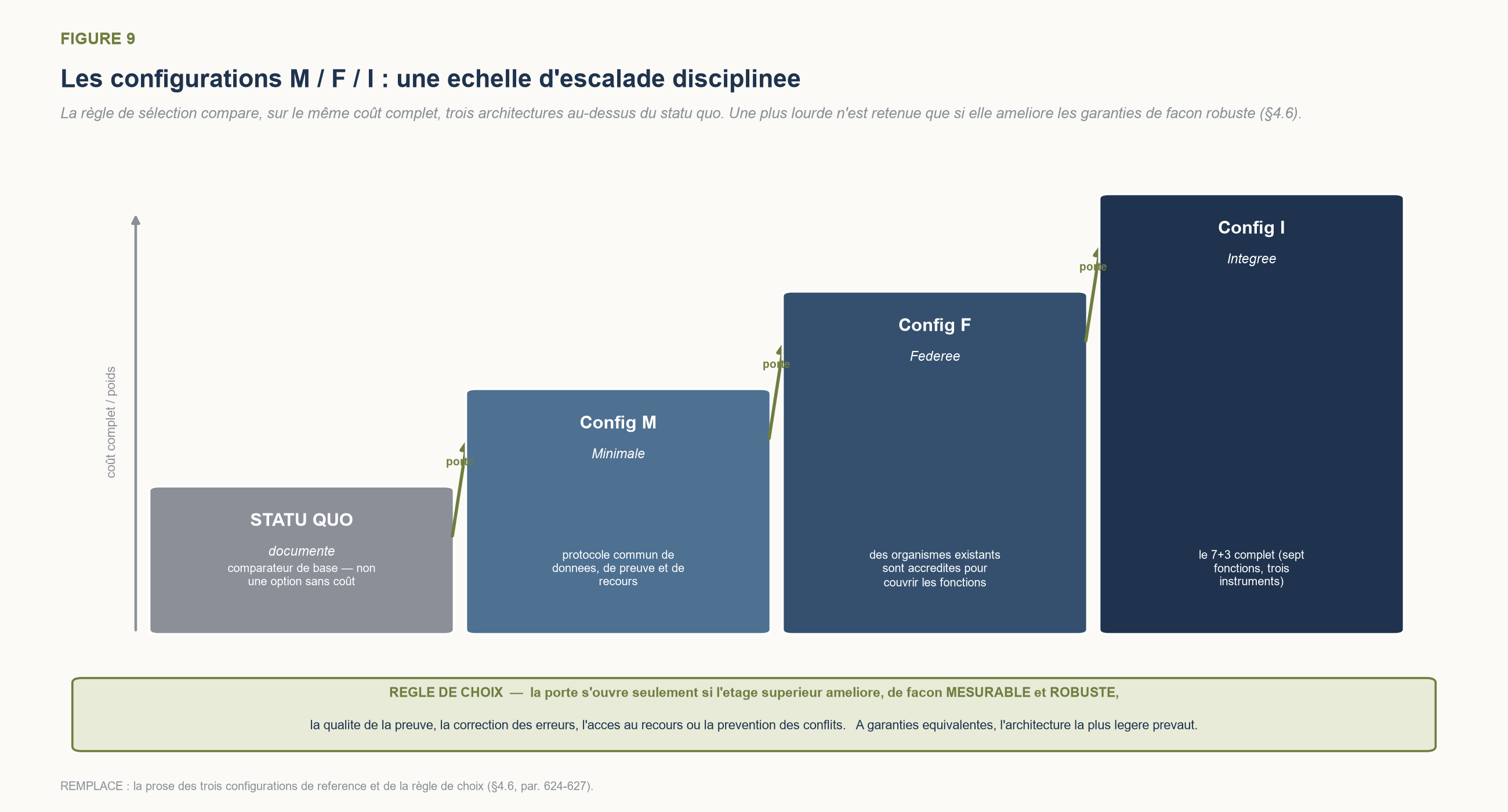
HuIB then applies six burden-shifting tests: carbon against water; operation against manufacturing; annual average against hourly constraint; consuming territory against producing territory; present benefit against future cost; beneficiaries of the computation against affected populations. The test does not automatically subtract a benefit from a harm. It asks whether the two quantities have the same holder, the same territory, the same period and a comparable grade of evidence. A useful global service does not mechanically offset a local water restriction; conversely, a local pressure does not establish that the service is devoid of social value.¶ 16
The table is wider than the screen: drag it sideways.
| Subject | Status | Decisive limitation | Procedural consequence |
|---|---|---|---|
| Electricity and PUE | Established within the scenario | Meters + settled definition | Transmission to GIRA possible |
| Direct water and WUE | Established for volume; probable for impact | Meters; dependence on basin and season | Territorial qualification required |
| Operational emissions | Probable | Local average factor; no hourly marginal factor | Range and dual reporting |
| REF and contracts | Established as a contractual attribute | Does not on its own demonstrate hourly physical impact | No automatic erasure |
| Embodied emissions | Gap | Bill of materials, suppliers and service life absent | No price; data obligation |
| Materials and electronic waste | Gap / indicative | Sectoral proxies only | Guarantee and traceability, no quantified damage |
| Biodiversity and soils | Indicative | Location known; baseline state absent | Site study before qualification |
| Effect on local electricity prices | Gap / indicative | Tariff allocation of network and supply costs not established | Territorial tariff study before any qualification |
| Social and economic benefits | Indicative | Employment, taxation and AI uses unspecified | Separate presentation; no overall offsetting |
The HuIB result is therefore neither a class nor a price. It is a multidimensional passport composed of values, uncertainty bands, gaps and exposure relations. It is versioned and contestable in accordance with §5.2. The first institutional conclusion of the case is negative but substantial: the absence of life-cycle data precludes any financial consequence on embodied emissions and waste. The chain does not fill the gap; it prevents the gap from being masked by a convenient average.¶ 17
8.4 GIRA: qualifying without pricing
GIRA consumes the HuIB case file without re-measuring the flows. It produces two outputs in accordance with §5.3: a qualification of severity by externality and an actor class accompanied by an outlook. Since the complete thresholds are not yet validated, no definitive numerical coefficient is manufactured in this simulation. Severity is merely situated relative to the neutral level: low for climate, water and grid in A; high for climate and grid in B; high for water and grid, moderate for climate in C. This restraint prevents a veneer of precision from being mistaken for an adopted method.¶ 18
The provisional class of A is B, stable outlook: the operational impacts are contained, but the class cannot reach A so long as the embodied data, the hourly matching of energy and the expansion trajectory are not established. B receives D, negative outlook: carbon intensity and the grid constraint dominate the limited gains from heat recovery. C receives D, negative outlook, with a non-offsettable ceiling linked to seasonal pressure on water: an improvement in carbon cannot raise the class above D so long as the territorial water threshold is not respected. These classes are simulation results, not enforceable ratings — and they follow mechanically from chosen parameters: it is the passage of the case file that is tested, not the verdict on a type of site.¶ 19
The qualification brings out a property that measurement alone cannot supply: two sites with identical IT consumption and comparable emissions may receive a different assessment according to territorial exposure and the distribution of the injury. But GIRA still does not turn water scarcity into a charge, nor a class D into a sanction. It transmits a structured output, signed by a named analyst, which preserves HuIB’s uncertainties and states the grounds for each ceiling. The entity may challenge the facts before HuIB and the qualification rules before GIRA; the two case files remain distinct.¶ 20
8.5 GFEA, BFM and GSF: consequence, adjustment and financing
GFEA receives the measurement by way of the qualification, but does not presume that every externality is monetisable. It applies four locks in succession: legal basis for the consequence; link between the activity and the cost; the operator’s ability to avoid or reduce the impact; corrective gain exceeding administrative costs and strategic reactions. In case A, it proposes no corrective levy. It may recognise, if national law so permits, a transition credit for heat recovery or verified flexibility, and require an end-of-life guarantee whose amount rests on the cost of decommissioning rather than on an abstract valuation of the harm.¶ 21
In B, GFEA distinguishes grid cost from climate. The share of reinforcement directly made necessary by the connection may give rise to a connection contribution or to a flexibility contract according to the applicable law; it does not become a global tax on AI. Operational emissions may call for a reduction obligation, a purchase of additional energy or a domestic price where the jurisdiction has incorporated one. The simulation sets no international price: the hourly marginal factor, the counterfactual cost and the taxing authority are not established.¶ 22
In C, the priority consequence is physical before being monetary: a seasonal ceiling, a minimum reuse of water, a water-curtailment mechanism and community monitoring. A charge becomes admissible only if water law, the local marginal cost, the rights of users and the allocation of the revenue are determined. Where essential human access or the integrity of the basin crosses a non-offsettable threshold, P8 prohibits treating the harm as a mere price line. GFEA may then recommend a condition or an exclusion; it does not turn the prohibition into a right to pay in order to harm.¶ 23
The Border Fairness Mechanism is not activated as a levy in this pilot. Cross-border digital services do not yet possess a recognised unit of impact, an operational rule of origin or a legal opinion covering trade in services, non-discrimination, data protection and trade secrets. The BFM may nevertheless test three non-pricing functions: an impact passport for imported equipment; the recognition of an equivalent foreign method; a disclosure requirement in public procurement or cloud contracts. This non-activation is a result of the design, not a failure: P3 and Table 7 prohibit a border mechanism from acquiring an effect that no jurisdiction has incorporated.¶ 24
GSF intervenes only where the object financed falls within a collective good, a public capacity or a protection of affected populations. It does not finance the operator’s normal obligations. It may contribute to a public basin measurement system, to a shared water-reuse infrastructure, to a recycling capacity accessible to several actors, or to the legal and technical representation of communities, subject to additionality. In B, it may co-finance a grid reinforcement that benefits the territory beyond the centre alone, once the share attributable to the operator has been separated out. In C, it does not subsidise an excessive water abstraction; it finances the prevention and adaptation capacity that the market does not supply. The re-measurement of results remains commissioned from HuIB, never carried out by the Fund itself (§5.6).¶ 25
8.6 IPDA: certifying the pipeline that measures AI
The case is reflexive: the architecture uses AI systems to analyse the physical impact of the infrastructure that makes AI possible. IPDA therefore does not certify only an AI model offered to the public; it certifies the sociotechnical system through which the architecture observes the centre. Its scope includes the meters and their interfaces, the breakdown between AI and non-AI loads, the versions of the consumption-allocation models, the grid factors, the PUE, WUE, REF and ERF calculations, the consistency checks, the access rights, the change logs and the final human signature.¶ 26
Certification imposes a dual presentation of electricity: physical impact based on location, and contractual attribute based on market instruments, without allowing one silently to erase the other. This distinction accords with the logic of the GHG Protocol Scope 2 Guidance, which separates location-based and market-based methods (GHG Protocol, 2015). In the pilot, HuIB’s calculations are location-based; the REF remains published alongside, as contractual information. IPDA verifies that this choice is applied identically to the three sites and that any methodological modification triggers a new version of the case file.¶ 27
Trade secrecy is handled in layers. Raw data on load, IT architecture or suppliers may remain in a secure data room; the units, methods, ranges, assumptions and results necessary for adversarial scrutiny are published. Every automated transformation retains the model, the version, the prompt or the rule, the input, the output, the error rate and the responsible human. The indicators of §7.5 — human-machine disagreement, review time, false positives, corrections and challenges — are mandatory. An institution that cannot produce them may not use automation as a binding lock.¶ 28
8.7 The case file passing through the seven institutions
Before contentious proceedings begin, the case file can be summarised as a succession of bounded outputs. Table 21 makes visible the interfaces, the negative mandates and the possible returns that prevent an upstream error from automatically becoming a downstream consequence.¶ 29
The table is wider than the screen: drag it sideways.
| Link | Question addressed | Output | Negative mandate | Redress / feedback |
|---|---|---|---|---|
| HuIB | Measures flows, exposures, uncertainties and gaps. | Versioned impact passport. | Does not rate or price. | Methodological feedback / Court |
| GIRA | Qualifies severity, trajectory and equity. | Provisional class and reasons. | Does not re-measure or set the price. | Review / Court |
| GFEA | Chooses response, base and any consequence. | Absence of price, condition, guarantee or contribution. | No power without a legal basis. | Court / national authority |
| BFM | Tests passport, equivalence and cross-border application. | Non-tariff pilot; levy not activated. | Does not create its own trade doctrine. | Court / trade mechanisms |
| GSF | Finances public capacity and additional protection. | Allocation separate from the operator obligation. | Does not tax, measure or rate. | Court / audit |
| IPDA | Certifies data, models, interfaces and the human lock. | Certificate, log and conditions of use. | Does not legitimise the substantive decision. | Court / certification review |
| Humanity Court | Reviews competence, procedure, evidence and proportionality. | Decision, suspension, annulment or remittal. | Does not remake policy or expertise. | Review as provided by the instrument |
Table 21 shows that continuity does not result from a single decision. Each link receives a bounded output, retains its level of uncertainty and produces a contestable item. The common base layer carries the case file; it does not do the work of any institution. A correction made to water within HuIB triggers a new version of the qualification and of the dependent consequences; it does not silently modify the other dimensions. The non-propagation of error becomes a property of the information system and not a mere intention of governance.¶ 30
8.8 Humanity Court: three simulated challenges
The Court becomes relevant only at the moment when an act, a procedure or a consequence is challenged. It chooses neither the site, nor the electricity mix, nor the cooling technology. It reviews competence, regularity, access to evidence, the giving of reasons, proportionality and respect for rights. Three challenges are simulated in order to verify that the transmitted case file retains enough information to permit effective review.¶ 31
The table is wider than the screen: drag it sideways.
| Case | Claim | Question of law and procedure | Simulated decision |
|---|---|---|---|
| A — Basin community against the decision concerning C | Annual measurement masks the dry season and the impact on essential uses. | Monthly data, basin status, legal thresholds and participation insufficient. | Suspension of the final water-related consequence; an interim cap may be maintained; remittal to HuIB and GIRA for re-measurement and fresh reasons. |
| B — Operator of site B against the climate qualification | Annual renewable contracts should neutralise the grid impact. | Alleged conflation of the physical method and the contractual method. | Obligation to publish both methods; the physical impact may be retained if the rule was prior, general and reasoned; remittal if hourly matching was not examined. |
| C — Equipment supplier against the Scope 3 data request | The bill of materials and the processes are trade secrets. | Proportionality of collection and the right to be heard. | Secure data room, publication in ranges and independent audit; absolute confidentiality refused; no pricing so long as the embodied evidence remains insufficient. |
These decisions illustrate four limits of the jurisdiction. First, referral back is preferred to the replacement of expertise: the Court may annul or suspend an irregular output, not itself produce the measurement. Second, interim measures remain possible where a serious and reversible risk requires immediate protection, subject to expiry and review. Third, transparency does not entail the publication of every raw datum; it requires that the affected party be able to know and challenge the reasons. Fourth, insufficiency of evidence blocks the consequence without making the harm non-existent. The Court guards the guardians, but it does not govern in their place (§5.8).¶ 32
8.9 The three instruments in the case
The seven functions do not operate in a constitutional vacuum. The Carthage Charter supplies the principles according to which the case is handled: dignity, non-discrimination, participation of affected parties, proportionality, sustainability, the right to reasons, data protection and redress. It authorises no levy by itself; it bounds the choices made under an acquired competence.¶ 33
The Global Accountability Framework organises the legal effects consented to: the mandate of each institution, interface contracts, rules of access to data, recognition of methods, financing, audit, liability, suspension and withdrawal. In the simulated phase, it takes the form of a pilot protocol accepted by the operator, the jurisdiction and the participating bodies. The outputs are notional except for obligations already grounded in national or European law. Binding force therefore derives from consent, incorporation or contract, never from the existence of the document alone (§6.4).¶ 34
The Call of Carthage opens referral, participation and agenda-setting. Workers, local residents, water users, researchers and users of digital services may report a gap, challenge the definition of an indicator or request the examination of a burden shift. The Call ratifies no norm and replaces neither parliaments nor contentious procedure. It renders visible the interests that are not necessarily represented in the contractual relation between the operator and the jurisdiction.¶ 35
8.10 Competing architectures and the selection rule
A case constructed to illustrate seven institutions could circularly conclude that all of them are necessary. The selection rule of §4.4 prohibits that reasoning. The demonstrator therefore compares four configurations: the fragmented status quo; a common data protocol without new institutions; a three-function architecture grouping measurement-qualification, consequence-financing and control; and the complete 7+3 chain. They are assessed on comparability, separation of roles, interface integrity, cost of participation, containment of error and access to redress.¶ 36
The table is wider than the screen: drag it sideways.
| Architecture | Comparability | Separation of roles | Error containment | Redress | Cost of participation | Test outcome |
|---|---|---|---|---|---|---|
| Fragmented status quo | Low to medium | Low | Low | Low to medium | Low | Low initial cost; incomplete and unconnected results. |
| Common protocol | High for data | Medium | Medium | Medium | High | Good starting point; insufficient if a consequence is contested. |
| Three-function architecture | High | Medium | Medium to high | High | Medium | Plausible compromise; risks of conflict between measurement and rating, pricing and financing. |
| Full 7+3 chain | High | High | High | High | High | Best separation; the highest interface cost and a need to prove added value. |
The result is more nuanced than a validation of the number of bodies. The common protocol suffices to produce a first comparable measurement and to render the gaps visible. The three-function architecture can handle a non-binding pilot provided that separate teams, budgets and decisions are maintained within the host bodies. The complete chain becomes justified when the outputs produce distributive or legal effects, when several jurisdictions must recognise the methods, when the funder depends on the measurement, or when challenges require an independent forum. The necessity of the functions is better established than the immediate necessity of seven new legal persons.¶ 37
The configuration recommended for the first phase is therefore federated and hybrid. HuIB, GIRA and IPDA begin as functionally separate protocols and panels; GFEA and GSF operate through the existing authorities and funds of the volunteer jurisdiction; the Humanity Court takes the form of an internal review mechanism or of a consented arbitration; the BFM remains in observation and becomes binding only after validation of the measurement and a specific legal opinion. This trajectory applies P4 — non-substitution — and P7 — the pilot before the regime — while preserving the full destination of the chain.¶ 38
8.11 Results, limits and the move to a pilot
The simulation produces five results. First, HuIB can cover a field remote from monetary spillover effects without abandoning the same discipline: ex ante boundaries, non-additive registers, impact-holders, attribution and uncertainty. Second, multidimensional measurement prevents carbon from serving as a substitute for the environment as a whole: water, the grid, materials and territory remain visible even where operational emissions are low. Third, the separation between HuIB, GIRA and GFEA produces different decisions according to the maturity of the evidence: measuring, qualifying, conditioning or not pricing. Fourth, IPDA and the Court are not ancillary functions; they render contestable the automated process by which the architecture claims to know. Fifth, the case does not demonstrate that a complete global organisation must precede action: a federated instantiation can produce value under existing law, in accordance with Table 7.¶ 39
Three conditions would nevertheless invalidate the added value of the 7+3. The first would be that a common protocol and a national review obtain the same precision, the same independence and the same access to redress at a significantly lower cost. The second would be that the necessary data remain durably inaccessible or non-auditable, such that the downstream outputs rest on proxies rather than on evidence. The third would be that the separation of bodies increases delays and costs without reducing role conflicts, errors or infringements of rights. In each of these cases, the rule of §4.4 requires merging, simplifying or abandoning the configuration, not defending the 7+3 by construction.¶ 40
The move to validation therefore requires a pre-registered pilot: a volunteer jurisdiction; a real operator and a real site; twelve months of hourly energy data and monthly water data; a minimum bill of materials for equipment; a territorial baseline; a panel of affected parties; two independent coding teams; a public log of corrections; a comparison between protocol, three-function architecture and complete chain; and consequences kept in notional mode during the first phase. The success indicators are those of Table 48 (infra, §12.5): coverage, error and correction, delay, cost, participation, accessibility of redress, data incidents and operation in degraded mode.¶ 41
The case thus fulfils its function without over-promising. In Chapter 9, monetary spillover will show why a chain is necessary when an incidence crosses borders without a common forum of attribution; the present demonstrator shows, for its part, how that chain can preserve a multidimensional case file from the physical datum through to redress, including where the correct answer is not to price or not to activate a link. The demonstration does not yet validate the architecture in the field; it renders its interfaces, its stopping points and its conditions of defeat sufficiently explicit to be tested. The internal tensions that these tests reveal are examined in Chapter 13.¶ 42
Cite this section
Yaïche, Nizar (2026). 8. The integrated demonstrator: an AI data centre. In The Humanity Compact (v2.3). Zenodo. https://doi.org/10.5281/zenodo.22746533
@incollection{yaiche_hc_chapitre_8,
  author    = {Yaïche, Nizar},
  title     = {8. The integrated demonstrator: an AI data centre},
  booktitle = {The Humanity Compact},
  year      = {2026},
  version   = {2.3},
  doi       = {10.5281/zenodo.22746533},
  publisher = {Zenodo},
  url       = {https://humanitycompact.org/ouvrage/chapitre-8/}
}A book by Nizar Yaïche, former Minister of Finance of the Republic of Tunisia. Who is the author?