Le texte de l’ouvrage est en anglais, tel qu’il a été écrit ; seule l’interface du site est en français.
5. Seven functions, not necessarily seven new institutions
Chapitre 5 sur 15 · ≈ 63 min de lecture · 145 paragraphes · 11ᵉ des 40 sections de lecture · rechercher dans l’ouvrage
None of these institutions is invented from nothing: each generalises functions already at work somewhere — sectorally, regionally, or voluntarily — and links them together.
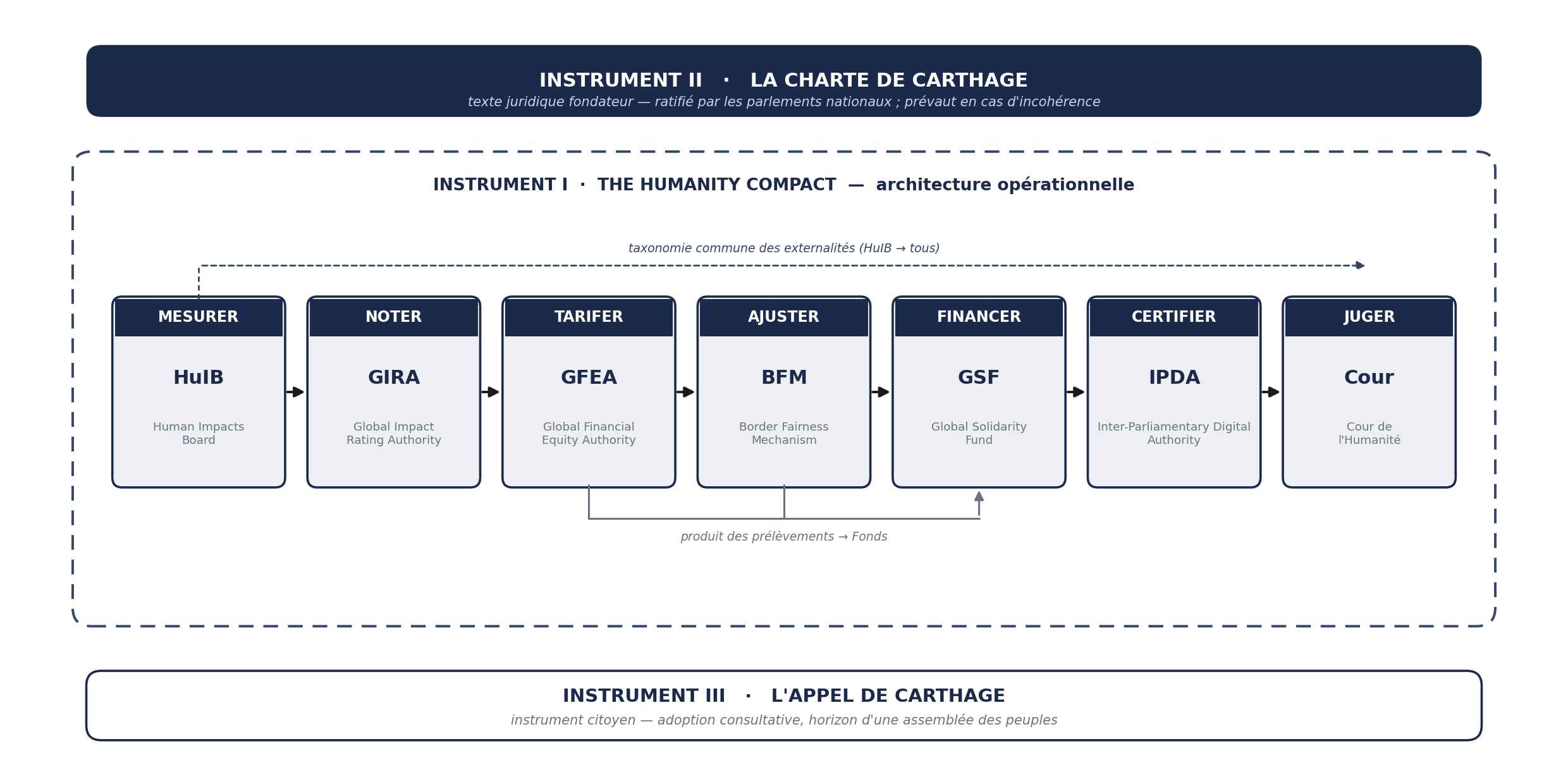
This section specifies each institution according to a common template: mandate; operation (the operational pipeline); precedents already at work on a smaller scale; negative mandate; key interfaces; safeguards; sequencing. Table 12 (below) offers the synoptic view. The names are given in full, the acronyms being used only sparingly thereafter. Two framing remarks apply throughout. First, none of these institutions is invented from nothing: each generalises functions already at work somewhere — sectorally, regionally, or voluntarily — and links them together; the precedents cited below constitute a proof of feasibility, not a claim of equivalence, and the architecture builds upon them without replacing, competing with or rating any of them. Second, honesty as to status: each pipeline described here is specified down to workflow level and implemented in a working software prototype — specified and prototyped, not yet operated. The methodologies are versioned and publicly revised on published cycles; and wherever artificial intelligence intervenes in a pipeline, it signals — an accountable human decides (Section 7). Figure 4 presents the seven institutions along that chain, within the three framing instruments.¶ 1
5.1 Common constitutional and governance foundation
Legal status of the architecture. The present document does not assert that a general principle of international law today requires the compensation of every lawful cross-border externality. It proposes an architecture by which participants may, within the limits of their existing competences and obligations, measure those effects, agree on consequences and render those consequences contestable. No measurement, rating or decision of the architecture creates, by itself, a pecuniary obligation or an international responsibility: a binding consequence presupposes an expressly identified treaty provision, incorporating statute or contractual undertaking. Where the damage results from an internationally wrongful act, the applicable rules of responsibility and reparation remain distinct and prevail.¶ 2
Each institution must specify the same constitutional minimum before any entry into operation — a foundation that follows it from its legal existence to its end of life: its existence and mandate (legal personality and seat; composition, appointment and representation formula; fixed and staggered terms; incompatibilities and removal; quorum and voting); its independence (source of budget and independent audit; declaration of interests); its transparency (rules of access to information; data controller and retention obligations; duty to give reasons); its checks (complaint and redress; emergency powers and their expiry; periodic external evaluation); and its revisability (amendment; sunset clause, merger or dissolution). Parity between impact-source and impact-recipient jurisdictions is a starting assumption, not a complete governance formula: States in a mixed position, small States, affected communities, workers, the interests of future generations and scientific independence must also be represented there, without thereby turning every governing body into a miniature general assembly. This foundation belongs to constitutional economics: legitimacy is decided at the level of rules, not of particular decisions, and proceeds from consent to those rules rather than from their imposition (Buchanan and Tullock, 1962) — the distinction between the constitutional level and the operational level embodied in the separation of this foundation from the mandates that follow it.¶ 3
Beyond this ordinary-time foundation, each institution also has a rule-based accelerated mode for acute shocks — pre-authorised in the instruments, bounded by its single mandate, and automatically time-limited — set out in §11.15-11.17.¶ 4
Le tableau dépasse la largeur de l’écran : faites-le glisser latéralement.
| Function | Can begin under existing law | Requires incorporation | Requires a new international instrument |
|---|---|---|---|
| HuIB measurement | Research body, public methodology and voluntary data | Data access, official evidential use | Only for privileges, mandatory cooperation or treaty status |
| GIRA rating | Publicly issued, contestable opinion | Regulatory, public-procurement or contractual effect | Only for a common public authority or immunities |
| GFEA pricing | Indicative reference prices | Taxation, levy, contribution and budgetary power | For coordinated obligations between States |
| BFM adjustment | National pilot within existing customs powers, subject to the law | National collection, certificates and redress | For mutual recognition or common disciplines |
| GSF financing | Voluntary/endowed fund | Allocation and beneficiary rules | For mandatory contributions or treaty privileges |
| IPDA certification | Model law, voluntary accreditation and standards | Enforceability, market surveillance and penalties | For an inter-parliamentary authority with common effect |
| Court adjudication | Internal review and consented arbitration | National legal action and enforcement | For treaty jurisdiction over States and common avenues of redress |
Le tableau dépasse la largeur de l’écran : faites-le glisser latéralement.
| Risk | Minimum safeguard | Proof of effectiveness |
|---|---|---|
| Political capture | Staggered appointment channels, removal for cause, minority opinions | Diversity of appointments, dissent and circumvention statistics |
| Financial capture | Multi-source budget, funding caps, protected core endowment | Donor concentration and budget continuity tests |
| Epistemic capture | Open methods, replication grants, adversarial challenge | Replication results and methodology change log |
| Data capture | Purpose limitation, access controls, deletion and independent security audit | Reporting on breaches, access and retention |
| Strategic exit | Severability, portability of standards and wind-down rules | Continuity under withdrawal scenarios |
Seven pathologies threaten any control architecture; naming them together with their early signal makes it possible to detect them before the consequence. Each finds here a structural remedy, not an exhortation to virtue.¶ 5
Le tableau dépasse la largeur de l’écran : faites-le glisser latéralement.
| Pathology | Mechanism | Early signal | Remedy in the architecture |
|---|---|---|---|
| Capture | An assessed entity steers the body that assesses it | Abnormal convergence of ratings towards a dominant actor; appeals in decline | Governance parity; negative mandates; non-circular budgets (P6); rating not paid for by the rated |
| Mandate drift | A body extends its functions beyond its mandate | Out-of-scope decisions, overlap with a neighbour | Explicit negative mandate (§5.2-5.8); legality review by the Court |
| Inter-body collusion | Two bodies coordinate to circumvent a control | Ratings and prices moving together without a common factual basis | Separation of rating and pricing; single measurement source (HuIB); auditable interface case files |
| Turf war | Two bodies claim the same function | Duplicate referrals, conflicts of competence | One function = one duty-holder (derivation §4.7); jurisdictional arbitration by the Court |
| Revolving door | Movement of staff between the body and assessed entities | Recruitments/departures to rated entities | Incompatibilities and cooling-off; named operational signature (§5.3) |
| Venue shopping | A party chooses the most favourable body | Referrals directed to the least strict body | Jurisdiction by consent; internal primacy of the Charter (Art. 22 §2); closed interfaces |
| Under-enforcement | A body refrains from acting against powerful actors | Gap between cases detected and cases handled, widening with the size of the actor | Publication of handling rates; redress for the affected party; review by the Court |
5.2 Human Impacts Board (HuIB) — the measurement layer
Mandate. An independent scientific body that makes human impacts measurable: it maintains the shared taxonomy of externalities (twenty families — from climate and air quality to digital harms and financial instability), sets the methods, and publishes measurements in the form of ranges attached to confidence grades, never in the form of point estimates with false precision. Its data contract specifies, for each published measurement, the metric, the range, the evidence grade and the quality level, under persistent identifiers. Its founding axiom: one can only correct what one can measure.¶ 6
Its mission has a corollary: to narrow the gap between what GDP counts and what actually counts — to measure the cross-border share of the harm that national accounting records the wrong way round (defensive expenditures counted as positive) or leaves off its books (the costs shifted onto others or onto future generations). What the Board measures — health, mortality, access, degradation suffered — belongs to what Amartya Sen called capabilities: the real freedoms to be and to do that income does not capture (Sen, 1999); the human impacts ledger is their institutional inscription.¶ 7
In naming and pursuing a ʿilm al-ʿumrān — a science of human social organisation — Ibn Khaldūn proposed, six centuries ago, to render society intelligible through the systematic observation of its regularities (Ibn Khaldūn, 1377). The Human Impacts Board constitutes an attempt to give that ambition a permanent institutional anchorage, and to extend it to a connected world where harms travel across borders and generations.¶ 8
The closest institutional precedent is the Intergovernmental Panel on Climate Change. The IPCC did not produce climate science; it assessed, synthesised and made it public (IPCC, 2023), carrying authority without coercive power — a model whose 2007 Nobel Peace Prize recognised that it lays the foundations of action. The Human Impacts Board generalises its logic, from climate to the whole range of human impacts: to produce robust, contestable and politically usable knowledge about global externalities. But the IPCC also marks its limit. Six assessment cycles have not sufficed to bend the trajectory of emissions: a science that informs without anything downstream rating, pricing or adjudicating leaves the accountability loop open. It is precisely that void which the chain fills — measurement is not the end, but its first link. Two design lessons follow: independence from political validation of the summary, and publication of minority opinions, so that scientific authority is not paid for by consensual dilution.¶ 9
Operation. The Board’s process runs through the following steps:¶ 10
1. Frame (taxonomy, affected population, scope).¶ 11
2. Measure (each method — life-cycle, input-output, quasi-experimental, expert elicitation — capped at the highest causal level it can defend).¶ 12
3. Qualify (evidence grade A–D, quality level Q1–Q5, uncertainty propagated in the form of bounded bands, never by quadrature, which would manufacture false precision).¶ 13
4. Adversarial notification (the measured entity is notified and may file evidence before publication).¶ 14
5. Certify (vote of the scientific committee, minority opinions preserved).¶ 15
6. Publish traceably, the result constituting the exact input of the rating authority.¶ 16
Each published measurement carries a nineteen-field data contract under a persistent identifier; declared gaps are never filled by invention; the whole methodological stack is revised on a multi-year public cycle. The human impacts ledger kept by an entity enters there as an item for examination, not as a verdict: placed on the case file, tested against independent sources and submitted to adversarial notification before any certification — the Board retains from it only what it can verify, never the raw declaration.¶ 17
Precedents. The IPCC has shown since 1988 that a global scientific body endowed with public methods and governmental oversight can establish facts with political consequences without governing anyone — confined, however, to a single domain and to an assessment rhythm too slow for continuous measurement. The United Nations Secretary-General’s Beyond-GDP expert group and its compass of some thirty indicators, Action 53 of the Pact for the Future, and the 2025 revision of the System of National Accounts establish that the political mandate to measure beyond product has already been granted — in the form of dashboards and standards, not of a permanent measurement body. UNDP’s inequality-adjusted and planetary-pressures-adjusted indices and the United Nations ecosystem accounting attest to the technical feasibility of metrics including well-being and nature — aggregated by country, not attributable to actors and flows. The Board generalises what these pioneers demonstrated, and adds the two properties that all of them lack: continuous attribution, at the level of entities and flows, and an institutional consumer for every figure.¶ 18
A second lineage illuminates its function: the genuine progress indicators (ISEW, GPI; Daly and Cobb, 1989), the Measure of Economic Welfare (Nordhaus and Tobin, 1972) and the theory of social costs (Kapp, 1950) have each, in their own way, measured the “bad” share of GDP — occasionally and without an institution. The HuIB makes this the charge of a permanent, contestable and public body, without replacing GDP.¶ 19
Two boundaries. The Board measures only the cross-border and intergenerational share of that gap — purely domestic defensive expenditures remain outside its mandate. And its object is not to reduce output but to improve its composition: to reduce illth, to preserve wealth — a requirement of quality of growth, not of degrowth.¶ 20
Negative mandate. The Board does not rate, does not price, does not adjudicate, recommends no policy, and never manufactures a missing figure — gaps are declared as such.¶ 21
The power to measure is also a power of knowledge. In delimiting the families of externalities, in deciding which harms are measurable and which causalities are recognised, the Board — and, downstream, GIRA when it fixes their severity — does not merely record a pre-existing reality: it takes part in defining what counts as an externality, who is recognised as author, victim or beneficiary, and which populations become visible (Barnett and Finnemore, 1999). To classify is already to exercise power. This is why the classification itself — the boundaries of the families, the severity thresholds, the assumed exclusions — is published, versioned and contestable on the same footing as the measurements it organises, and not treated as a neutral datum.¶ 22
Interfaces. HuIB is the architecture’s single source of quantitative truth (P5): the rating authority consumes its measurements as structured inputs; the pricing authority uses them doctrinally through the rating channel; the border mechanism derives footprint factors from them; the fund commissions HuIB — never itself — to re-measure results after disbursement; the court seeks scientific opinions in contentious cases; the digital authority co-defines with it the thresholds qualifying high-human-impact AI systems.¶ 23
Safeguards. Independence from downstream users (none of them can commission a measurement); full methodological publicity; adversarial challenge procedures; and judicial review — the Board’s acts are themselves contestable before the Court.¶ 24
Sequencing. HuIB is the natural first mover: a measurement institution requires no treaty in order to begin producing value, and its outputs are the precondition of everything that follows downstream. Its intellectual filiation runs from Stiglitz, Sen and Fitoussi (2009) to the Dasgupta Review (2021), through to the United Nations beyond-GDP workstream of which it constitutes the institutional culmination.¶ 25
Accelerated mode. Under a certified shock, HuIB switches to accelerated nowcasting — provisional measurements published more rapidly and attached to wider, clearly flagged bands — and maintains a standing polycrisis watch; it still does nothing but measure (see Section 11).¶ 26
Data governance. Continuous measurement at the level of entities and flows requires lawful access, provenance traceability, purpose limitation, confidentiality levels, secure computation, rights of rectification and deletion schedules. A measurement gap caused by data that are unavailable or unlawfully obtained must remain a declared gap; technological feasibility never confers legal authority.¶ 27
5.3 Global Impact Rating Authority (GIRA) — the translation layer
Mandate. GIRA condenses HuIB’s measurements into signals usable for decision, and rates exactly two objects. Per externality, it issues a dimensionless severity coefficient — bounded, with neutrality at one — used downstream to modulate fiscal and customs consequences. Per entity, it issues a class (A+ to E) together with an outlook, produced by transparent aggregation according to a published and versioned methodology, in which certain red-line findings cap the class in a non-offsettable manner. It inverts the perspective of conventional ESG: it rates the harm that an actor imposes on humanity (impact materiality), not the risk that the world places on the actor’s portfolio.¶ 28
Operation. The process runs through the following steps:¶ 29
1. Ingestion of certified measurements (with provenance and version).¶ 30
2. Normalisation and weighting according to published doctrinal weights.¶ 31
3. Aggregation, then capping (the per-externality severity coefficient is bounded and dimensionless; red-line findings cap an entity’s class in a non-offsettable manner).¶ 32
4. The AI linter flags anomalies, inconsistencies and class jumps.¶ 33
5. A named human analyst signs — never the machine.¶ 34
6. Publication of the class, of the outlook, of a separate confidence index, and of an “unrated” status where data are absent (absence is never an automatic penalty).¶ 35
7. Challenge and revision before a committee distinct from the authors of the rating.¶ 36
The capping matrix is versioned so that every historical rating can be faithfully recomputed according to the method that produced it.¶ 37
Precedents. The credit rating agencies constitute the decisive precedent — not as a model to admire, but as proof of the channel: an unregulated private opinion, incorporated by reference into regulation and contracts, disciplines even sovereign States. And the mechanism is established: this authority was not wrested from States — it was delegated to the agencies. Governments wrote ratings into their own regulation, to the point that in the United States the sovereign ratings of Moody’s and Standard & Poor’s have the force of law (Abdelal, 2007, pp. 162-165; Abdelal and Blyth, 2015). Their documented defects — conflicts of interest in the issuer-pays model, post-2008 failures, and a structural bias quantified by UNCTAD (sixty-eight developing countries below investment grade, against twenty-four above, while a separate UNDP study estimated up to 74.5 billion US dollars of excess interest cost and lost financing for African sovereigns) — are not reasons to abandon the instrument; they constitute the specification for its inversion. The ESG rating agencies prove the market demand for an extra-financial assessment — and, through their massive methodological divergence, the cost of proprietary opacity. The rating authority retains the proven mechanism and inverts its defects point by point: impact materiality instead of portfolio risk, transparent box instead of black box, and never paid by the rated entity.¶ 38
SOURCE CLARIFICATION UNCTAD’s 2024 review confirms the distribution of 68 countries below investment grade against 24 at investment grade, and examines the extent of the bias. The estimate of up to 74.5 billion US dollars of excess interest cost and lost financing comes from the 2023 UNDP study and must be assessed according to its own model assumptions.¶ 39
Regulatory licence. The issuer-pays conflict is only the first leg of the agencies’ failure; the second is the regulatory licence. Once a rating is incorporated into a consequence — prudential risk weighting, collateral eligibility, and here pricing and adjustment — it creates a mandatory demand: the rater’s authority then proceeds from delegation, not from accuracy, and the delegator, having forgotten that it delegated, no longer knows how to take it back. That is the question Abdelal and Blyth (2015) put to the agencies — who put you in charge? — and whose answer, we did, is an admission of design. The rating authority is exposed to the same mechanism, and the document does not deny it: its rating feeds a consequence, therefore it creates a demand. It responds to this by what no rating regime has ever brought together — accreditation of a plurality of raters rather than a monopoly (§13), a versioned transparent-box method, challenge of every rating before the Court by the rated entity as well as by affected parties, and external certification of the algorithmic pipeline by the digital authority (§5.7) — the detail of which appears below. The licence is therefore not avoided: it is assumed, and attached to the forum that was missing.¶ 40
Negative mandate. GIRA does not measure (it consumes HuIB); it sets no monetary price (that is GFEA’s function — the coefficient is a pure number, never an amount); it never rates individual persons (no social scoring); it never rates acts as such; and it never attributes legal responsibility — fault falls within the exclusive competence of the Court. The three rungs of the rating ladder are strictly ordered: measured (HuIB), rated (GIRA), adjudicated (Court); a rated entity is not thereby a liable entity. Corollary: an entity’s human impacts ledger feeds HuIB’s measurement upstream — where it is verified adversarially (§5.2) — not the rating; GIRA never rates self-declared data, but only certified measurements, and it is the interposition of an independent measurer that separates it from ESG self-declaration.¶ 41
Interfaces. Inbound: HuIB’s normalised indicators (the most critical data contract of the architecture). Outbound: the class and the coefficient to the pricing authority (the “heart of the chain”); the coefficient to the border mechanism under a firm contract; eligibility signals to the fund; published ratings to the markets as an informational public good; complete case files to the Court where a rating is challenged.¶ 42
Safeguards. Transparent-box methodology (published weights, versioned modifications); strict separation of any commercial activity from analysis; absolute prohibition of the issuer-pays model (the rated entity never pays; its positive source of financing — a mutualised levy and an independent endowment — falls under §5.10); human validation of every rating, AI systems being confined to flagging; contestability by the rated entity and by affected parties; and certification of its algorithmic pipeline by the digital authority.¶ 43
Sequencing. A proto-GIRA can operate on pilot sectors from published data well before any treaty — the least costly and fastest proof of concept of the architecture.¶ 44
Accelerated mode. During a systemic episode, GIRA issues an accelerated contagion and severity signal and may re-rate fast-moving harm, according to published criteria open to challenge (see Section 11).¶ 45
The rationale for this layer is a problem of asymmetric information. The entity knows its footprint; third parties do not — and without credible certification, adverse selection sets in: “impact-lemons” drive out real impact, exactly as lemons drive good cars out of a market where quality cannot be verified (Akerlof, 1970). A rating corrects that defect only if it is costly to falsify and credible: hence the contestable signal (Spence, 1973), the independent measurement upstream (HuIB) and, above all, the rule that the rating is never paid for by the rated (P6) — for a rater remunerated by the entity it rates reproduces the conflict that discredited the credit rating agencies. GIRA’s informational solvency rests on that separation, not on its method alone. Market regulators have, moreover, found as much for existing extra-financial ratings: opacity of methods, conflicts of interest and divergence of ratings led them to recommend transparency, management of conflicts and dedicated governance (IOSCO, 2021) — precisely the properties that the separation of measurement from rating and the non-payment by the rated write into the design, rather than leaving them to goodwill.¶ 46
5.4 Global Financial Equity Authority (GFEA) — the pricing layer
Mandate. The Global Financial Equity Authority never presumes that an impact must receive a price. It determines first whether a financial consequence is legally and economically admissible in the light of the class of the case file, the quality of the identification, the net loss, the offsetting benefits, the domestic vulnerabilities and proportionality. It may conclude that there is no consequence, recommend a non-financial measure, route the case file towards solidarity, establish a reference price for an efficiency correction, or find that a question falls under the applicable law rather than under pricing. It does not measure, does not requalify the facts and never turns an equity decision into proof of responsibility.¶ 47
The legal nature of this equity contribution is specified rather than left open, for the qualification fixes its legal basis, the competence required to levy it, and the standard of review it must satisfy. It is designed as a regulatory charge tied to a measured base and to a published methodology — not as a general tax on income or wealth, nor as a charge having equivalent effect to a customs duty — so that it can be incorporated through the ordinary fiscal and regulatory competences of an adopting jurisdiction rather than requiring a new taxing power. Where a jurisdiction’s own law would qualify it otherwise, it is that qualification, and not the label used here, that prevails.¶ 48
Operation. The sequence is as follows:¶ 49
1. Frame the referral (which externality, which entity, who decides, who pays).¶ 50
2. Collect the base from the measurement and rating layers.¶ 51
3. Compute the equity contribution (measured base × published reference price × severity coefficient; severity counted exactly once; the result carries an “indicative” status until its adoption by a competent authority).¶ 52
4. Adversarial second look (independent recomputation and examination of legal risk, the assessed entity being notified).¶ 53
5. Validation by a methodological committee which publishes ranges and minority opinions.¶ 54
6. Publication, and entry of the assessment in a shared anti-double-penalty register with the border mechanism, so that no measured externality is ever billed twice.¶ 55
7. Monitoring of remediation, credits being strictly bounded by the evidence and by the contribution itself.¶ 56
The authority’s own budget is independent of the amounts it computes.¶ 57
Precedents. The OECD’s Pillar Two (OECD, 2021) shows that a global minimum taxation standard can be designed and adopted across jurisdictions without a universal treaty — within a restricted circle, and resting on profit rather than on impact. The United Nations framework convention on international tax cooperation — carried by the Africa Group and launched by a General Assembly resolution adopted by 125 votes — attests that the political mandate for universal tax cooperation now exists; it remains a negotiation, not an authority. International solidarity levies on air transport illustrate earmarked micro-taxation at international scale. The FACTI Panel quantified the cost of non-enforcement. The financial equity authority assembles this evidence into a single function: a published price per unit of measured impact, executable by any tax administration that chooses to incorporate it.¶ 58
Negative mandate. GFEA neither measures nor rates — and never recomputes a rating. It does not collect: there exists no global tax administration in this architecture; collection remains the province of the national systems that incorporate the scale (fiscal subsidiarity, P3). It does not redistribute (the fund’s function) and does not adjust at the border (the mechanism’s function).¶ 59
Interfaces. Inbound: the ratings (GIRA), the doctrinal foundations (HuIB, through the rating channel), and the scope of the border mechanism so as to avoid double correction. Outbound: executable allocation rules and earmarked revenues to the fund; the reference price per unit of impact to the border mechanism (firm contract, mirroring the contract on the coefficient); usage feedback to GIRA, expressly non-binding.¶ 60
Safeguards. Parity between impact-source and impact-recipient jurisdictions in its governance (anti-capture); prohibition of automatic verdicts (a rating triggers an assessment, never a sanction, and appeal remains open); full traceability of every scale; judicial review of proportionality. An avenue of redress with suspensive effect is open in the event of a substantial error in the computation; and the allocation of the proceeds is separated — victim reparation, preventive financing and general revenue are not conflated, the collecting authority not enriching itself from what it levies.¶ 61
Sequencing. First the doctrinal work and the shadow pricing pilots; the scales incorporated only where legislators adopt them.¶ 62
Accelerated mode. Its contributions are designed to be contingent on the state of the economy — easing automatically during a certified downturn and tightening in expansion — through a pre-established formula rather than discretionary derogations (see Section 11).¶ 63
The reference price that this layer publishes belongs to the lineage of climate economics: it was Nordhaus (1991), with the DICE model, who founded the idea that an externality is priced at its social cost, of which the social cost of carbon is the archetype — held here in explicit ranges (Rennert et al., 2022), never in a single figure, so sensitive does the value remain to the discount rate. But the architecture does not take from that tradition an objective of efficiency in the static sense: it embraces a more demanding one. Sustainable efficiency is not separable from justice. An order that lets uncompensated harm accumulate is not efficient — it merely defers its bill, in instability, in lost trust and in crises (§13, §11); the static trade-off between efficiency and equity dissolves as soon as the dynamic cost of untreated injustice is written into the price. That is the lesson that the sustainable governance of the commons established empirically — inequitable rules are not complied with and collapse (Ostrom, 1990) — and that the epigraph of this document sums up: injustice ruins civilisation. Pricing harm is not a supplement of soul added to efficiency: it is its condition.¶ 64
A symmetry must be maintained. If negative externalities are over-produced for want of being priced, positive externalities — foremost among them knowledge and innovation — are under-produced because their producer does not capture their full value (Romer, 1990). The architecture prices the former; it must never penalise the latter. An activity with net positive knowledge spillovers — open research, digital commons — falls under support, not under charge; the rating layer (§5.3) separates the harmful footprint from the contribution, and the negative list (§7) bounds what may be priced. To correct harm is not to discourage progress: it is to remove from it the share that is paid for by others.¶ 65
5.4.1 Debtor, enforcement and immunity
The obstacle, stated at its full strength. The debtor designated in §9.7 — the source central bank, on assets held for its own account — falls, in the principal jurisdictions, within the best-protected category of property in international law. In the United States, the Foreign Sovereign Immunities Act renders the property of a foreign central bank held for its own account immune from attachment and execution, save for explicit waiver by the bank or by its State; that immunity does not depend on the institution’s independence, and central banking activity that might have the appearance of commerce does not defeat it (NML Capital v. Banco Central de la República Argentina, 2011). In the United Kingdom, the State Immunity Act 1978 provides that the property of a central bank is not to be regarded as in use for commercial purposes, which places the balances of its accounts beyond the reach of execution. In France, Article L. 153-1 of the Monetary and Financial Code renders the assets of foreign central banks immune from attachment, subject to a narrow exception conditional upon judicial authorisation. The United Nations Convention on Jurisdictional Immunities of States and Their Property (2004) reserves to them a quasi-absolute immunity from measures of constraint (Articles 19 and 21); it has not entered into force, but reflects the practice of the principal fora. Two clarifications complete the picture: immunity from execution is distinct from immunity from jurisdiction and survives it; and waiver, where admitted, must be express and specific. A judgment rendered against a central bank is therefore, as a general rule, unenforceable against its reserves.¶ 66
Why this obstacle does not reach the arrangement. It would be fatal if the architecture sought to attach assets. It does not seek to, and it could not: GFEA’s negative mandate forbids it to collect (§4.7). The remedy is not a measure of constraint bearing on property; it is an accounting obligation. The impact is measured by HuIB, rated by GIRA, priced by GFEA — and recorded by the central bank itself, as a deduction from the profits it remits to its treasury. Immunity from execution is engaged by measures of constraint; a self-assessed and published deduction is not one. This is not a circumvention: it is the only form of the remedy compatible with its purpose (§9.7). A seizure would move money; a recorded and published charge changes a decision. The corollary deserves to be stated: the efficiency ground survives immunity, where a purely reparative ground would succumb to it — if the object were to obtain a payment, execution would be indispensable and immunity would prevail.¶ 67
Three layers, in order of availability. The first calls for no consent: measurement and rating. No State is immune from being measured, and Box 6 shows that the measurement already exists. That layer alone activates the second monitor described in §9.7. The second is incorporation through the existing fora — Article IV surveillance, Basel standards, Bank for International Settlements committees: incorporating a spillover rating there requires no waiver, since no constraint bears on property. The third is express and specific waiver, at treaty level (rungs L3 and L4 of §12.1), for the central banks that adhere. The instrument of accession must stipulate it: drafted, not presumed.¶ 68
What the architecture cannot do, and does not claim to do. It cannot compel a source jurisdiction that has not consented to pay. The lever that works elsewhere in the chain — market access, on the model of border adjustment (§5.5) or of the undertaxed profits rule — does not reach a central bank: it sells nothing in the recipient jurisdiction that could be adjusted at its border. The monetary case is therefore the one where the corrective bite is reputational and political before it is pecuniary. This is not an oversight but a limit, and it is no exception to principle P3: nothing binds without consent. The architecture nonetheless has here a lever that the other free-rider problems lack — the treasury of the source State itself (§9.7) — and that lever is not operated by constraint, but by publication.¶ 69
A necessary distinction. Recent practice might lend itself to confusion. Restrictive measures targeting central bank assets have shown themselves to be materially possible where the custodial jurisdictions act in concert. They remain legally contested, and they proceed from a logic of sanction: unilateral, asymmetric, without a judge. That is the exact opposite of what is proposed here — a general rule, symmetrical, consented to, measured by a scientific third party and subject to review by the Court. The architecture does not rest on that precedent; it separates itself from it.¶ 70
Le tableau dépasse la largeur de l’écran : faites-le glisser latéralement.
| Jurisdiction or instrument | Rule applicable to central bank assets | Waiver | Scope for the GFEA |
|---|---|---|---|
| United States — Foreign Sovereign Immunities Act, § 1611 (b) (1); NML Capital v. BCRA (2011) | Property held for its own account: immune from attachment and execution. The independence of the institution is immaterial; commercial appearance does not defeat immunity. | Explicit, by the bank or its State | Attachment excluded. A self-liquidating accounting entry is not a measure of constraint. |
| United Kingdom — State Immunity Act 1978, art. 14 (4) | The property of a central bank is not deemed to be in use for commercial purposes: account balances escape execution. | Express | Idem. |
| France — code monétaire et financier, art. L. 153-1 | Assets of foreign central banks, in particular reserves: not subject to attachment. Narrow exception, upon authorisation of the enforcement judge. | Express and specific | Idem. |
| United Nations — 2004 Convention, art. 19 and 21 (1) c) | Near-absolute immunity from constraint. Not in force; reflects practice. | Express | Idem. |
5.5 Border Fairness Mechanism — the adjustment layer
Mandate. The Border Fairness Mechanism makes the border a point of fairness: where a cross-border flow embodies a human externality that has been measured, rated and not priced, the Mechanism applies a correction to market access — always founded on the measured gap, never on nationality. Its response is calibrated by category of case, not uniform: a price adjustment for measurable environmental externalities (the logic of the CBAM, generalised); a non-offsettable exclusion for gravely unlawful conduct (P8); a levy on destabilising financial flows, in the lineage of the Tobin tax (the pricing doctrine belongs to GFEA; the Mechanism merely applies in passage the scale already set, §5.4); mandatory disclosure for financial services and products. The revenues are earmarked for the solidarity fund.¶ 71
Operation. The process unfolds in six steps:¶ 72
1. Declaration (an importer files the product passport; exporters attach certificates).¶ 73
2. Measurement of the fairness gap (the measured footprint and the severity coefficient compared with the sectoral benchmark).¶ 74
3. Computation of the adjustment, crediting any equivalent charge already paid on national territory — the anti-double-charge logic of national treatment law — and pricing the process, never the country (nationality neutrality is hard-wired).¶ 75
4. Adversarial review, with appeal before the Court.¶ 76
5. Collection at the customs point through the existing infrastructure.¶ 77
6. Publication of every computation on a public fairness register and transfer of the revenues to the solidarity fund — not to the budget of the jurisdiction applying the adjustment: the structural difference with the CBAM, whose proceeds feed the Union budget.¶ 78
Precedents. The CBAM, in its definitive regime since January 2026, shows that border adjustment on a measured externality is operational at the scale of a major customs union — operational, but — as at the date of writing, July 2026 — not yet settled in law: its compatibility with trade law remains contested and untested before any panel (a dispute was indeed brought before the WTO in 2025 — DS639 — consultations having been declined and no panel established to date) — for a single externality, the revenues being retained at national level. The WTO customs valuation system and the some 5,600 headings of the Harmonized System establish that a universal customs language exists and works daily; its base is market value, not impact. Anti-dumping and countervailing practice attests that a surcharge computed on a measured gap is legally commonplace — within a logic of competition. And the forced-labour import bans that several jurisdictions already apply illustrate the most demanding window of all in positive law: non-offsettable exclusion. The Mechanism generalises the logic of the measured gap to the whole set of externality classes and, unlike all the precedents, sends the proceeds to the victims rather than to the collector’s treasury.¶ 79
The process and the product. Step 3 of the Mechanism prices the process, never the country, and that formula covers the most difficult legal question the architecture has to face. Trade law indeed distinguishes externalities incorporated into the product — the carbon in a steel, the pollutant in an input, measurable on the merchandise itself — from process externalities not incorporated into the product: the working conditions under which it was manufactured, the data governance that served it, the algorithm that designed it. Two physically identical goods may arise from processes one of which causes harm and the other not. A border measure that treats them differently claims to discipline what the law long held to be indiscernible at the point of entry. That is the knot of the Mechanism, and this document names it rather than skirting it.¶ 80
The precedent, and what it settles. The product/process distinction is written nowhere in the text of the GATT; it was built by practice, and its disciplinary reach has been forcefully contested (Howse and Regan, 2000). In United States — Shrimp, the Appellate Body examined an import prohibition founded not on a characteristic of the merchandise, but on the method of fishing — the use of a turtle excluder device. It held the measure provisionally justified under Article XX(g) — in other words, a border measure resting on a process may fall within an exception — and it faulted it only under the chapeau: arbitrary and unjustifiable discrimination, for want of flexible application, fair procedure and serious efforts at prior negotiation (WT/DS58/AB/R, adopted on 6 November 1998). Once the United States had corrected those three defects, the revised measure — still founded on the process — was held to conform to Article XX (WT/DS58/RW, 15 June 2001, upheld on appeal).¶ 81
The lesson, and why it favours the Mechanism. It is not the grounding in the process that was condemned: it is the manner of applying it. What the Appellate Body required is exactly the three disciplines that the Mechanism carries by construction. Flexibility: recognising a comparable effectiveness rather than imposing an identical measure — that is the function of the equivalence credit at step 3. Fair procedure: publication of every computation on a public register, adversarial review, appeal before the Court — steps 4 and 6. And the effort at prior cooperation: the single-sector pilot with volunteer jurisdictions, the upgrading credits, and the special and differential treatment anchored in the Enabling Clause. Nationality neutrality, hard-wired, answers the second limb of the chapeau. The precedent therefore dispenses with none of these disciplines: it makes them the condition of legality, and the Mechanism holds them as such.¶ 82
Three tiers, and the document says where the law stops. Tier 1 — externalities incorporated into the product (carbon, measurable pollutants): price adjustment in the strict sense, in the outline of the CBAM, defensible under subparagraphs (b) and (g) of Article XX, on the conditions of the chapeau. Tier 2 — processes not incorporated into the product (labour, data, algorithmic governance): the litigation risk there is high, and it is assumed (Howse and Regan, 2000; Pauwelyn, 2013). The Mechanism therefore employs there not the generalised levy, but the only two instruments of which positive law already bears the trace — non-offsettable exclusion for gravely unlawful conduct, on the precedent of the forced-labour import bans (P8), and the L2-level instruments of the ladder in §12.1: public procurement clauses, contractual access conditionalities, notified preferences, which bind only consenting parties and are the strict application of P3. Tier 3 — a generalised border levy on non-incorporated processes: it is subordinated to a favourable external legal memorandum and to the evolution of case law; until then, it is an object of research, not an operational link. This gradation confers on the Mechanism no status of settled link: the chain remains closed at tiers 1 and 2; its generalisation is conditional, and said to be such.¶ 83
Negative mandate. The Mechanism sets no general fiscal doctrine (GFEA’s function), produces no science of its own (it consumes HuIB and GIRA), decides no use of the funds, is not a tribunal (first-instance disputes fall to its contentious chamber, appeals to the Court), and is never an instrument of geopolitical retaliation — nationality neutrality is absolute.¶ 84
Interfaces. Inbound: HuIB’s physical bases; GIRA’s severity coefficient (firm contract); GFEA’s reference price (firm contract); the digital authority’s algorithmic certification. Outbound: revenues earmarked for the fund according to a published distribution key (provisional pending deliberation); field feedback to HuIB and GIRA, non-binding; reasoned case files to the Court where adjustments are challenged.¶ 85
Safeguards. An explicit anti-protectionist clause; special and differential treatment for low-capacity countries — anchored in the tradition of development-based differentiation of the Enabling Clause, with objective and published eligibility criteria, so that it composes with nationality neutrality rather than contradicting it (the process is priced identically for all; the accompaniment differs according to capacity, never according to origin as such) — including upgrading credits rather than exclusion from trade; publication of the computation of every adjustment; a discipline of WTO compatibility (the Mechanism prices measured harm — it does not discriminate according to origin, which constitutes at once its ethic and its best legal defence, on the precedent of the CBAM).¶ 86
QUALIFICATION UNDER TRADE LAW An origin-neutral design is necessary but not sufficient for WTO compatibility. A pilot must test the effects on product likeness, the most-favoured-nation clause and national treatment; the availability and application of the Article XX justifications; necessity and proportionality; the credit granted to equivalent measures; due process; special and differential treatment; and the prohibition, laid down by the chapeau, of any arbitrary or unjustifiable discrimination. WTO compatibility is a legal undertaking, not a property created by mere assertion of design.¶ 87
Le tableau dépasse la largeur de l’écran : faites-le glisser latéralement.
| Window | Possible legal form | Principal disciplines | Publication condition |
|---|---|---|---|
| Environmental price adjustment | Internal tax adjustment or import charge | GATT I, II, III and XX; likeness; equivalent internal charge | Measure-specific WTO opinion and domestic symmetry |
| Exclusion of gravely unlawful flows | Import prohibition / quantitative restriction | GATT XI and available exceptions; procedural safeguards; evidence | Defined legal basis, necessity and appeal |
| Levy on financial flows | Taxation or financial regulation | GATS, Annex on Financial Services, tax and capital rules | Nexus, non-discrimination, prudential and tax analysis |
| Services/products disclosure | Technical regulation or conformity assessment | TBT, GATS VI/XIV, privacy protection and trade secrets | Necessity, interoperability, assistance and review |
| GSF-linked disbursement | Subsidy or benefit to recipients | SCM Agreement where a benefit specific to an enterprise/industry exists | Subsidy qualification and safeguards |
Sequencing. Three circles: a single-sector pilot basket with volunteer jurisdictions; a multi-sector extension; a multi-impact regime.¶ 88
Accelerated mode. Under a certified supply or price shock, it may grant pre-authorised and time-limited derogations, and accelerate the equivalence credit, so that the adjustment absorbs the shock instead of amplifying it (see Section 11).¶ 89
Two specialised bodies of work support the feasibility of this layer. On the technical side, the design of unilateral measures against carbon leakage — when and how to adjust at the border without penalising wrongly — has been the object of a dedicated literature that illuminates its efficiency and equity effects (Böhringer, Carbone and Rutherford, 2012). On the legal side, the compatibility of such adjustments with WTO law — non-discrimination, national treatment, Article XX exceptions — has been analysed in detail and conditions the form the mechanism can take (Pauwelyn, 2013). The mechanism situates itself within that double constraint: pricing the process and not the country, crediting any charge already paid, and submitting to judicial review — all choices that answer the requirements those works identified.¶ 90
5.6 Global Solidarity Fund (GSF) — the financing layer
Mandate. The fund turns the architecture’s revenues into protection: a Stability window for rapid disbursement in the event of a shock, and a Solidarity window for the programmed financing of a durable recovery — grants as a priority, and never debt imposed on the most vulnerable. Allocation follows the equity measurements produced upstream — exposure measured by HuIB, priority set by GIRA — according to rules laid down by the pricing authority, with full traceability from revenue through to result. The measurement of exposure distinguishes the suffered, structural and eligible share from the reasonably avoidable share arising from a policy choice: the fund repairs and protects, it does not subsidise improvidence — the mirror of the idiosyncratic premium held at zero (§9.2).¶ 91
Operation. The circuit unfolds as follows: identify the need (a signal from the measurement body, a shock threshold or a community referral) → assess eligibility against non-offsettable blocking criteria (fit with the mandate, established need, admissible operator, additionality) → decide within an allocation committee with declared conflicts of interest and reasoned decisions, kept separate from the analysis → disburse in conditional tranches with dual sign-off and a clawback clause → verify impact through a re-measurement commissioned from the measurement body at twelve months, published. Emergencies take a distinct and capped fast track, with ex post audit. The two windows — stability and solidarity — are sealed from one another: no transfer between them without a reasoned and recorded decision; and targeting follows measured need, never the rating class.¶ 92
Precedents. The Global Fund has kept a global thematic fund alive for a quarter of a century through periodic replenishments — proof of a durable multilateral pooling, sectoral and dependent on pledges. The Loss and Damage Fund moved from decision to operationalisation in two years — attesting that speed is possible — and remains underfunded and disconnected from any measurement layer. Sovereign stabilisation funds and parametric sovereign insurance demonstrate disbursement on an objective trigger and counter-cyclical smoothing — at national level, and capped. Each precedent falls short on the same two properties: a permanent source tied to the externality-correcting flows themselves, and the absence of austerity conditionality. Those two properties constitute the very definition of the fund.¶ 93
Negative mandate. The fund neither taxes nor collects (the GFEA and the Mechanism feed it); it neither measures nor rates (it commissions HuIB to measure results — a deliberate inversion of the usual pathology of self-evaluation); it is not a development bank in search of return; and it imposes no austerity conditionality — its conditionality is traceability, not the surrender of sovereignty in matters of policy. That discipline applies differently by window: the Stability window disburses unconditionally on parametric triggers (§11), for one does not attach conditions to emergency relief; the Solidarity window directs its financing towards a recovery that reduces future exposure, so that support extinguishes itself as measured exposure falls — it is success, not failure, that ends it (§12.6). In both cases, the sole requirement remains traceability from revenue to the result measured by HuIB, never a policy prescription. This separation — the fund finances but does not rate — is precisely what distinguishes its financing from that of a lender who is also its own judge: the condition is set by a neutral measurement (HuIB/GIRA), not by the creditor.¶ 94
Interfaces. Upstream: earmarked revenues (Mechanism, GFEA); exposure measurements (HuIB); priorities (GIRA); legitimation of its allocation algorithm (digital authority) and judicial review (Court) — two interfaces that a single-mandate design must take care not to omit (section 13). Downstream: disbursements to beneficiaries; effectiveness feedback upstream, non-binding; full audit trails transmitted to the Court.¶ 95
Safeguards. Additionality (no substitution for existing ODA); the non-circularity rule (P6): a seed endowment independent of border revenues, with a designated guarantor, so that the fund’s existence never depends on the flows it is meant to complement; a cap on emergency disbursement; anti-double-financing and beneficiary-integrity controls.¶ 96
Sequencing. An endowed pilot; consolidation; scaling up towards the full regime — with, as the horizon of that regime and not as an initial stake, the order of magnitude of the 2025 proposal (one to two trillion dollars a year, financed by the mechanisms that destabilise rather than by humanity as a whole).¶ 97
Accelerated mode. A pre-funded rapid-response window disburses on objective parametric triggers rather than on a slow damage assessment — pre-committed and with automatic sunset, and not a discretionary bailout (see section 11).¶ 98
CLARIFICATION ON THE COSTING. The figure of 1 to 2 trillion dollars constitutes a regime-horizon scenario, not a starting budget nor a demonstrated revenue forecast. A fund proposal requires a bottom-up administrative costing, revenue scenarios source by source, volatility and leakage tests, additionality rules, a currency and liquidity policy, as well as a fallback scale at which each window remains useful.¶ 99
The architecture here goes beyond a founding criterion of cost-benefit analysis. The Kaldor-Hicks criterion (Kaldor, 1939; Hicks, 1939) holds a change to be a progress as soon as the winners could compensate the losers — even if they never do. The solidarity fund converts that conditional into an indicative: from a possible compensation to a realised one. Where classical efficiency is satisfied with a hypothetical compensation, the architecture makes it effective — and that is precisely what closes the gap between efficiency and justice.¶ 100
5.7 Democratic certification of digital systems — IPDA as candidate host
Mandate. The digital authority is the democratic chamber of the architecture. Mandated by national parliaments — the institutions that already hold the legitimacy the digital sphere lacks — it lays down transparency standards for algorithmic systems, made opposable by interparliamentary ratification; it qualifies high-human-impact AI systems against thresholds co-defined with the measurement body; it accredits parliamentary delegations; and it certifies the deliberative infrastructures that the architecture itself uses. Its doctrine on AI holds in one sentence: AI signals; elected humans decide.¶ 101
Necessary function, open hosting. The function to be protected is the independent certification of digital systems that produce, transform or rank evidence. Its existence does not demonstrate that its best hosting is necessarily an autonomous interparliamentary authority. IPDA is one candidate architecture among several: a network of existing regulators, an independent accreditation body, a mixed parliamentary and technical panel, or a distributed function under a common standard. Such a function of independent certification corresponds to a boundary organisation between expertise and political decision (Guston, 2001).¶ 102
Distribution of legitimacy and competence. Parliaments are legitimate to define the objectives, the risk thresholds, the non-derogable guarantees and the transparency obligations. They should not themselves carry out the technical audits or certify a particular model. Assessments are conducted by technically competent bodies, accredited, independent of suppliers and subject to appeal. The interparliamentary body sets the framework, oversees accreditation and receives the public reports; it replaces neither the regulator, nor the auditor, nor the judge. This division extends the interparliamentary analyses on artificial intelligence, democracy and the rule of law (Inter-Parliamentary Union, 2024).¶ 103
Selection test. IPDA should be retained as a distinct institution only if it brings legitimacy, coordination and contestability superior to those of a network of existing authorities, at acceptable cost and delay. Failing that, the certification function remains in the chain, but its hosting is federated or distributed.¶ 104
What parliaments commit, and why. The legitimacy of the digital authority comes not from an imposed treaty, but from a graduated adherence at three levels (§6.4): accrediting a delegation and co-writing the model laws; transposing, clause by clause and according to their own constitutional procedure, the standards they choose to adopt (by graduated majorities); and, for binding obligations alone — mutual recognition of certification, non-derogable floors (§11) — ratifying the Carthage Convention. None of these commitments cedes sovereignty: a model law binds only where a parliament incorporates it (P3). What motivates adherence is symmetrical to the cost: a collective lever over AI that no parliament holds alone, a common standard that removes regulatory arbitrage, and certification as a public good — democratic legitimacy restored to a sphere that lacks it.¶ 105
Operation. Two streams. The watch observes: detect and rate digital systems along six separately published dimensions (severity, scale, repeatability, vulnerability of the persons affected, robustness of the evidence, urgency — never merged into a single score) → qualify the systems against the register of high-human-impact systems → examine within a time-stamped evidence vault → adversarial deliberation before an editorial-scientific committee. The workshop legislates: draft the model law → expert review → public consultation on the certified deliberative infrastructure → publish with national options → interparliamentary ratification by graduated majorities → national transposition, clause by clause. A model law binds no one by itself; it binds where a parliament incorporates it — all the coercive power of the authority resides in the quality of its drafting.¶ 106
Precedents. The Inter-Parliamentary Union (IPU), founded in 1889 and today bringing together some 180 parliaments, shows that a permanent global parliamentary federation is not a utopia but an achievement of the Victorian era — endowed with deliberative soft power alone, and whose first resolution on artificial intelligence was adopted in 2024. The model laws of the United Nations Commission on International Trade Law (UNCITRAL) establish that a uniform law spreads through voluntary transposition. The vTaiwan process and its Pol.is infrastructure illustrate that an algorithmic mapping of preferences can bring tens of thousands of citizens to converge on concrete recommendations without deciding anything in their place. The United Nations scientific panel on AI attests to the mandate — advisory by construction. The digital authority combines the four: the representation base of the IPU, the instrument of UNCITRAL, the infrastructure of vTaiwan and the mandate of the scientific panel — plus the one power that none of them holds: certification.¶ 107
Negative mandate. It neither measures, nor rates, nor taxes, nor adjudicates; it regulates no trade; it is not a global ministry of truth — it certifies processes and transparency, never content, and censors nothing; and it is not “an AI that governs”. A platform abuse nonetheless escapes no consequence: detected and, where appropriate, decertified by the digital authority, it is downgraded by GIRA, priced by GFEA and the Border Mechanism, adjudicated by the Court and enforced by the national authorities that have incorporated it — the sanction is the loss of certified access to markets, not a verdict of the authority itself, which neither adjudicates nor sanctions.¶ 108
Interfaces. Upstream: parliamentary mandates; thresholds from HuIB; case law of the Court; certification requests from the four operational institutions. Downstream — and here lies the reflexive gesture of the architecture: the digital authority certifies the GAF’s own algorithms (GIRA’s rating circuit, GFEA’s scales, the fund’s allocation engine, the Mechanism’s adjustment computations) under a three-tier risk regime — a gradation by risk also adopted by the European regulation on artificial intelligence (European Union, 2024) — from self-declaration to mandatory certification through to external audit under judicial review. An architecture that claims to certify the world’s algorithms must first submit its own to democratic certification.¶ 109
Safeguards. Digital subsidiarity (it acts only where no parliament alone can); equity keys of representation in its governance; full publicity of the standards and of the certification reports.¶ 110
5.7.1 Algorithmic assurance beyond human sign-off.
The human signature is necessary but remedies neither biased data, nor an invalid metric, nor deference to automation. Every high-impact system should therefore carry a data provenance record, a model and system card, a delimitation of the intended use, a pre-deployment impact assessment, an independent red-team report, performance and subgroup thresholds, drift monitoring, incident reporting, change control, secure logging, rights of challenge and correction, as well as a designated and accountable officer. Certification must assess the sociotechnical system, and not the model alone.¶ 111
Sequencing. Its natural first product is a model law — the instrument through which interparliamentary bodies have often extended their reach — together with the certification of the architecture’s own pilots.¶ 112
Accelerated mode. It offers accelerated certification of emergency algorithmic measures, coupled with mandatory ex post review and automatic sunset, and monitors threats to information integrity, so that automation in time of crisis remains accountable (see section 11).¶ 113
The power that this layer sets out to render accountable has a particular economic structure. Digital platforms are two-sided markets: they bring together distinct groups — users, developers, advertisers — and network effects concentrate power in whoever holds the intermediation (Rochet and Tirole, 2003). It is that power, and the externalities it shifts onto third parties, that the digital authority seeks to certify and to render contestable — not to administer. The regulator classically knows less than the regulated, and effective regulation is designed under that asymmetry (Laffont and Tirole, 1993). But the architecture updates that premise. Designed natively for AI, the digital authority can reduce the information gap — and, in certain data-rich domains, reverse it: by cross-checking in near real time multiple sources that no regulated entity holds alone — for it knows only its own operations, whereas the authority sees the aggregate, the cross-border spillovers and the comparisons between actors — it applies the informativeness principle (Holmström, 1979) at a scale hitherto out of reach. That superiority remains bounded: it holds only where the facts are observable and cross-checkable, not on private intent or the tacit; it depends on lawful access to data and on fallible models (§14); and it is legitimate only when governed — hence the reflexive certification of its own algorithms and the cardinal principle “AI signals, the human decides”. The asymmetry is therefore not abolished: it ceases to be a fixed disadvantage and becomes a function of the data architecture. Finally, regulating remains difficult — capture, unintended effects, information costs are real; this is why the authority imposes no single solution but certifies, publishes and renders contestable, leaving sanction to judicial review: regulatory prudence is not an argument against accountability, but for an accountability designed against its own modes of failure (§4.6).¶ 114
A word on what this authority does not do. It certifies; it does not sanction. Sanction does exist — but distributed: legal before the Court (§5.8), economic through pricing and border adjustment (§5.4-5.5), reputational through public rating (§5.3). It is never concentrated in the certifier. This is a deliberate choice, which distinguishes the architecture from a regulator that investigates, certifies and imposes the fine within one and the same body: bringing judge and policeman together in the certifier would give faster teeth, but at the price of the concentration of power and of the circumvention of due process that the rest of the architecture works to prevent. The teeth are not lacking; they are distributed so as never to be captive.¶ 115
5.8 Humanity Court — the adjudicative layer
Mandate. The Court is the keystone of legality: it reviews the legality — never the expediency — of the acts of the six institutions in the light of the Charter (section 6); it rules on actions for breach brought by States, by institutions and, subject to conditions of admissibility, by directly affected persons; it settles conflicts of competence; it delivers preliminary rulings on interface disputes and preventive advisory opinions. Its remedies are graduated: declaration, injunction, suspension, annulment with remand — and, as soon as an application is admissible, suspensive effect on the contested act downstream. Its cardinal principle, and the signature of the architecture: the Court guards the guardians, it does not command them. It may annul an unlawful rating or adjustment; it can never dictate the content of the one that corrects it.¶ 116
CLARIFICATION ON INTERIM MEASURES. The suspensive effect is confined to the contested acts downstream within the architecture, is limited in time and is subject to immediate review of necessity, urgency, proportionality and harm to third parties. The statute must deter dilatory applications and permit a reasoned continuation where the suspension itself would create serious or irreversible harm.¶ 117
Operation. The procedure unfolds as follows: referral (a standing filter examines the applications) → qualification of jurisdiction under one of three regimes — advisory, consensual or arbitral, treaty-based — of which only the last two are binding → examination within a time-stamped evidence vault, AI acting as a contestable assistant and never as judge → adversarial hearing → deliberation in chamber, with dissenting opinions recorded, according to standards of review of legality, of procedure and of manifest error → decision and remand: the remedies are graduated, from declaration to injunction, to suspension and to annulment, the contested act returning to its author — the Court never re-decides the merits and never enforces on the economic plane (neither automatic seizure, nor automatic compensation, including by the fund) → publication and follow-up of compliance. Interim measures require four cumulative conditions: necessity, urgency, proportionality and scheduled review.¶ 118
Precedents. The International Court of Justice (ICJ) — whose 2025 advisory opinion on climate clarified the scope of States’ obligations, including in matters of reparation — shows the viability of the form of a world court, with access reserved to States. The International Criminal Court (ICC) establishes that a permanent treaty-based jurisdiction can bring together 125 parties — but in respect of individuals, not institutions. The regional human rights courts attest to citizens’ direct access to a supranational jurisdiction. Investment arbitration illustrates, through thousands of consent clauses in force, that private actors submit on a large scale to a binding international jurisdiction once the clause is built into the price of the relationship. The Court of Arbitration for Sport (CAS), in Lausanne, offers the most extensive example of this: its jurisdiction, accepted through a clause incorporated into statutes or into registration, extends to the whole of world sport, and its awards are enforced in more than 170 countries under the New York Convention (United Nations, 1958); the Mutu and Pechstein judgment nonetheless recalls its twofold requirement — real independence from those who finance it and a public hearing — failing which consent becomes a façade (European Court of Human Rights, 2018). As for the WTO Appellate Body — paralysed since 2019 by the blocking of appointments — it is retained here as a lesson in design rather than as an objection: the jurisdiction of the Humanity Court is first and foremost consensual and arbitral, so that no appointment veto can by itself extinguish it.¶ 119
Subsidiary jurisdiction: the complementarity technique. The Rome Statute (Article 17) provides the model of subsidiarity that the Court’s treaty-based regime lacks: the international jurisdiction is activated only if the normally competent order is unwilling or unable to deal with the case. Transposed, the rule is as follows — the Court hears a case file only where no competent national, regional or sectoral forum has examined it under equivalent guarantees: access for affected parties, adversarial process, reasons, publicity and an avenue of redress. Equivalence is established by a reasoned, published and contestable decision. This clause lowers the political cost of adherence, answers in advance the objection of divesting national jurisdictions, and extends the principle of the lightest architecture (§5.1).¶ 120
Declarable exclusions by category. The Statute of the International Court of Justice (Article 36, paragraph 2) and the United Nations Convention on the Law of the Sea (Article 298) establish that a large-scale compulsory jurisdiction becomes acceptable when its acceptance remains declaratory and when certain categories of dispute can be excluded by declaration. The Court’s four regimes (Table 11) already apply the choice of forum; the declarable exclusion is what they lack. Each party should be able to exclude, by a declaration that is published and modifiable for the future only, defined categories of dispute — without the exclusion ever being able to bear on the non-derogable floors of the Carthage Charter: dignity, non-discrimination and access to redress (§6.1). A jurisdiction of chosen and declared geometry is worth more than a maximal jurisdiction that no one accepts.¶ 121
The substantive law that such claims would apply is not invented here. The notion of breach and its consequences — cessation of the wrongful act and full reparation of the harm caused — rest on the International Law Commission’s Articles on the Responsibility of States for Internationally Wrongful Acts (International Law Commission, 2001), the established reference in matters of breach of an international obligation. The Court provides a forum and a standard of review; it does not lay down a new primary rule of responsibility.¶ 122
5.8.1 From primary obligation to full reparation: the scope of the 2025 climate advisory opinion
In its advisory opinion of 23 July 2025 on the obligations of States in respect of climate change, the International Court of Justice applied the general framework of international responsibility to the climate context. It recalled that, where conduct attributable to a State constitutes the breach of an applicable international obligation and causes harm, the responsible State is required to make full reparation for that harm. This principle, formulated in Article 31 of the Articles on the Responsibility of States and rooted in the case law of the Chorzów Factory, aims to wipe out so far as possible the consequences of the wrongful act and to re-establish the situation that would in all probability have existed in its absence.¶ 123
The legal consequence does not, however, arise from the mere observation of damage. The reasoning comprises several operations that must remain separate: identifying a primary obligation in force; determining the subjects to whom it applies; attributing an action or an omission to the State; establishing non-compliance; ruling out, where applicable, the circumstances precluding wrongfulness; establishing the harm; demonstrating a legally sufficient causal link — the Court adopting the standard of a sufficiently direct and certain link, assessed in concreto including in the presence of multiple causes; determining who may invoke responsibility; then choosing a suitable form of reparation.¶ 124
The Articles on Responsibility distinguish cessation and guarantees of non-repetition, on the one hand, and reparation of the harm, on the other. Reparation may take the form of restitution, compensation and satisfaction, singly or in combination. Compensation covers only established financially assessable damage; the contribution of the injured State or of the beneficiaries to the harm must be taken into consideration. Full reparation is therefore neither an automatic amount, nor a punitive sanction, nor the mechanical conversion of every economic incidence into a debt.¶ 125
The scope of the opinion must also be correctly qualified. The advisory opinion is not a judgment condemning a particular State and does not possess the inter partes binding force of a contentious judgment. Its importance lies in the authority of the interpretation given by the principal judicial organ of the United Nations — at the close of a procedure that brought together unprecedented State participation — and in the fact that it sets out the primary obligations, including customary obligations and obligations opposable erga omnes in matters of prevention of harm to the climate system, and the secondary rules capable of being applied subsequently by international, regional or national jurisdictions. The non-binding character of the opinion does not render non-binding the rules it interprets.¶ 126
For the Global Accountability Chain, the contribution is twofold. First, the opinion confirms that an infrastructure linking evidence, causation, harm, legal qualification and redress answers a necessity of the law of responsibility, and not a moral aspiration alone. Second, it imposes a limit: the chain cannot turn an externality, an economic loss or a distributive inequality into legal reparation without a breached obligation, attribution, causation and standing.¶ 127
Class S6 must, in consequence, remain legally narrow. It covers only those case files in which an applicable obligation can be identified and in which the conditions of responsibility are capable of being established. Case files arising from an un-internalised global loss, from an inequitable incidence or from a need for solidarity may warrant prevention, cooperation, financing or efficiency correction; they must not be presented as reparation claims within the meaning of Article 31 so long as the threshold of the internationally wrongful act has not been crossed (§9.7).¶ 128
The Humanity Court would therefore create neither a general responsibility for externalities nor a universal right to compensation. It would provide, within the limits of consent and of the applicable law, a forum capable of reviewing the quality of the case file, of distinguishing lawful damage from a wrongful act, of verifying causation and of determining the permitted remedies. It could apply the regime of reparation only from an existing or validly adopted primary rule.¶ 129
JURISDICTION AND ENFORCEMENT. Advisory authority, treaty-based jurisdiction, contractual arbitration, recognition of awards, State immunity, standing and enforcement are distinct legal questions. Consent to a contract incorporating a product of the architecture does not, by itself, create a universal jurisdiction. The Court’s legal document must specify the applicable convention, the seat, the law, the standard of review and the route of enforcement for each category of defendant and of remedy. The case of central banks is dealt with separately, at §5.4: their assets fall under a quasi-absolute immunity from execution, and the financial consequence that the chain attaches to them does not take the route of constraint, but that of accounting entry.¶ 130
Le tableau dépasse la largeur de l’écran : faites-le glisser latéralement.
| Regime | Respondents | Source of consent | Remedies | Enforcement |
|---|---|---|---|---|
| Internal legality chamber | The six institutions | Constitutive Charter / Compact | Declaration, suspension, annulment and remittal within the internal order | Institutional law and budgetary/appointment guarantees |
| Consented arbitration | Contracting States, companies or organisations | Written arbitration agreement | Inter partes award within the limits of the mandate | Law of the seat and New York Convention; immunity remains distinct |
| Treaty court | States parties and entities covered by the treaty | Ratification / accession | Binding judgments defined by the treaty | Treaty, national implementation and applicable immunity rules |
| Advisory function | Authorised requesting bodies | Constitutive authorisation | Reasoned opinion, non-binding unless the text provides otherwise | Authority through reasoning, publication and incorporation |
Negative mandate. The Court defines no impact, fiscal, trade, digital or allocation policy; it enforces nothing (neither collection, nor disbursement); it never places itself above the Charter; it does not try individuals under criminal law; and it cannot take up political questions of its own motion.¶ 131
Interfaces. Upstream: referrals from the six institutions, from States parties and from admissible individual applications; factual signals from the architecture’s coherence-monitoring systems (which signal, without ever deciding). Downstream: binding interpretation of the Charter; reasoned public decisions; signals addressed to the Charter amendment process where litigation reveals design defects — the Court proposes an amendment to no one and lays down none.¶ 132
Safeguards. Jurisdiction by consent (P3) — treaty accession for States, arbitration clauses for private actors, and derivation through national law where legislators so provide; a doctrine of judicial self-restraint; an independent fiduciary financing arrangement, not revisable by a single party (P6); a deliberately compact bench (of the order of twelve to twenty-four judges divided into two to four chambers). The enforcement of its decisions, for want of force of its own, rests on the mutual recognition of adhering countries (solidarity clause, §6), on the model of the recognition of arbitral awards.¶ 133
Sequencing. Three phases, each with its own value: an advisory and compliance chamber; binding internal review for adhering institutions and parties; a jurisdiction instituted by treaty. The closest existing relative — the International Court of Justice (ICJ) — is at once precedent and warning: its access is reserved to States, and the enforcement of its judgments passes through the veto of the Security Council (Charter of the United Nations, Articles 92-94). The Humanity Court is designed to begin where that design stops: access for injured persons, and remedies that operate on the architecture’s own acts, which constitutes the only scope where full effectiveness requires the submission of no State — only the architecture’s own constitution.¶ 134
Accelerated mode. It examines emergency measures under an accelerated procedure — necessity, proportionality and duration — and enforces their automatic sunset, which is precisely what prevents any other accelerated mode from freezing into permanent power (see section 11).¶ 135
Le tableau dépasse la largeur de l’écran : faites-le glisser latéralement.
| Institution | Function | Rates/decides on | Must never | First-mover value | Closest precedents |
|---|---|---|---|---|---|
| Human Impacts Board | Measure | Metrics, ranges, gaps | Rate, price, adjudicate, invent data | Immediate: requires no treaty | IPCC; Beyond-GDP; SNA 2025 |
| Global Impact Rating Authority | Rate | Severity coefficient (externality); class (entity) | Price, rate persons/acts, impute fault | Proto-rating on public data | Credit rating agencies (inverted) |
| Global Financial Equity Authority | Price | Reference prices; contribution scales; allocation rules | Collect, re-rate, redistribute | Shadow pricing pilots | BEPS Pillar Two; UN tax convention |
| Border Fairness Mechanism | Adjust | Price adjustment; exclusion; levy; disclosure | Discriminate by nationality; retaliate | Voluntary pilot basket | CBAM; import bans; HS system |
| Global Solidarity Fund | Finance | Two-window disbursements | Tax, measure, impose austerity | Endowed pilot | Global Fund; L&D Fund; sovereign wealth funds |
| Inter-Parliamentary Digital Authority | Certify | Algorithmic transparency; high-impact AI thresholds | Censor content; govern by AI | Model law + self-certification | IPU (1889); UNCITRAL; vTaiwan |
| Humanity Court | Adjudicate | Legality of the six; breaches | Dictate content; judge expediency | Advisory chamber | ICJ; ICC; investment arbitration |
5.9 The architecture as a chain: the interfaces between the seven
The seven institutions are worth something only when linked. A single measurement layer (HuIB) feeds the whole chain through a public interface — standardised identifiers (LEI, ISO 17442) and footprint factors by category — so that each downstream body reads the same exposure datum. The cardinal rule of the seams is anti-double-counting: gross exposure is established once by HuIB; its severity is rated once by GIRA; its unit price is set once by GFEA or the Border Mechanism; the Solidarity Fund finances only on those magnitudes, without recreating them. The functional thread is therefore: measurement (HuIB) → rating (GIRA) → pricing (GFEA and Border Mechanism) → financing (GSF), while IPDA certifies the algorithms of the sister pillars and the Court settles authentic interpretation and conflicts of competence — it interfaces the seven without governing any of them.¶ 136
Three design features deserve to be named. First, the Border Mechanism is not a single window but a constellation of regimes (carbon, standards, taxation, illicit flows) sharing the same measurement layer. Next, the interfaces do not run downstream only: downstream→upstream feedback loops carry detected asymmetries back to the audit — a gap between what GIRA rates and what the GSF finances is a signal of rigour, not a defect to be masked; these asymmetries, noted during a nine-point coherence audit, are henceforth propagated to the interface canon. Finally, three legal gaps remain open and declared as such — the status of the Border Mechanism under trade law, the articulation of the Court with existing jurisdictions, and the jurisdictional basis of IPDA — because an honest chain names its weak seams rather than concealing them.¶ 137
Onto the technical interfaces described above is superimposed a layer of accountability relations: each function is complete only when attached to a responsible actor, to a forum capable of questioning and judging it, and — a reflexive principle — to an avenue of redress against the forum itself, so that no reviewing body escapes review.¶ 138
Le tableau dépasse la largeur de l’écran : faites-le glisser latéralement.
| Institution | Accountable actor | Principal forum | Object of the account | Possible consequence | Redress against the forum |
|---|---|---|---|---|---|
| HuIB | Scientific direction and authors | Peers, affected parties, methodology committee | Data, methods, uncertainties | Correction, withdrawal, new measurement | Review by a separate methodology committee |
| GIRA | Rating panel | Appeals committee, rated actors | Coefficient, method, consistency | Revision or annulment of the rating | Appeal before a separate panel |
| GFEA | Pricing authority | Audit, contributing parties, Court | Conversion function and incidence | Recalculation, suspension, reparation | Suspensive appeal; review by the Court |
| BFM | Adjustment administration | National authorities, operators, courts | Base and non-discrimination | Refund, annulment, modification | WTO/national litigation |
| GSF | Allocation board | Contributors, beneficiaries, audit | Allocation decisions and results | Suspension, reallocation, restitution | Beneficiary complaint |
| IPDA | Assembly and secretariat | Member parliaments, the public | Standards, votes, algorithmic systems | Revision, withdrawal, non-transposition | Parliamentary scrutiny |
| Humanity Court | Judges and Court administration | Appeal/review mechanisms, rules | Jurisdiction, reasoning, impartiality | Recusal, review, statutory reform | Recusal; internal review; in the last resort, before the peoples |
To the accountability relation of each interface is added a procedural requirement. Each output transmitted to the next link carries not a mere figure, but a minimum case file: the decision, its legal basis, the data and the methodology employed, the uncertainties, the observations received, the responses to the principal objections, the identity of the human officers responsible, the versions of the AI systems, as well as the avenues of redress and the time limits for exercising them.¶ 139
Principle. — No consequence may be computed on an output that does not carry its justification case file. The administrative integrity of an interface denotes the preservation, in passing from one function to the next, of the legal basis, the methodological limits, the uncertainties, the rights of participation, the reasons and the avenues of redress attached to the original decision. Where global administrative law frames the procedure of an isolated body, the Humanity Compact extends it to the inter-institutional transformation of a decision.¶ 140
A category error is therefore not a mere scientific error. Unless it is stopped, it propagates along the chain: an erroneous classification becomes an erroneous rating, then an erroneous price, then an erroneous allocation, and finally a legally sanctioned injustice (Barnett and Finnemore, 1999). This is why interface integrity and the containment of failures are not technical refinements but first-order requirements: the justification case file that accompanies each output must make it possible to go back to the original category and to contest it before it hardens into a consequence.¶ 141
5.10 Who pays: the rated never pays the rater
An architecture that renders a harm measurable at once raises the question of its cost — and the answer is a doctrine, not a mere budget line. Three distinct costs, which are ordinarily conflated, must be separated. Keeping the record — the human impacts ledger that an entity maintains on its own footprint (conclusion) — is a compliance cost that falls to it, like the keeping of its accounts, its tax returns or its safety registers: the one who produces the harm bears the disclosure. Verifying and rating that record — the “audit” function — can, for its part, never be paid for by the verified entity. That verification is not qualitative: it applies to impact the tested assertions of financial audit — completeness (no affected party omitted), occurrence, accuracy of magnitudes, correctness of attribution, cut-off to the right period, classification, presentation of uncertainties and the correspondence of remedies to approved obligations — so that an impacts record is audited with the discipline of a financial statement. And the attributed harm itself is priced downstream (GFEA, Border Mechanism) and feeds the Fund: that is the consequence, not the cost of the measurement, and the two are never conflated.¶ 142
It is precisely here that the analogy with financial statements breaks down, and this must be said without evasion. A company prepares its accounts and itself remunerates its auditor — and that issuer-pays arrangement is the documented source of the Enron failures, of the capture of the credit rating agencies and of the limits of ESG (§13): whoever pays the assessor steers the verdict. The architecture keeps the sound half of the analogy — the record is kept by the entity — and cuts away the vitiated half: measurement and rating are authoritative from a third party that the entity neither chooses nor remunerates (P6; §5.2, §5.3). The entity never pays for its own rating. The architecture goes further, moreover, than the reform born of Enron: that reform confined itself to supervising, through the PCAOB, the auditor that the entity continues to choose and to pay (Sarbanes-Oxley Act, 2002), and the attempt to assign raters so as to break the same conflict remained a dead letter (Dodd-Frank Act, 2010); here, the measurer is public and the entity never commissions its measurement — there is no auditor to hire, hence no conflict to police.¶ 143
There remains the financing of independent verification without reintroducing the conflict — and the model exists, tried and tested: to mutualise a mandatory levy, resting on a neutral formula, towards an independent body that governs it. Three precedents establish this. The American Public Company Accounting Oversight Board is financed by a mandatory fee levied on listed companies in proportion to their market capitalisation, and supervises auditors without any company choosing or paying its own inspector (Sarbanes-Oxley Act, 2002). The Federal Deposit Insurance Corporation, an independent agency receiving no budgetary appropriation, finances itself through risk-based assessments levied on all banks (Federal Deposit Insurance Corporation, 2024). And the European Securities and Markets Authority supervises the rating agencies through a fee levied on the sector it oversees (European Union, 2009). The common point — and the condition that preserves non-circularity (P6) — is that the levy is a function of size or of exposure, never of the outcome of the rating: one contributes as a class, not for one’s own verdict. To this are added a seed fiduciary endowment, public or multilateral, not revisable by a single party (on the model of the Court’s financing, §5.8), and a marginal cost held low by two properties already established: artificial intelligence makes continuous measurement possible “in millions, not in billions” (§7), and the measurement layer is a public good — measured once, consumed by all, never re-measured entity by entity (P5). The revenues that the architecture generates downstream remain, for their part, walled off from that budget: they finance reparation through the Fund, never the operation of the bodies that measure and rate (P6).¶ 144
A requirement of equity closes the arrangement. The cost of keeping the record would exclude low-capacity actors — small States, modest firms — that the architecture precisely intends to protect; the Fund’s transition window (§12.6) therefore finances the upgrading of those weak capacities alone, never that of the actors that have the means to adopt by themselves, on pain of subsidising the status quo, and the non-circularity firewall (§5.1) forbids that this support come from the entities that will subsequently have to be measured. Two limits, finally, are assumed: this financing — a mutualised levy and a public endowment — presupposes sustained political commitment, and the levy model is not exempt from capture, the subject industry being able to seek to weigh on the body it finances; parity of governance, transparency of the formula and its establishment by an independent authority are the safeguards against this. Set against the harm they render visible — counted in trillions (§2.4) — these budgets are counted in millions: the argument is not that they are costless, but that their cost is derisory in the light of what they make it possible to internalise.¶ 145
Citer cette section
Yaïche, Nizar (2026). 5. Seven functions, not necessarily seven new institutions. In The Humanity Compact (v2.3). Zenodo. https://doi.org/10.5281/zenodo.22746533
@incollection{yaiche_hc_chapitre_5,
  author    = {Yaïche, Nizar},
  title     = {5. Seven functions, not necessarily seven new institutions},
  booktitle = {The Humanity Compact},
  year      = {2026},
  version   = {2.3},
  doi       = {10.5281/zenodo.22746533},
  publisher = {Zenodo},
  url       = {https://humanitycompact.org/ouvrage/chapitre-5/}
}Ouvrage de Nizar Yaïche, ancien ministre des Finances de la République tunisienne. Qui est l’auteur ?