Le texte de l’ouvrage est en anglais, tel qu’il a été écrit ; seule l’interface du site est en français.
4. The theory of chain-based accountability: origins and design principles
Chapitre 4 sur 15 · ≈ 29 min de lecture · 50 paragraphes · 10ᵉ des 40 sections de lecture · rechercher dans l’ouvrage
A solution holds only if it places the human being and human values at the heart of the decision — and it keeps them there only by inscribing them in the very structure of that decision, rather than by entrusting them to the conscience of the decision-maker.
4.1 Origins of the framework
The first three chapters established a fact and a gap: decisions cross borders, but accountability stops at their threshold, and the international system, dense though it is, does not connect its functions. This chapter draws from them the central contribution of the present work — the Global Accountability Chain: a theory of accountability as functional, relational and procedural completeness, ordered by functions rather than by organisations, and grounded in rights. Its design principles are not deduced from an axiom; their origin must first be stated.¶ 1
These principles were not born of a theory but of a conviction forged in practice: a solution holds only if it places the human being and human values at the heart of the decision — and it keeps them there only by inscribing them in the very structure of that decision, rather than by entrusting them to the conscience of the decision-maker. The six convictions that follow are its expressions; each anchors this requirement to a precise function.¶ 2
The framework presented here generalises a sequence of narrower proposals, developed and publicly tested between 2022 and 2025. At a joint ERF-IMF panel, in December 2022, I put forward four instruments — a facility for immediate support to populations in extreme poverty, a non-profit instrument for sharing sovereign risk, a mechanism for steering private investment towards high-potential, high-risk regions, and a research programme on the hidden costs and the failures of the global financial system — while calling, in parallel, for the research capacity of the IMF to undertake a systematic study of the hidden cross-border costs of monetary tightening in the advanced economies (Yaiche, 2022). The quantification of these spillover effects followed in 2023 (Yaiche, 2023). At IEEE TSYP13, in December 2025, these proposals had matured into two complementary objects. First a diagnostic — the Humanity Test — in five questions: who benefits from it? who bears the cost of it? is that cost visible, measurable and priced? is there an accountability mechanism? what becomes of the next generation? Then four mechanisms: an international court for cross-border human impact, a border adjustment extending the logic of the CBAM beyond carbon, a stability fund of the order of one to two trillion dollars financed by levies on destabilising activities, and a family of impact-based financial instruments (Yaiche, 2025). The genealogy of the framework explains the selection of the problem; it constitutes neither a validation of the functional decomposition nor a proof of institutional superiority.¶ 3
The architecture presented here takes up these four mechanisms and goes beyond them. Work on their interfaces brought to light the functions they lacked — who measures, who rates, who certifies the algorithms now present at each of these links, and by what right the whole binds — and answering that required three further institutions, a strict doctrine of separation and three instruments of legitimation. The four mechanisms of 2025 become, respectively, the Humanity Court, the Border Fairness Mechanism, the Global Solidarity Fund and the Global Financial Equity Authority described below; the Humanity Test, for its part, remains — the diagnostic that every candidate externality must pass in order to enter the system.¶ 4
A conviction underpins each of the institutions that follow. Every decision — taken by a person or by an entity — should bear the weight of its effect on others. Today this is rarely the case, not because those who decide are indifferent, but because the accounting stops where their interest stops. Voluntary correction is therefore not merely insufficient; it is structurally unreliable, since it asks the actor to act against their own short-term advantage. This observation is that of public choice: elected officials, regulators and firms being self-interested actors, not benevolent planners, accountability cannot be founded on virtue (Buchanan et Tullock, 1962). The response proposed here is not to demand more virtue, but to complete a chain — so that a harm, once measured, is rated, priced and, where the law allows, made justiciable, the consequence no longer depending on conscience. The objective is the exhaustiveness of that chain, never the totality of the correction: the architecture refuses to stop halfway between measurement and consequence, but it binds no one beyond consent and imposes no outcome that the Humanity Court could not review. This stance is that of a comparative rather than a transcendental justice: it seeks to reduce manifest and measurable injustice, not to define the perfectly just order — the distinction that Amartya Sen (2009) places at the heart of justice, privileging realised outcomes over ideal institutions.¶ 5
4.1.1 From convictions to principles.
These principles do not descend from a theory; they crystallise six normative convictions that practice has forged over the years — not empirical results, but the commitments that dictated the specification, and that fall within the fourth category of Table 1, avowed normative commitments.¶ 6
To leave the invisible invisible is to condone injustice: hence a measurement layer. The one who is rated or certified must never be the one who pays their assessor: hence the separation of rating and certification, a memory of the issuer-pays conflict of 2008. A market economy cannot concede a competitive advantage to those who do not comply with the standards: hence a border fairness mechanism. There must exist no space where speculating pays more than producing for humanity: hence a pricing layer. The development of peoples cannot depend on the discretionary generosity of the richest; it must be architectural and systemic: hence a solidarity fund. No algorithm, no platform, no mechanism must stand above the will and the interest of peoples: hence the democratic certification of digital systems and a court. These convictions call for as many distinct functions — measure, rate, price, adjust at the border, finance, certify and adjudicate — as are embodied, one by one, by the seven institutions of Section 5.¶ 7
What the architecture designs are institutions in the precise sense that economics gives them: the rules of the game that structure interaction, reduce uncertainty and shape incentives — to be distinguished from the organisations that play by them (North, 1990). This distinction illuminates the adoption strategy: one does not first create powerful organisations, one lays down incorporable rules; and because institutional change is gradual and path-dependent, the architecture advances by incorporation and by pilots rather than by decree, building the path it treads.¶ 8
This architecture rests on no single moral tradition. Several traditions — Islamic moral economy, the African philosophy of interdependence, human rights, capability theory, ecological economics — can support the same institutional guarantees for different reasons, without a common metaphysics. Universal legitimacy rests on this convergence, not on the imposition of a doctrine.¶ 9
4.1.2 Positioning within the neighbouring literatures and the contribution proper
Positioning. The Global Accountability Chain does not start from empty theoretical ground. The literature on accountability has defined the relationship by which an actor must explain and justify their conduct before a forum able to question, to assess and, where appropriate, to attach consequences (Bovens, 2007; Grant et Keohane, 2005). Global administrative law has, for its part, brought to the fore transparency, reason-giving, participation, review and the control of decisions taken in transnational regulatory spaces (Kingsbury, Krisch et Stewart, 2005). The present framework takes up these achievements; it does not claim to have created them.¶ 10
Institutions and plurality. The rational design of international institutions analyses the way in which actors adjust membership, centralisation, control, flexibility and decision rules to the cooperation problems they face (Koremenos, Lipson et Snidal, 2001). Work on regime complexes and polycentric governance shows, conversely, that fragmentation can offer adaptability, experimentation and several centres of decision, while creating overlap, forum shopping and inconsistencies (Ostrom, 2010; Keohane et Victor, 2011; Alter et Meunier, 2009). The proposed chain therefore does not set a single centre against a fragmented system: it seeks the conditions under which distinct centres can remain autonomous while making their interfaces explicit. The design of mandates and of structural prohibitions belongs to the theory of institutional design (Goodin, 1996).¶ 11
Orchestration and experimentation. Orchestration and global experimentalist governance have likewise shown that an organisation can pursue collective objectives through autonomous actors, revisable standards, comparisons, peer reviews and learning loops, without holding general hierarchical power (Abbott et al., 2015; de Búrca, Keohane et Sabel, 2014). The Humanity Compact belongs to this non-coercive family when it begins with protocols, comparable measurements, pilots and revision mechanisms. This priority of functions over organisations continues the functionalist tradition (Mitrany, 1943; Haas, 1964).¶ 12
The contribution proper. The contribution claimed is narrower than the invention of a new general theory of global power, but more precise than a call for more coordination. It consists in treating cross-border accountability as a chain of distinct transformations and in laying down three cumulative requirements: the functional completeness of the necessary operations; the relational completeness of the links between duty-holders and oversight forums; and the procedural completeness of the interfaces, which must preserve the provenance of the evidence, the uncertainty, the reasons, the objections and the avenues of correction.¶ 13
Four specific additions. To these three completenesses are added four design proposals: negative mandates that prohibit one and the same actor from combining the most conflicting roles; a doctrine of the interface as an autonomous object of audit; stopping rules that allow the architecture not to conclude or not to price; and a mandatory comparison with lighter architectures. The novelty of the framework must therefore be assessed on this combination and on its capacity to produce testable consequences, not on the vocabulary of the “chain” alone.¶ 14
Limit of the claim. This contribution remains a theoretical hypothesis for as long as it has not been confronted with a systematic review of the neighbouring literatures, with competing functional decompositions and with comparative pilots. A contribution may be original through the ordered assembly of known mechanisms; it becomes scientifically established only after showing that this assembly explains or resolves a problem that earlier frameworks leave insufficiently addressed.¶ 15
Map of the foundations drawn upon. None of the theories drawn upon covers the whole of the chain on its own. Their complementarity reads as a division of intellectual labour: the external foundations supply criteria and mechanisms; the contribution proper consists in linking them, in identifying their interfaces and in submitting the whole to rules of non-confusion and of refutability. The right-hand column carries the limit that each foundation retains — it does not disappear because that foundation is drawn upon.¶ 16
Le tableau dépasse la largeur de l’écran : faites-le glisser latéralement.
| 6. TWO LOOPS | Respond to observed effects / prevent reasonably foreseeable cascades · Articulate correction, preparedness and learning |
|---|
4.2 Nine design principles
P1 — Complete the chain, a minima. One accountable institutional capacity per missing function, no more: measurement (HuIB), rating (GIRA), pricing (GFEA), border adjustment (the Border Fairness Mechanism), financing (GSF), democratic certification of digital systems (IPDA), adjudication (Humanity Court). Seven is not numerology; it is the number of distinct functions of the chain (measure, rate, price, adjust, finance, certify, adjudicate). Nor is it a number deduced from first principles: it derives from the functional decomposition of the chain — one function, one duty-holder, one negative mandate — and must satisfy the eight design requirements (§4.3). The derivation is conducted function by function in §4.7. This “a minima” is a rule of subsidiarity: the architecture duplicates no existing regime that works — World Trade Organization, International Monetary Fund and Financial Stability Board, Financial Action Task Force, World Health Organization — it completes them and links them through the measurement layer and through the border, where they stop (§3). This decomposition remains a refutable hypothesis, subject to the test of exhaustiveness, inclusion and fusion of functions (§4.3.1).¶ 17
P2 — Single mandates, negative mandates. Each institution does one thing only, and its charter expressly states what it does not do. The measurement board does not rate; the rating authority sets no price; the pricing authority itself levies no tax; the fund neither measures nor taxes; the court “guards the guardians, it does not command them” — it reviews legality, never expediency, and never substitutes its own judgment for an institution’s discretion in matters of policy. The negative mandates constitute the architecture’s first line of defence, against mission drift as much as against the “world government” objection. To this separation of functions corresponds a separation of the modes of accountability: no institution can be held to account under a conception of accountability incompatible with its function (Koppell, 2005). The independence of the Court from state instructions, like the fidelity of the measurement board to scientific standards alone, are not accountability deficits but its appropriate forms.¶ 18
P3 — Jurisdiction by consent. No component binds anyone by its own force alone. A rating is “a public and contestable impact opinion”; it acquires legal effect only when a statute, a contract, an authority or a court incorporates it — exactly as credit ratings, accounting standards and technical standards acquire their effect today. The contentious jurisdiction of the Court is acquired by consent (accession to a treaty, contractual arbitration clauses, or derivation through national law for private actors). This is not a weakness for which apology is owed: consent and incorporation are the principal mechanisms through which international arrangements acquire durable legal effect across jurisdictions, and they define the adoption pathways of Section 11.¶ 19
P4 — Non-substitution. The architecture fills the blind spots of the multilateral system — enforceable measurement, consequence, participation — and replaces nothing. It does not amend the Charter of the United Nations, does not place itself above constitutions or treaties, and expressly recognises existing mandates (independence of monetary policy, WTO law, human rights treaty bodies). Its posture towards the United Nations is one of continuity: from “We the peoples” through to Monterrey, Addis Ababa and Sevilla, each generation has added the layer that its predecessors could not lay.¶ 20
P5 — A single measurement layer; rating is not pricing. Every quantitative claim comes from a single scientific institution (HuIB), endowed with a public methodology, uncertainty ranges and declared gaps; each downstream institution consumes these measurements and none re-measures. Downstream, the functions remain separated: the rating authority converts the measurements into a severity coefficient (per externality) and a class (per entity), but never into a monetary amount; the pricing authority converts the coefficient and the class into a price; the border mechanism applies that price to market access. A single figure, measured once, transformed at each link by a single institution — that is what makes the chain auditable and what prevents, by construction, double counting and double penalty.¶ 21
P6 — Non-circular budgets. No institution’s operating budget may depend on the flows that it generates or on which it rules. The initial endowment of the fund is independent of the revenues of the border mechanism; the court is financed by an autonomous fiduciary arrangement that no single party can modify; the rating authority is never paid by the entities that it rates.¶ 22
P7 — Sequence: the pilot before the regime. Each component is specified in phases — a pilot scope with volunteer jurisdictions and sectors, then an extension, then a regime — and the court itself is staged (advisory chamber; binding internal review for members; treaty-based jurisdiction). Nothing in the design presupposes wholesale adoption, and each phase is useful even if the next never sees the light of day.¶ 23
P8 — Some things are not for sale. Where an externality arises from gravely unlawful conduct — forced labour, or activity carried out in contexts internationally recognised as illegal — the response is non-compensable exclusion, never pricing: to put a price on exploitation would amount to authorising it in exchange for payment. The severity coefficient includes, for such cases, a non-compensable ceiling, and the qualification of the illegality itself is a matter for the law and the courts, never for rating bodies. In all cases, these situations are treated generically, by category of conduct, without ever naming jurisdictions. The pricing of a harm constitutes neither a moral authorisation, nor a presumption of lawfulness, nor a right to buy the possibility of causing harm: it imputes its cost without releasing it from legal liability, and certain flows remain non-compensable.¶ 24
P9 — Do no harm: the architecture holds itself to its own standard. An architecture designed to correct injustice must first guard against reproducing it; these safeguards are not wishes but tests, the failure of which entails simplification or withdrawal (§4.4). It must not add complexity that it does not offset: failing a demonstration that the separation of functions yields more than it costs, a simpler design would be preferable — a demonstration that this document establishes function by function (§4.7). It must not cost exorbitantly: its budgets are modest, non-circular and published (P6, §5.10), and a function that cannot be financed at the minimum viable scale is abandoned. It must not create new harm or aggravate the existing harm: each instrument is tested by pilot before any regime (P7), and the risk of government failure is there treated as real, not denied (§13). It must not produce injustice: special and differential treatment protects low capacities (§5.5), and the burden can never exclude those whom it means to defend (§12.6). It must offer no purchase to the predators who would divert it: parity of governance, prohibition of issuer-pays, glass-box methods and non-solidarity between institutions respond structurally to capture (§13, §5.1). And it must never substitute itself for the sovereignty of peoples: nothing binds without consent (P3), primacy remains strictly internal (§5), and no algorithm stands above the will of peoples (§5.7, §5.8). Should a single one of these safeguards give way without remedy, it is not the rule that bends but the body at fault — or the entire architecture — that must give way. That is all that an honest design can promise itself.¶ 25
4.3 Design requirements and alternative architectures
The division into seven institutions is not a number deduced from first principles: it derives from the functions of the chain — one function, one duty-holder (§4.7) — and must satisfy eight design requirements: functional completeness; separation between the evidence and the consequence; jurisdiction by consent; contestability; the possibility of implementation through existing channels; resistance to capture; affordable data and operation; and containment of failure. A candidate architecture must satisfy these eight requirements, at the level of the institutions as much as at that of their interfaces.¶ 26
These requirements extend a recognised framework. Where the rational design of institutions (Koremenos, Lipson et Snidal, 2001) compares an isolated institution along five dimensions — membership, scope, centralisation, control and flexibility — The Humanity Compact extends the analysis to a multi-body chain and adds to it four dimensions of its own: contestability, interface integrity, containment of failures and reflexive assurance. To claim the extension of an established framework, rather than an independent theory, is the more solid position.¶ 27
The number of bodies does not, moreover, measure fragmentation. An architecture of seven institutions sharing common standards, interfaces and conflict-resolution procedures may be less fragmented than an architecture of three bodies with competing mandates and incompatible coalitions (Biermann et al., 2009).¶ 28
Le tableau dépasse la largeur de l’écran : faites-le glisser latéralement.
| Candidate | Potential advantage | Principal risk | Decision test |
|---|---|---|---|
| Three integrated bodies | Lower cost and fewer interfaces | Concentration of epistemic, fiscal and judicial power | Can internal firewalls provide equivalent contestability? |
| Five-body architecture | Merges rating and pricing and treats certification transversally | Role conflicts and weakened democratic oversight | Do the merged functions alter outcomes or avenues of redress? |
| Seven institutions + three instruments | Specialisation, negative mandates and mutual oversight | Coordination delays and institutional burden | Do the interface guarantees outweigh the added transaction costs? |
| Orchestration by incumbents alone | No new organisation and faster political entry | Fragmentation, mandate gaps and weak oversight | Can the incumbents jointly deliver the full chain and the avenues of redress? |
4.3.1 Test of exhaustiveness, inclusion and fusion of functions
Status of the number seven. The chain cannot claim functional completeness by simple enumeration. It must show that every necessary transformation is covered, that no decisive activity is left without a duty-holder and that no separation is maintained for merely nominal reasons. The following test applies to any proposed function.¶ 29
A test in five questions. A distinct function is justified when five conditions converge: first, it transforms the case file according to a logic different from that of the preceding function; second, it applies a standard of proof or of decision of its own; third, its combination with another function creates a conflict of interests or an asymmetric error cost; fourth, its decision must be reasoned and separately contestable; fifth, its output constitutes an identifiable interface for the following function. The absence of several of these conditions creates a presumption of fusion.¶ 30
Candidate functions. Investigation, the representation of affected persons, mediation, continuous monitoring, enforcement, norm-making and the review of appointments may appear as missing functions. The framework treats them provisionally as cross-cutting or subordinate capacities: investigation falls within measurement and within the procedural powers of the jurisdiction; representation and counter-assessment fall within the rights base; mediation constitutes a procedural avenue before adjudication; continuous monitoring falls within measurement; enforcement depends on the applicable legal vehicle; norm-making belongs to the three instruments and to the competent authorities; appointment falls within the common constitutional base. This allocation must be tested, and not presumed.¶ 31
Refutation criterion. The decomposition into seven functions is refuted if a candidate function finds no effective duty-holder, if two separated functions produce inseparable decisions with no benefit in terms of oversight, or if a competing architecture covers the same risks at lower cost, in shorter timeframes and with at least equivalent contestability. The theory of the chain can survive such a refutation; the 7+3 instantiation, for its part, must be revised.¶ 32
4.4 Selection rule and refutability
Functional separation is retained where it improves accuracy, legitimacy or redress; where an interface can be specified and audited; and where each phase creates autonomous value. The derivation of §4.7 establishes that the seven functions of the chain satisfy these three conditions; the burden of proof therefore falls on whoever proposes a fusion — it is for them to name the separation that the fusion sacrifices and to establish that the chain does not suffer from it. A future comparison should test the four candidates against common scenarios — a monetary spillover effect, a harm linked to embedded labour, an AI system failure and a contested border adjustment. It is this test, and not a design preference, that could establish that a narrower configuration or a different sequencing suffices.¶ 33
Refutation of the whole (rare). Two demonstrations only — more demanding than the revision of a single body — would call the entire architecture into question, and the programme holds them to be genuine tests rather than objections of principle: (i) that a narrower architecture covers the same functional chain with at least equivalent contestability and a lower coordination cost — which presupposes establishing, for each proposed fusion, which of the separations derived in §4.7 is sacrificed and why the chain does not suffer from it (comparison presented in §4.5); or (ii) that the institutions in place could internalise the missing functions without reproducing the accountability deficit measured in §4. Should either of the two come to be established on the published data, the 7+3 architecture would give way to the solution thus demonstrated.¶ 34
Revision or simplification of a body (the ordinary case). A body — not the architecture — must be redesigned, or abolished, if it is established that: its data burden in practice excludes low-capacity jurisdictions (redesign through thresholds and gradualism); a border or fiscal instrument cannot be implemented in conformity with the applicable law (revision or abandonment of that instrument, the chain being maintained by the others); or capture and strategic exit prevail over its safeguards (reinforcement or abolition).¶ 35
What does not constitute a refutation. The fact of being bounded by consent is a design choice (Table 1, “proposal” category), not a flaw: it would amount to a refutation only if, in the very places where States have consented, no substantial consequence ensued. These are research tests accompanied by their burden of proof, not rhetorical concessions.¶ 36
4.5 Qualitative comparison of the candidate architectures
This document sets the 7+3 architecture against three alternatives — three integrated bodies, a five-body architecture, and orchestration by the institutions in place alone — along eight criteria: functional completeness, separation of functions, compatibility with consent, contestability, feasibility of implementation, resistance to capture, economy of operation and containment of failures. The comparison is qualitative and by the designer’s own hand: it is not an independent evaluation, and only an external examination on common scenarios would be decisive. On these criteria, the 7+3 is preferred where separation, completeness, contestability and containment of failures take priority — at the price of a lesser economy of coordination. The most serious alternative is the five-body architecture: it gains in coordination cost and in ease of political entry, and loses the separation derived in §4.7 between the judge of severity and the judge of price — that is, the very firewall that prevents severity from being adjusted to the desired tariff; orchestration by the incumbents alone is the simplest to launch but the weakest in separation and in contestability; the three integrated bodies economise on coordination but sacrifice separation. The detail appears in Annex E. In the body, no numerical score or weighting is claimed — Annex E presents a purely illustrative author’s pre-test, without probative value: the table orders relative strengths and weaknesses, not a ranking.¶ 37
A provisional multi-criteria comparison of the four candidate architectures — its criteria, its qualitative assessments and its stated reservations — is presented in Annex E (Table E1). Drafted by the designer’s own hand, it is placed outside the body of the text and treated as contestable rather than probative.¶ 38
It emerges from this that the five-body architecture is the only competitor that remains to be seriously tested — not because the question of the number would remain open (§4.7 settles it function by function), but because the trade-off between the separation that it sacrifices and the economy of coordination that it affords is empirical, and has not yet been submitted to an external test. The next external simulation will have to compare them directly on common scenarios.¶ 39
4.6 The governance choice criterion: transaction costs, human costs and the counterfactual
Transaction cost theory explains the choice of a governance structure — market, hierarchy or hybrid form — by its capacity to economise on the costs of negotiating, of monitoring and of enforcing exchange (Williamson, 1985). This tradition goes back to Coase (1937), who explained the very existence of the firm by the cost of resorting to the market. This criterion is powerful, but it remains, by construction, silent on another category of costs: those that a transaction shifts onto third parties who are not party to it — the tradition of the social costs of private enterprise (Kapp, 1950). Where these external costs were once largely local and not measurable, they are today cross-border, systemic and quantifiable; the criterion of institutional choice must therefore internalise them. The architecture adopts an extended criterion: one chooses the governance structure that economises not only on private transaction costs, but also on externalised human costs — and it is this double economy, not the first alone, that justifies a chain of specialised institutions where the market and Coasean bargaining (Coase, 1960) leave the harm without an owner.¶ 40
There remains the baseline of comparison. The common objection — that new institutions add interface and bureaucracy costs — bites only if they are compared with a costless status quo. Yet that baseline does not exist: the right term of comparison is not zero, but the counterfactual — the cost of inaction (§13) and the exposure to future crises (§11), kept separate and never added together, in conformity with the aggregation discipline of the document. Measured against this real baseline, the costs of a governance chain cease to be a decisive objection: the question is no longer “do they cost something?” but “do they cost less than what they avert?” It is an empirical question, not a rhetorical one: it belongs to the option value of an infrastructure of measurement and of correction (§5.6, §14) and, in the last resort, to demonstration by the pilot (§12.5) — not to an assertion of design.¶ 41
This logic belongs to an empirical tradition. The conditions of durability that Ostrom (1990) drew from successfully governed commons — clear boundaries, participation of affected persons in the rule, monitoring, graduated sanctions, conflict resolution, and polycentric nesting of authorities — are found again, one by one, in the architecture: single-purpose mandates for the boundaries, a citizen instrument for participation, the Human Impacts Board for monitoring, severity coefficients for gradation, the Court for conflicts, and the chain itself for nesting. Polycentric governance (Ostrom, 2010a) names the theoretical family of the arrangement: several centres of partial authority that check one another, none sovereign over the whole. The transposition is not automatic, however — Ostrom’s cases are local and communal, whereas the architecture is global and among actors with neither neighbourhood nor shared norms: an objection addressed in §12.¶ 42
Put otherwise, the whole belongs to mechanism design: starting from a social objective — internalising the harm, providing redress — and working back to the rules that attain it given the private information and the incentives of the actors (Hurwicz, 1973), while requiring that no one has an interest in lying or in sabotage (incentive compatibility; Myerson, 1979) and that the outcome holds in equilibrium despite strategic behaviour (Maskin, 1999). The safeguards of the architecture — a rating never paid for by the rated (P6), negative mandates, non-circularity — are so many incentive-compatibility constraints. Two honesties are called for. First, the complete formalisation — the objective/information/constraint matrix, the implementation proof — remains work to be done, acknowledged as such (§14). Second, and this is the decisive difference: classical mechanism design presupposes a designer endowed with the power to compel and to enforce, whereas the architecture must align incentives without a central enforcer — through incorporation, contestability and reputational force rather than through a world government. It is a mechanism design without a sovereign: harder, and that is the wager of the document.¶ 43
Three reference configurations. The selection rule must compare at least three architectures: a configuration M, limited to a common protocol of data, of evidence and of remedy; a configuration F, federated, in which existing bodies are accredited to cover the functions; and a configuration I, integrated, corresponding to the complete 7+3. The documented status quo constitutes the baseline comparator, not a costless option.¶ 44
Full cost. Cost is not limited to the administrative budget. It comprises fixed and variable costs, data-collection costs, delays, interface costs, false-positive and false-negative errors, the burden imposed on affected parties, the probability of capture, the cost of remedy and the cost of the harm left untreated. The assumptions and the weightings are published; where the weights are contested, the results are presented by dominance and sensitivity analyses rather than by a single score.¶ 45
Choice rule. A heavier architecture is retained only if it improves in a measurable manner the quality of the evidence, the correction of errors, access to remedy or the prevention of conflicts of interests, and if this improvement remains robust across several weightings. At equivalent guarantees, the lighter architecture prevails.¶ 46
These three configurations extend the qualitative comparison of § 4.5 and the annexes devoted to the comparison of architectures, which already name configurations M and F; they do not introduce a new grid but require their full costing and an explicit choice rule.¶ 47
4.7 From the chain to the institutions: the design requirements and their institutional response
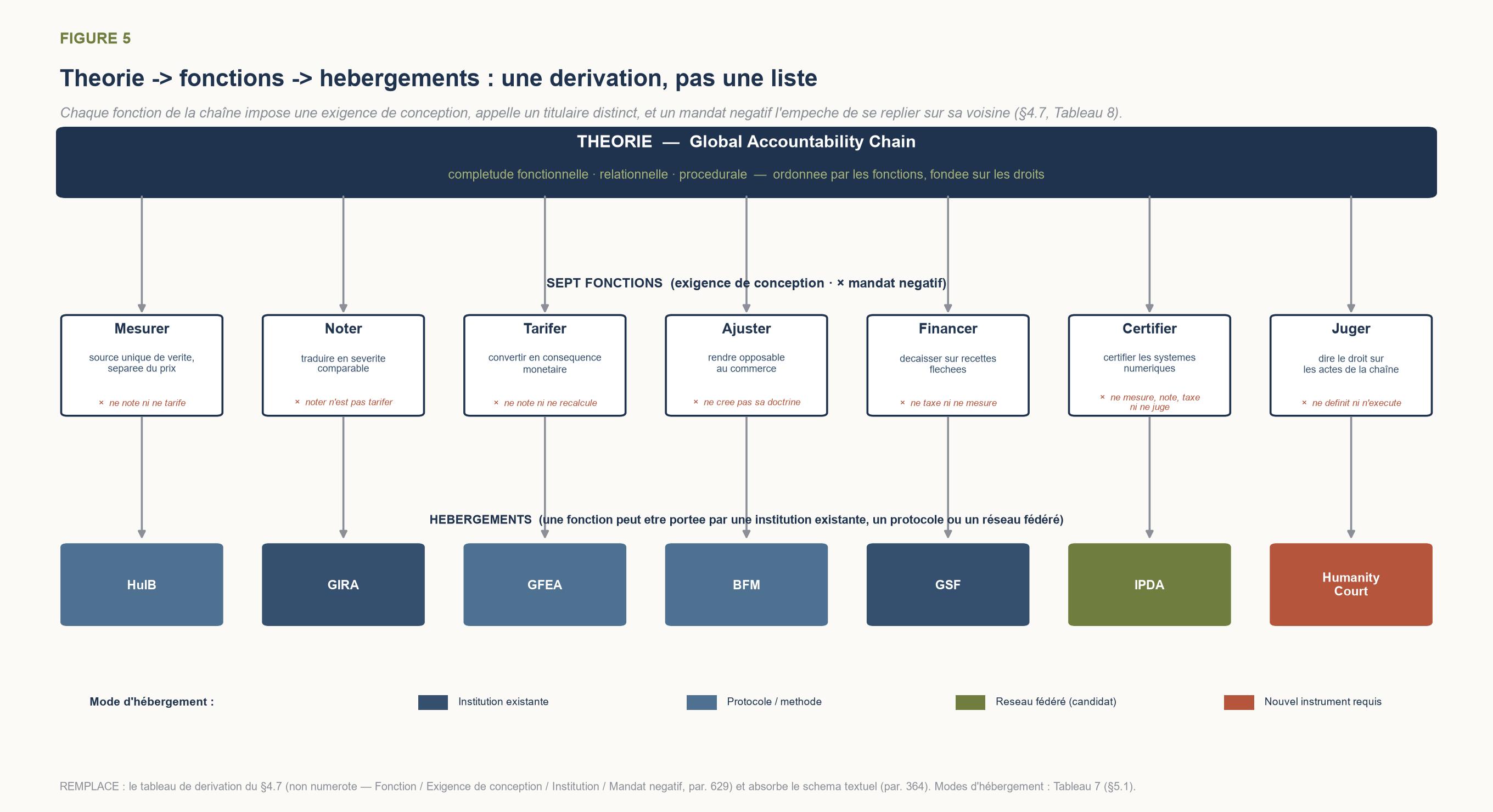
The seven institutions are not posited first and justified afterwards: they are deduced from the functions of the chain according to an explicit method. Each necessary function — measure, rate, price, adjust at the border, finance, certify, adjudicate — imposes a design requirement; each requirement calls for a distinct duty-holder; and the negative mandate of each, the list of the functions that are forbidden to it, prevents two functions from folding into one another. The derivation extends the rational design of institutions (Koremenos, Lipson et Snidal, 2001), where institutional features respond to identified cooperation problems rather than to preferences. The requirements were settled on the basis of the deficit stated in §2.5 and of the eight criteria of §4.3, before the allocation of bodies — a condition for the derivation to be auditable and not retro-fitted to the 7+3.¶ 48
Le tableau dépasse la largeur de l’écran : faites-le glisser latéralement.
| Chain function | Design requirement it imposes | Institution that meets it | Why it does not merge (negative mandate) |
|---|---|---|---|
| Measure | A single source of quantitative truth, separate from any value judgement and any price | Human Impacts Board (HuIB) | Does not rate, does not price, does not adjudicate — otherwise measurement bends to the desired outcome |
| Rate | Translate measurement into comparable severity, separately from the facts and from price | Global Impact Rating Authority (GIRA) | Does not measure (consumes HuIB), sets no price — to rate is not to price |
| Price | Convert severity into a monetary consequence, separately from rating | Global Financial Equity Authority (GFEA) | Does not rate, never recomputes a rating, does not collect |
| Adjust at borders | Make the consequence enforceable against trade, with no tax doctrine or science of its own | Border Fairness Mechanism | Sets no fiscal doctrine, produces no science (consumes HuIB and GIRA) |
| Finance | Disburse solidarity from earmarked revenues, without levying tax or producing the measurement | Global Solidarity Fund (GSF) | Neither taxes nor collects, neither measures nor rates — whoever spends does not set what it receives |
| Certify democratically | Subject digital systems — including those of the architecture — to a certification legitimated by parliaments | Inter-Parliamentary Digital Authority (IPDA) | Does not measure, rate, tax or adjudicate, and regulates no trade |
| Adjudicate | State the law on the acts of the chain, without defining policy or executing | Humanity Court | Defines no policy, executes nothing — “the Court guards the guardians, it does not command them” |
The last column carries the argument: merging two functions removes a separation on which the chain depends. To conflate measurement and rating bends the facts to the desired result; to conflate rating and pricing lets the judge of severity set the price; to conflate adjudication and enforcement deprives the Court of its independence. The number seven is therefore not aesthetic: it is the number of distinct functions that the chain must cover, each separated from its neighbour by a boundary specified in §6. The subsidiarity of principle P1 (§4.2) reserves the single case where a separation improves neither accuracy, nor legitimacy, nor redress; the burden then falls on whoever proposes the fusion to demonstrate that none of the three suffers from it — an assessment conducted in §4.5 and in §4.6.¶ 49
The burden of proof, and why it is asymmetric. This rule of burden calls for a justification, and not a simple declaration: it is the most assailable normative choice of the arrangement, and it must be grounded in an analysis of error costs. Two errors are possible, and they do not cost the same thing. A false positive — separating two functions that could have been merged without damage — costs one institution more, one interface more, and the coordination cost that accompanies them; the cost is real, it is bounded, and it is reversible: one can merge after the fact. A false negative — merging two functions that should have remained separate — costs something else entirely. The body that combines measurement and rating no longer chooses its disclosure policy as a function of accuracy, but of its own objective (Laffont et Tirole, 1991); the chain becomes capturable at a single point; and the capture of one link neutralises the whole, since the downstream links consume without being able to contest. That cost is not bounded, and it is not reversible: once the authority has been delegated to a single body, it is not taken back — this is the lesson of the rating agencies (§5.3), and it is what became of the Palais-Royal chain, entrusted to the International Monetary Fund, an institution governed by the very countries that it ought to have penalised (Box 9, §3.3). Asymmetric error costs justify an asymmetric burden of proof: this is the precautionary principle applied to institutional design, and not a preference for the multiplication of bodies. The burden therefore shifts because the functional decomposition has been carried out, and not because the number seven had been chosen in advance; it would shift back as soon as that decomposition were refuted. The conditions of that refutation are stated in §1, and the cost analysis that would allow it to be settled — a bottom-up budget per institution, compared with the total cost of the rival architectures — remains to be produced: it is an avowed gap, and it is recorded in §14.¶ 50
Citer cette section
Yaïche, Nizar (2026). 4. The theory of chain-based accountability: origins and design principles. In The Humanity Compact (v2.3). Zenodo. https://doi.org/10.5281/zenodo.22746533
@incollection{yaiche_hc_chapitre_4,
  author    = {Yaïche, Nizar},
  title     = {4. The theory of chain-based accountability: origins and design principles},
  booktitle = {The Humanity Compact},
  year      = {2026},
  version   = {2.3},
  doi       = {10.5281/zenodo.22746533},
  publisher = {Zenodo},
  url       = {https://humanitycompact.org/ouvrage/chapitre-4/}
}Ouvrage de Nizar Yaïche, ancien ministre des Finances de la République tunisienne. Qui est l’auteur ?