Le texte de l’ouvrage est en anglais, tel qu’il a été écrit ; seule l’interface du site est en français.
12. The political economy of adoption
Chapitre 12 sur 15 · ≈ 40 min de lecture · 68 paragraphes · 18ᵉ des 40 sections de lecture · rechercher dans l’ouvrage
The question every reader should ask is not “is this desirable?” but “through what sequence of individually rational steps could any one of these elements come into being?”.
The question every reader should ask is not “is this desirable?” but “through what sequence of individually rational steps could any one of these elements come into being?”. Three routes, cumulative rather than alternative, answer it — and none requires a founding treaty in order to start.¶ 1
Incorporation, the general mechanism. Under P3, every output of the architecture is designed to be incorporable: a rating that a regulator can reference, a scale that a finance ministry can promulgate, a model law that a parliament can adopt, an arbitration clause that two contracting parties can sign. This is precisely how credit ratings, the IFRS accounting standards, the Basel ratios and the ISO standards acquired their grip on the world — none of them by treaty. The outputs of the architecture are built to the same standard of incorporability, with one difference: a public issuer, glass-box, whose acts are themselves justiciable.¶ 2
The existing institutions, without amendment. A systematic examination of the legal frameworks of the principal incumbents, conducted for this programme, led to a conclusion that surprised us: the essential part of what the architecture asks of them requires no statutory amendment (Table 50, infra). The only exception is full justiciability, which does require new instruments — which is why the Court is sequenced last (Section 5.8).¶ 3
Table 50 (infra) constitutes a working legal hypothesis and a map of cooperation, not a definitive legal opinion. “No statutory amendment” means only that a plausible existing decision channel has been identified. This establishes neither that the proposed action falls within the mandate, nor that the executive boards would adopt it, nor that a national implementing law would be unnecessary, nor that the affected parties could not contest it.¶ 4
This chapter now distinguishes two questions. The first is that of functional adoption: through what individually rational decisions can the elements of the chain begin to operate? The second is that of institutional approval: what level of endorsement is to be sought, through what forum, with what mandate and according to what passage gates? The first leads from constant law to the pilot (§12.1-12.6); the second leads from the pilot to a possible resolution, then from voluntary incorporation to only those legal commitments whose necessity will have been demonstrated (§12.7).¶ 5
12.1 Legal feasibility scale
Le tableau dépasse la largeur de l’écran : faites-le glisser latéralement.
| Level | Instrument | Illustrative use | Validation required |
|---|---|---|---|
| L0 | Research cooperation / public methodology | Joint measurement and pilot datasets | Data authority, confidentiality and institutional mandate |
| L1 | Internal policy or board decision | Supervisory lens, lending criterion or standard | Constitutive instrument and administrative-law review |
| L2 | Contractual incorporation | Procurement, financing or arbitration clause | Consent, applicable law, enforceability and avenues of redress |
| L3 | National legislation | Contribution schedule, border collection, transposition of a model law | Constitutional, fiscal, trade and rights review |
| L4 | Treaty or treaty amendment | Compulsory inter-State jurisdiction or common legal obligation | Negotiation, ratification, reservations and entry into force |
12.1.1 Legal mapping, competence and effectiveness
Scope of the mapping. The L0–L4 scale identifies possible vehicles; it does not constitute a conclusion as to competence. An existing institution may hold a substantively close mandate without being authorised to produce the act envisaged, to process the necessary data, to commit resources, to recognise an external output or to confer effect on a decision. The possibility of a pilot under constant law must therefore be validated body by body, act by act and jurisdiction by jurisdiction.¶ 6
Four-step legal gate. Before any activation, the case file must identify: first, the legal basis and the competent actor; second, the applicable procedural guarantees — information, adversarial process, reasoning, confidentiality and redress; third, the mechanism for incorporating or recognising the output; fourth, the conditions of execution, including immunities, budgetary law, commercial, tax, constitutional and data protection law. Failure at any one of these steps limits the output to the non-binding level immediately below. The four-step gate is the entry filter; the full examination follows the twelve-question test of Annex H.1.¶ 7
Principle of non-deduction. A scientific measurement does not create an obligation; a rating does not create a base; a political agreement does not create a fiscal competence; a treaty is not self-executing in every jurisdiction; a decision is not effective so long as its recognition and its enforcement are not established. The law therefore does not intervene only at the end of the chain: it qualifies every interface.¶ 8
Cautious formulation. A first mapping suggests that several non-binding functions — data protocols, comparable measurements, methodological review, shadow prices and advisory chambers — could be trialled under constant institutional law. This hypothesis must be confirmed by independent opinions and does not prejudge the competence required for any binding consequence.¶ 9
12.2 Political economy of adoption
Adoption requires a coalition, and not only incorporable outputs. The analysis of first movers should identify the net beneficiaries of an unpriced harm; the jurisdictions seeking a lower cost of capital; the parliaments seeking leverage over AI; the standard-setting bodies seeking public legitimacy; the firms that gain from a common rather than fragmented compliance regime; and the donors willing to finance a public infrastructure. Ranged against them stand the actors confronted with new prices, with disclosure, with litigation or with the loss of discretionary power. A viable pilot must make participation individually useful before the complete chain exists, and must offset capacity costs without buying methodological control. The diffusion of a new norm follows, moreover, a documented cycle: norm entrepreneurs carry it first, up to a tipping point where adherence propagates in a cascade, before being taken for granted (Finnemore and Sikkink, 1998). The adoption strategy exploits this cycle — begin with the willing jurisdictions, reach the threshold at which abstention becomes costly, then internalisation.¶ 10
One obstacle needs to be named without circumlocution: the principal beneficiaries of the status quo hold a real veto power, and may seek less to oppose frontally than to block the critical interfaces — refusing a datum, contesting a rating, delaying an incorporation. The architecture does not claim to dissolve that power; it reduces its yield: by making abstention costly (reputational rating, access, border adjustment) rather than by requiring adherence, by building useful coverage without universality, and by sequencing adoption through an incorporation cascade that does not need the most reluctant actors in order to start. This is a mitigation, not a guarantee: where a dominant bloc chooses durable blockage, coverage plateaus — and this document accepts that as a limit (§14), not as a detail.¶ 11
This opposition is itself mappable, and it is instructive that it should arise simultaneously from both directions — from those who hold that pricing cross-border harm oversteps the market, and from those who hold that pricing it concedes too much to the market. A position contested on both flanks is not thereby validated; but it situates the debate, and the task of political economy consists in answering the strongest version of each flank rather than in treating this crossfire as proof.¶ 12
None of this presupposes new trust among the actors; recent history shows, on the contrary, that binding coordination is possible when it is properly equipped. The Montreal Protocol (United Nations, 1987), ratified by almost all States, reversed the destruction of the ozone layer, today on the path to recovery (OMM et al., 2022): a measured damage, a binding timetable, a compliance mechanism. More recently, the reform of international taxation carried by the OECD/G20 Inclusive Framework brought one hundred and thirty-six jurisdictions together around a global minimum tax of 15% (OECD, 2021). These precedents are not transposable as they stand — the first bore on a narrow and well-defined problem, the second remains imperfectly applied — but they establish the point that matters: what the 7+3 architecture asks for is not a supplement of virtue, but the replacement of trust by architecture — binding what must be bound, and measuring what is not.¶ 13
The human impacts ledger offers the architecture its most concrete point of entry. Each line carries the minimum that makes it verifiable — an affected party, a causal mechanism, a magnitude, an attribution logic, an evidentiary status, a remedy and an assurance level — so that a board may read it, an auditor may check it and an injured party may contest it. Its diffusion follows two converging forces. From above, a jurisdiction may impose it first on the largest firms — as the European Union mandated sustainability disclosure above a size threshold (§13) —, not through a coercive world authority, which the architecture rejects, but by incorporation into national law (P3): the large actors concentrate the bulk of cross-border impact and have the capacity to keep the register, while the smallest are exempted from it or supported (special and differential treatment, §5.5; transition window, §12.6). From below, demand arises within the actors: employees, customers and investors — interested parties as much as affected ones — have shown that they can require transparency of impacts, making the register an asset of legitimacy rather than a constraint; this is the constituency that the Call of Carthage (§6) federates, and that Table 49 (infra, §12.5) breaks down into entry offers specific to each actor. Neither force suffices alone — the first without the second freezes into formal compliance, the second without the first remains without leverage —, but their conjunction is the realistic route by which a register of responsibility takes hold without waiting for a treaty.¶ 14
A fact of experience illuminates why coordination is not a luxury but a condition. A jurisdiction that internalises an externality on its own bears the cost while its competitors dispense with it: the harm avoided is global, the burden is local. The European Union illustrates this — carbon pricing, sustainability disclosure, environmental standards: a pioneer of rules, it pays the competitive price for them when it alone applies them, to the point of having to correct course (carbon border adjustment, easing of the CSRD). This is not an argument against rules, but against their unilateral application: the first to internalise is penalised so long as the free-rider is not (Buchanan and Tullock, 1962; Nordhaus, 2015). This is precisely what the architecture corrects — the coordinated minimum (§12) removes the free-rider’s advantage, border adjustment (§5.5) neutralises leakage, and reputational rating (§5.3) makes going it alone visible. The good rule does not need to be universal in order to hold; it needs not to leave the virtuous paying alone.¶ 15
These dynamics have a grammar: that of non-cooperative games. Without a device, the equilibrium of a commons dilemma is defection — each has an interest in free-riding, and cooperation, though collectively superior, is not an equilibrium (Nash, 1951); the history of international environmental agreements confirms that goodwill alone does not hold against free-riding (Barrett, 2003). The architecture does not answer this by pleading virtue, but by changing the game: incorporation, border adjustment and reputational cost alter the payoffs so that participating becomes the individually rational choice, and abstention ceases to be free. This is also what makes commitment credible — a voluntary commitment is credible only in so far as it serves the interest of the one who makes it (Selten, 1975), whereas an incorporated and justiciable commitment no longer depends on good faith alone. The architecture does not ask for cooperation; it makes it pay.¶ 16
12.3 Producing and disciplining political will
An architecture that depended on a prior political will would merely displace the problem it claims to solve. The will to act is neither a resource available in fixed quantity, nor a moral quality that the law could presume: it results from a distribution of interests, of information, of costs, of benefits, of veto capacities and of electoral horizons. The Humanity Compact therefore does not treat it as a condition external to its adoption. It seeks to modify the conditions under which action becomes individually rational, publicly visible and politically sustainable, and then to prevent that will, once mobilised, from turning into power without limits. Its doctrine of adoption thus comprises two inseparable movements: producing commitment and disciplining its exercise.¶ 17
Making inaction politically legible. The first function consists in transforming a diffuse harm into a case file for decision without transforming science into prescription. The HuIB recommends neither a tax, nor a prohibition, nor an expenditure; it produces, for every material impact, a territorialised reading that distinguishes the magnitude, the affected parties, the distribution between households, firms and public finances, the time horizon, the counterfactual, the compensations and the uncertainty (§5.2). This legibility creates a political event: beyond a pre-agreed threshold, the competent government or parliament must place the case file on its agenda and publish a reasoned response within a fixed period. The response may conclude in favour of action, of postponement, of a different measure or of no consequence for want of sufficient evidence; it cannot treat the case file as though it did not exist. Politics retains the right to choose; it loses the right not to explain.¶ 18
Organising a coalition of compatible interests. Table 49 (infra, §12.5) must not merely describe the actors: it constitutes the matrix of a coalition. The impact-recipient jurisdictions obtain evidence and a forum; parliaments, a lever of control over transnational decisions; firms, a common regime more predictable than a proliferation of incompatible rules; investors and insurers, comparable information on risks today dispersed; standard-setting bodies, an articulation with public legitimacy; donors, a measurement infrastructure that improves targeting and monitoring. None of these gains requires the complete chain to be already in place. Each module must create autonomous value before adherence to the next, while the Fund finances weak capacities and transition costs without buying the method, the rating or control (§5.6, §5.10).¶ 19
Grading commitment rather than demanding total adherence. Political entry follows a progression that is reversible in its first steps and more binding as evidence accumulates: data sharing and methodological participation; shadow assessment without consequence; pre-registered public pilot; incorporation into a financing, an authorisation or a public procurement; mutual recognition between jurisdictions; limited and contestable financial consequences; and finally, treaty commitment and consented jurisdiction. Each step possesses an entry condition, a review period, success criteria, an exit rule and the identification of the obligations that survive withdrawal. This progression allows a government to enter without having to approve the whole of the 7+3 from the outset, but it forbids “progressive” from meaning “indefinitely voluntary”: exemptions expire, milestones are public and any move to a stronger consequence requires new evidence.¶ 20
Making peer review a mechanism of soft enforcement. Several regimes show that a common method, an independent or peer review, the publication of results and a corrective plan can convert a political commitment into national implementation without immediately creating a universal coercive authority. The enhanced transparency framework of the Paris Agreement submits the information communicated to a technical expert review; the FATF and the Financial Stability Board use peer evaluations to examine the implementation and effectiveness of standards; the minimum standards of the OECD/G20 Inclusive Framework on BEPS are monitored through reviews in which members participate on an equal footing; the Extractive Industries Transparency Initiative combines disclosure, multi-stakeholder oversight and validation (UNFCCC, 2018; FATF, 2025; FSB, 2017; OECD, 2025; EITI, 2023). None of these precedents is transposable as it stands. They do, however, establish a common institutional technology: explicit standard, documented evidence, adversarial process, publication, recommendations and follow-up.¶ 21
The GAF would take up this technology in a graded form, without a moral blacklist. A public register would distinguish documented participation, verified progress and demonstrated compliance; it would publish the method, the limits, the response of the assessed actor and the agreed corrective actions. Any unfavourable conclusion would be preceded by an adversarial procedure and open to review. The objective is not to manufacture an autonomous reputational sanction, but to reduce the asymmetry of information and to make the cost of inaction comparable to the benefit of action. Reputation becomes legitimate only as the consequence of a verifiable case file, never as a substitute for evidence or for law.¶ 22
Incorporate before centralising. The most realistic route of influence runs through the integration of the chain’s outputs into the instruments that the actors already use: administrative authorisations, public procurement, financing conditions, investment contracts, disclosure obligations, professional standards and national law (§12.1). This incorporation increases the usefulness of participation and progressively makes abstention costly. It nevertheless carries the risk identified by H2: that a large market or a focal institution should turn its economic power into normative power. Any incorporation having a market-access effect must therefore satisfy five cumulative conditions: co-development of the method; financing of capacities; recognition of equivalent methods; a proportionate transition period; and independent redress. The Border Fairness Mechanism constitutes the last storey of this progression, not its starting point (§5.5).¶ 23
Reducing the cost of transition without subsidising the status quo. The first actor to internalise a cross-border cost on its own may lose out to the free-rider; conversely, to compensate all compliance indiscriminately would amount to socialising an obligation that belongs to the source actor. The GSF must therefore finance the public goods of transition — data, meters, methods, training, corrective infrastructures and access to redress — as well as the jurisdictions and parties whose weak capacity would prevent participation. It does not automatically reimburse the normal compliance costs of actors able to bear them, and its support lapses when the capacity or the exposure targeted reaches the agreed threshold (§12.6). Support makes the rule practicable; it does not pay for adherence and confers no right over the measurement or the rating.¶ 24
Disciplining the will once mobilised. A political coalition can be as captured, as punitive or as precipitate as the status quo it fights. Any political decision taken on the basis of a measurement or a rating must therefore publish its grounds, the interests consulted, the conflicts declared, the principal contributions received, the analysis of distributive effects and the duration of the measure. Temporary decisions carry a sunset or review clause; departures from the HuIB-GIRA case file are permitted but expressly reasoned; the AI models or systems used to classify contributions, simulate effects or monitor execution fall under IPDA certification; and legality, proportionality and respect for rights remain reviewable before the Humanity Court (§5.7–§5.8). The architecture therefore does not seek only to make power act: it keeps the trace of the reasons for which it acts and of the limits within which it may do so.¶ 25
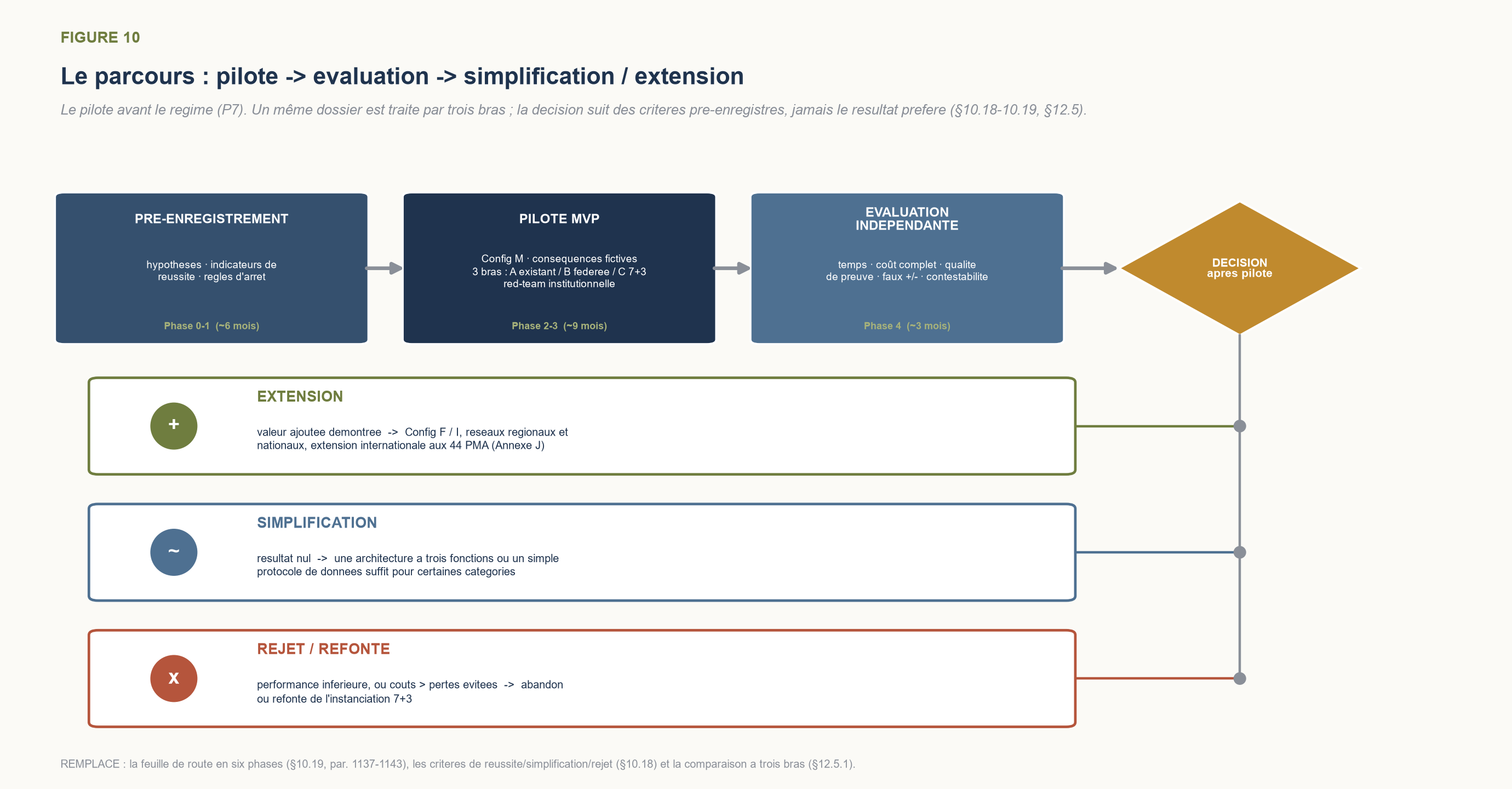
Financing the adversarial process. Formal participation produces no legitimacy if the weakest actors cannot read the case file, produce an independent counter-assessment or support an avenue of redress. The participation mechanism must finance, independently of the institutions called into question, access to data, translation, scientific and legal assistance, collective actions and the protection of persons who report material information. This guarantee holds for affected communities as much as for small States and low-capacity firms. It gives an operational translation to H3: contestability improves legitimacy only when the cost of information and of redress does not exclude those to whom that right is recognised.¶ 26
The counter-hypothesis must finally be formulated without weakening it: the Humanity Compact could become a new technology of conditionality, in which the holders of data would define the metric, the large markets would impose their method and the less powerful countries would finance a compliance designed elsewhere. Four prohibitions follow from this. No financier controls the method it finances; no unfavourable public rating is published without an adversarial process and a right of reply; no market-access condition is applied without equivalence, assistance and proportionality; no financial consequence follows from reputation alone or from a non-justiciable indicator. The symmetry of obligations matters as much as their severity: an architecture that measured the weak more easily than the powerful would be technically effective and politically illegitimate.¶ 27
Political will thus becomes an object of governance, not an act of faith. The project makes the cost visible, organises the beneficiaries, offers a progression of commitment, reduces the first mover’s disadvantage and uses incorporation and peer review to stabilise commitments. At the same time, it submits that mobilisation to adversarial scrutiny, to transparency, to the financing of weak parties and to redress. Producing action is therefore not enough; it remains to establish to whom those who act answer, who takes part in their decision and under what conditions a member may withdraw. That is the object of the following sub-section.¶ 28
12.3.1 First-mover theory and minimal coalition
Two coalitions, two thresholds. The pilot and the regime do not require the same coalition. A non-binding pilot can begin with a willing host jurisdiction, a technical institution capable of measuring, an independent financier, representatives of the affected parties and an external evaluator. It can operate without the adherence of the source actor, provided that its results remain experimental, adversarial and without binding effect. A binding regime, by contrast, requires that at least one recognised legal vehicle connect the consequence to the actors to whom it applies.¶ 29
Autonomous value of the first move. The first mover must not adhere out of abstract altruism. It must receive a value of its own before any universalisation: better-quality data, reduction of regulatory risk, access to technical assistance, transition financing, recognition of equivalence, improvement of negotiating capacity or reduction of litigation costs. Each entry offer must identify the beneficiary, the gain, the transition cost and the withdrawal condition.¶ 30
Protection of the first mover. A small jurisdiction that measures a cross-border effect may bear diplomatic, commercial or financial costs. The pilot must therefore provide for the confidentiality of the exploratory phases, legal assistance, the diversification of partners, collective rather than isolated publication and a clause prohibiting the use of experimental results as a sanction. The absence of credible protection against reprisals constitutes a condition of non-launch.¶ 31
Diffusion test. The activation theory is confirmed only if the autonomous advantages bring about the voluntary adherence of additional actors, if the cost of withdrawal remains orderly and if influence does not concentrate in the financier or the host. A coalition that extends only to the affected jurisdictions without including, directly or by incorporation, actors capable of acting on the source of the harm remains a device of knowledge and negotiation, not a regime of correction.¶ 32
12.3.2 Veto map, incentives and failure criteria
Political economy must be written as a veto map rather than as a general hypothesis of goodwill. For each determining actor, the pilot identifies the blocking power, the expected benefit, the incentive instrument, the risk of capture and the possible response. An incentive is admissible only if it does not pay the actor to accept a measurement that ought to remain independent and if it does not transfer control of the device to the financier.¶ 33
12.4 Legitimacy, representation and withdrawal
Input legitimacy requires more than a parliamentary veneer: affected persons hold rights of petition, of information, of hearing and of qualified agenda-setting; a petition reaching a threshold triggers a reasoned response; an independently financed participation mechanism supports the gathering of evidence and the avenues of redress. Throughput legitimacy (Schmidt, 2013) rests on transparent methods, the reasoning of decisions, inclusion, expeditiousness and review. Output legitimacy is measured by accuracy, by distribution, by compliance and by harm avoided, and is not presumed from design. Each institution must publish withdrawal rules: notice, pending case files, data portability, surviving obligations, financial settlement and continuity. These requirements are not merely normative: the theory of legitimacy in international law shows that a rule exerts a compliance pull of its own — a power to secure observance without compelling it — when it is determinate (clear), coherent and attached to a recognised normative hierarchy (Franck, 1990). It is that pull that the architecture seeks through public, contestable and incorporable methods, rather than through coercion.¶ 34
This wager is institutional in the strong sense. Lasting prosperity follows inclusive institutions — those that distribute participation and rights — and not extractive institutions that concentrate power and rent (Acemoglu, Johnson and Robinson, 2001; Acemoglu and Robinson, 2012). The legitimacy of the architecture therefore rests not on its function alone, but on its inclusive character: parity between source and recipient jurisdictions of impact, rights of affected persons, contestable methods, tested representation. A corrective architecture designed in extractive fashion — captured by those it ought to hold responsible — would reproduce the very harm it claims to correct; inclusiveness here is not an ornament, but the condition of its success.¶ 35
When the architecture opens access to affected persons, it does so within an established human rights framework rather than within an ad hoc one. The third pillar of the United Nations Guiding Principles on Business and Human Rights — access to effective remedy (United Nations, 2011) — provides the standard against which that access is designed and judged: remedies should be legitimate, accessible, predictable, equitable and rights-compatible. The rights of petition, of hearing and of agenda-setting mentioned above are intended to satisfy that standard, not to substitute a bespoke standard for it.¶ 36
Two formulas of representation are retained for pilot comparison rather than selected without probative data. Option A uses a double chamber: groups of equal States distributed according to their net impact position, plus a chamber of affected interests selected by transparent mixed methods. Option B uses a single council with capped weightings combining population, exposure, contribution and a floor for small States. Both require scientific independence, conflict-of-interest rules, gender and regional balance, and published simulations of voting power.¶ 37
12.4.1 Dual channel of representation
Dual channel. Representation by the State and participation by affected persons answer two different legitimacies. The State carries constitutional responsibility, international commitments and the general interest that it defines according to its own law. The individuals, communities, workers, local authorities and generations represented carry the experience of the harm, of the distributive effects and of the obstacles to access to redress. Neither channel automatically replaces the other.¶ 38
Effective guarantees. Every case file with a significant impact provides, according to its nature, for accessible notification, translation, sufficient time, independent financing of the counter-assessment, protection against reprisals, publication of the responses to observations and standing to request a review. Participation does not amount to presumed consent and does not create a general veto absent from the applicable law; it obliges the authority to take cognisance of, to address and to give reasons on the effects upon those who do not control the decision.¶ 39
Independence of support. The financing of participation and of counter-assessment comes from an envelope independent of the decision-maker, of the measurer and of the assessed entity. Representatives declare their mandates and conflicts of interest; significant dissents are annexed to the case file.¶ 40
12.5 Minimum viable pilot
The artificial intelligence data centre case of Section 8 constitutes a natural candidate for this phase: it has minimal public metrics, combines several externalities without requiring that they be monetised, and makes it possible to test the passage of a case file between distinct functions. It nevertheless preselects neither a country nor an operator; the pilot jurisdiction must be willing, the data legally accessible and the consequences kept in shadow mode during the first phase.¶ 41
Le tableau dépasse la largeur de l’écran : faites-le glisser latéralement.
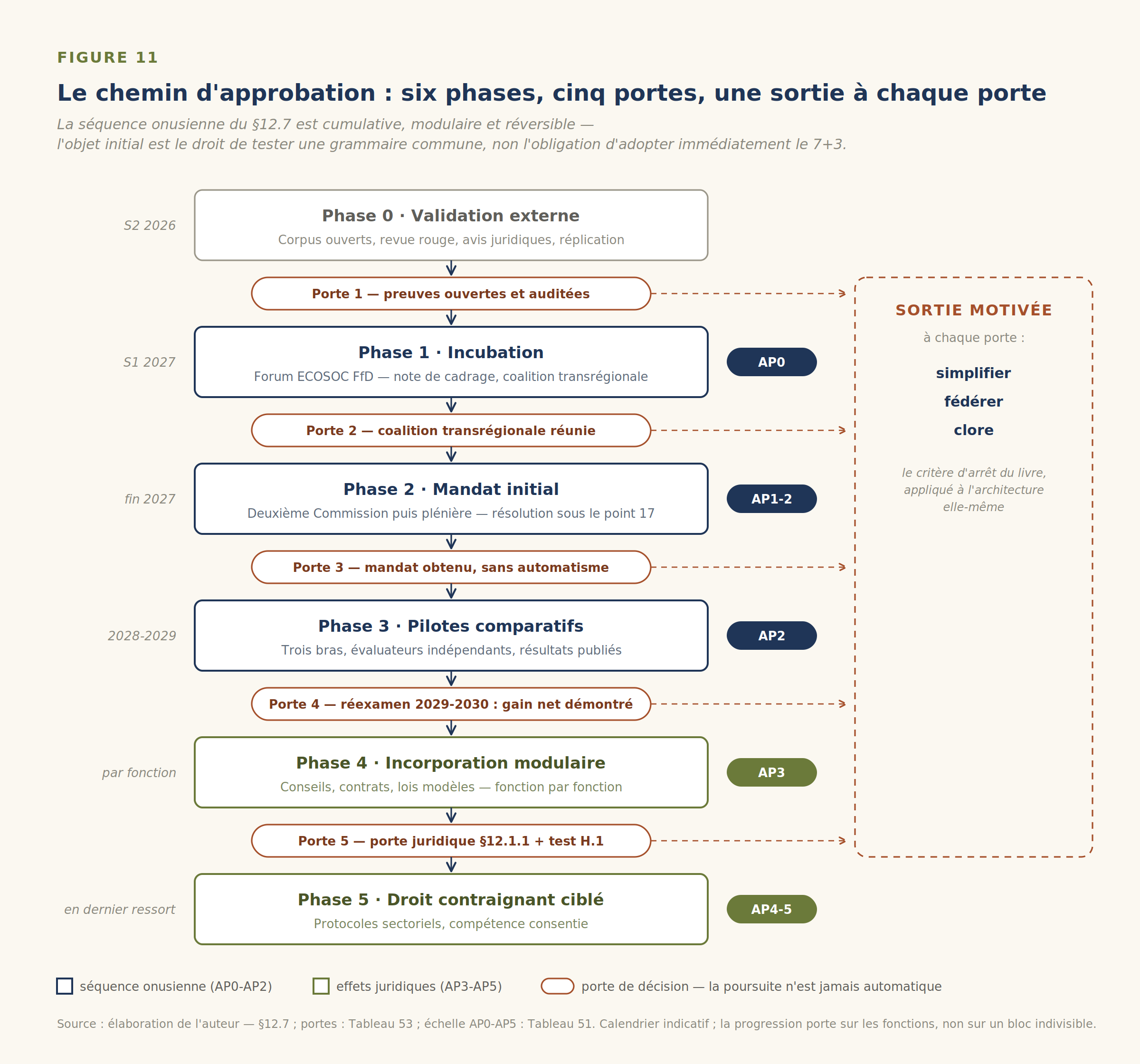
| Element | Current specification |
|---|---|
| Scope | One volunteer jurisdiction; one sector; measurement and rating in shadow mode only; no tax, border charge or sanction in phase 1 |
| Candidate | A lower-middle-income country with usable public data; Tunisia may be assessed but is not pre-selected |
| Duration | 12 months of baseline and construction; 6 months of evaluation and external replication |
| Comparator | Existing fragmented process or matched historical benchmark |
| Principal indicators | Coverage, error/correction, time to decision, participation, cost of redress, distribution and full operating cost |
| Safety indicators | Data incidents, misclassifications, derogation rate, supplier concentration and recovery in degraded mode |
| Governance | Independent evaluator, public protocol, panel of affected parties and legal/ethical data review |
| Stopping rules | Substantial infringement of rights, uncorrected security failure, persistent error on a subgroup, financially inaccessible redress or cost above the declared ceiling |
| Extension lock | Only if stand-alone value is demonstrated and the next phase has legal authority and funded capacity |
Le tableau dépasse la largeur de l’écran : faites-le glisser latéralement.
| Actor | Probable gain | Probable concern | Entry offer |
|---|---|---|---|
| Pilot State | Visibility, negotiating assets and support for stability | Administrative burden and reprisals | Funded measurement and a first phase in shadow mode only |
| Incumbent institution | Standardised data and early risk signals | Mandate drift and reputational exposure | Severable cooperation note and absence of institutional subordination |
| Private company | Common method and reduction of regulatory fragmentation | New liability and disclosure obligations | Secured pilot, correction rights and transition credits |
| Affected communities | Standing, visibility and potential reparation | Technocratic appropriation and data extraction | Representation, consent, benefit and accessible redress |
| Major source jurisdiction | Predictable rather than unilateral responses | Budgetary and sovereignty cost | Reciprocity, credit for equivalent action and revision |
| Employees, customers and investors | A voice on the impacts of the organisation on which they depend; alignment between values and work, purchase or investment | Reprisals or instrumentalisation; exposure without any real power of correction | A register that can be invoked and contested; a protected reporting and redress channel; internal demand recognised as a source of legitimacy (Call of Carthage) |
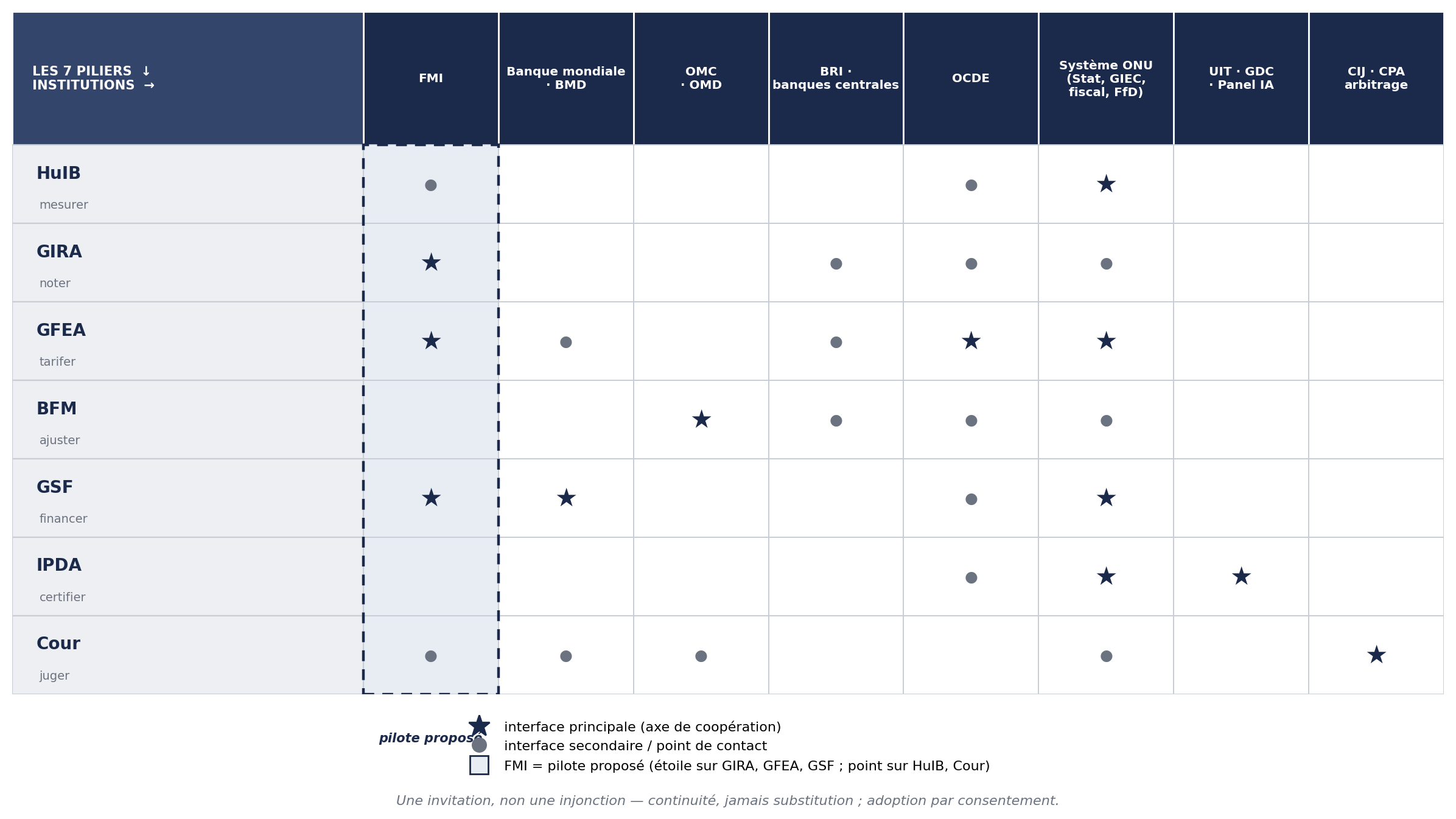
Figure 10 brings out, at a glance, the interface points of each institution with an existing incumbent and the reasons why the IMF constitutes the natural first pilot; Table 50 sets them out in detail, interface by interface.¶ 42
Le tableau dépasse la largeur de l’écran : faites-le glisser latéralement.
| Incumbent actor | Principal interface | What the architecture would draw on / offer | Anchoring requiring no statutory amendment | What the incumbent actor gains |
|---|---|---|---|---|
| IMF | GIRA · GFEA · GSF · HuIB | Draw on: surveillance data, debt sustainability analysis. Offer: impact lens, severity coefficients | Article IV surveillance guidance by Board decision; methodological annex to the DSA; precedents of SDR reallocation (Resilience and Sustainability Trust) | Early and standardised visibility of debt distress induced by externalities |
| World Bank and MDBs | GSF · GIRA | Draw on: project portfolios, safeguard practices. Offer: concessionality criteria linked to rating | Board-level lending criteria; existing safeguard frameworks | A sharper impact pricing of portfolios |
| WTO and WCO | Border Fairness Mechanism | Draw on: customs data, valuation practices. Offer: measured-gap methodology | CBAM precedent; trade facilitation instruments; de minimis practice | A principled, non-discriminatory standard in place of ad hoc unilateralism |
| OECD | GFEA | Draw on: BEPS architecture, guidance instruments. Offer: externality schedules | Soft-law guidance; the Pillar Two model | Extension of its normative role to impact equity |
| BIS and central banks | Contact point and measurement of harm | Draw on: research on spillover effects. Offer: the measurement, the rating and, where appropriate, the pricing of cross-border harm — never a say over the monetary decision | The independence of the monetary decision remains a red line; cross-border harm is treated like any externality, with the issuing central bank accountable for it | A better evidence base on spillover effects |
| UN statistical system and IPCC | HuIB | Draw on: 2025 SNA, beyond-GDP indicators, climate science. Offer: institutional completion of the measurement agenda | Work of the Statistical Commission; continuity of expert groups | A permanent consumer and amplifier of its outputs |
| ITU and AI governance bodies | IPDA | Draw on: technical standards. Offer: a channel of parliamentary legitimation | Model-law practice; the scientific panel established by UNGA resolution 79/325 | The democratic anchoring these bodies currently lack |
| ICJ and PCA | Humanity Court | Draw on: case law, procedure. Offer: complementarity, never competition | Opt-in arbitration within existing frameworks; advisory continuity | None required — the relationship is deferential by construction |
The interface with the IMF illustrates the method. Nothing in the Fund’s Articles prevents surveillance that takes externalities into account: Article IV consultations already incorporate new analytical prisms by Board decision, as was the case for climate and macrofinancial risk; an annex of severity coefficients to the debt sustainability analysis constitutes a methodological, not a statutory, change; and the reallocation of special drawing rights through the Resilience and Sustainability Trust has already established the precedent on which the solidarity fund would rely. What the Fund would gain is symmetrical: early and standardised visibility of the fiscal distress induced by externalities, precisely in the countries where its programmes are concentrated. The case of central banks calls for a distinction that the architecture holds firmly. The independence of monetary decision — which sets rates sheltered from capture — remains a red line: the architecture seeks no anchorage there and claims no right of oversight over the policy itself. But the cross-border harm that this decision inflicts on third parties is an externality like any other; it would be measured, rated and, where appropriate, priced on the same footing as the others, and the party liable would be the source central bank — not the treasury of the recipient country nor its taxpayer —, precisely so that the social cost of spillover effects returns into the decision function and is internalised in subsequent trade-offs. The charge would be automatic and rule-based, never a discretionary sanction; it would target harm to third parties, never the domestic orientation of policy; and on large non-consenting jurisdictions its enforcement would remain limited (P3) — but stating the principle costs nothing. The externality is thus corrected without the decision being overseen from above.¶ 43
Two disciplines govern every line of Table 50. First, invitation, never injunction: each interface is recorded in the form of a cooperation note — what the architecture would consume, what it would offer, what the incumbent would gain — and lapses in the event of refusal. Second, severability: the architecture seeks no anchorage within any incumbent, and each interface stands or falls in isolation, so that the refusal of one institution compromises nothing else.¶ 44
National platforms as pilots. The architecture is a set of global rules; its natural pilots are national. A country implementing an integrated financing framework can adopt the measurement taxonomy, run a shadow rating on its own portfolio and pilot an equity contribution scale at the domestic level — demonstrating the chain end to end at national scale, where consent is not a problem because it is sovereignty. Lower-middle-income countries may have strong incentives to position themselves first when they are net recipients of unpriced damage; section 2.1 illustrates one such national case, while the broader distributive claim remains to be tested comparatively.¶ 45
The discipline of the pilot borrows from experimental development economics, which made the controlled, pre-registered trial the benchmark of causal evidence (Duflo, Glennerster and Kremer, 2007; Banerjee and Duflo, 2011). Two borrowings, one reservation. Pre-registration first: fixing in advance the hypothesis, the success indicators and the failure criteria — which Table 48 formalises — avoids reading success after the fact. Causal humility next: a pilot establishes what works in a context, not a universal law, and its external validity remains to be tested by replication (§14). The reservation, finally: one does not randomise a global architecture as a block; what is piloted are components — a measurement board, a proto-rating, a national platform — each of which creates autonomous value (P7), the assembly being a matter of a distinct institutional inference, not of a single trial.¶ 46
12.5.1 Comparator, pre-registration and adversarial team
Three-arm comparison. The pilot does not test the 7+3 in isolation. A single case file, based on the same data and the same freeze date, is processed by three routes: A, the existing process; B, a light federated architecture; C, the 7+3 chain. The teams are separated and gain access to the results of the other arms only after their own decisions have been frozen. The protocol pre-registers the hypotheses, the permitted decisions, the stopping rules and the indicators.¶ 47
Indicators. The comparison bears at a minimum on processing time, full cost, the quality and traceability of the data, the frequency of requests for further information, false positives and false negatives, divergences between assessors, the number of decisions revised, comprehension by the parties, access to counter-assessment, procedural satisfaction, resistance to conflicts of interest and the capacity to identify a correct decision of non-activation.¶ 48
Institutional red-team. An independent team seeks to make each architecture fail by representing in turn a large source jurisdiction, a recipient country, a firm, an affected community, a financier, a regulator and a non-participating jurisdiction. It tests data retention, forum shopping, model manipulation, capture of financing, political pressure, abuse of process, dependence on a single AI supplier and coordinated withdrawal.¶ 49
Decision after the pilot. The 7+3 is not retained because it produces the substantive decision preferred by the author or by the parties. It is retained only if it improves the pre-registered criteria without disproportionate cost or risk. A null result justifies simplification; inferior performance justifies abandonment or redesign of the instantiation.¶ 50
12.6 Transition and capacities: a graded and framed trajectory
Adoption does not have to be simultaneous or immediate. Three observations impose this: low-capacity jurisdictions cannot bear the data and compliance burden from the outset (a refutation condition recognised in §4.4); the institutions in place need time and tools in order to interface without amending their statutes (§12.1); and a credible reform is first proven on a pilot (§12.5). The transition is therefore graded — but graded is not optional. Three principles frame it. First, targeted support, not a new body: transition support — financing, measurement tools, methods, training, certification — operates through a dedicated window of the Solidarity Fund (§5.6) and through the capacity-support mandates of the measurement layer (§5.2) and of the certification layer (§5.7); it introduces no eighth institution. Second, it targets weak capacities, not the powerful: assistance goes to low-capacity jurisdictions and to injured parties — those whom the burden would exclude — and not to actors that have the means to adopt by themselves; failing which, the device would subsidise the status quo it intends to correct. Third, gradualness is accompanied by commitment devices: each phase is bounded by pre-agreed milestones, a scheduled expiry of exemptions and non-reversible ratchets (the same discipline as the rapid modes of §11); without which “progressive” slides towards “eternally voluntary” — precisely the best-effort defect that this architecture corrects. Two inherited safeguards apply: transition support is governed separately, with published eligibility rules, and cannot finance the entities that it rates or prices (non-circularity firewall, §5.1). The precedent exists: the Multilateral Fund of the Montreal Protocol financed the transition of developing countries — a condition of its binding success —, as did the capacity support of the IMF and the OECD and the transition period of the EU carbon border mechanism. The detailed design (fund scale, curricula, tooling) is a matter for later work, not for the present framework.¶ 51
12.7 From the work to institutional approval: the United Nations sequence
A global governance architecture does not pass directly from publication to legal obligation. Its adoption is a succession of decisions of differing reach: recognising that a problem deserves common treatment; authorising a study or a pilot; approving principles or a protocol; incorporating certain outputs into institutions or national laws; and, only for the functions that require it, negotiating a treaty obligation or accepting a dispute settlement jurisdiction. To confuse these levels would lead either to underestimating the reach of the first decisions, or to asking too early for a commitment that the evidence, the law and the political economy do not yet permit to be sustained.¶ 52
The path proposed is therefore cumulative, modular and reversible. It seeks a first approval limited enough to be rational for States with divergent interests, but structured enough to produce new evidence and to prevent a further general report from simply being added to its predecessors. The initial object is not the adoption of the 7+3: it is the adoption of a procedure allowing the status quo, a light federated architecture and the 7+3 instantiation to be compared on the same case files, according to pre-registered indicators and stopping rules (§12.5).¶ 53
12.7.1 Approval is not a single act
The term covers at least six levels, whose political and legal force must remain distinct. Table 51 orders them.¶ 54
Le tableau dépasse la largeur de l’écran : faites-le glisser latéralement.
| Level | Decision sought | Possible vehicle | Real effect |
|---|---|---|---|
| AP0 | Recognition of the problem | Declaration, debate, report or mention in an existing text | The subject becomes legitimate and monitored, without any new obligation |
| AP1 | Authorisation to study and to test | Resolution, board decision, research mandate or voluntary pilot | Data, comparators and results that can be invoked in debate are produced |
| AP2 | Approval of common principles and procedures | Voluntary framework, guidelines or annex to a resolution | Participants commit politically to measure, notify, give reasons and publish |
| AP3 | Institutional incorporation | Board decision, internal policy, contract, standard or national legislation | Certain results acquire effect within the participating institutions or jurisdictions |
| AP4 | Modular legal commitment | Agreement, sectoral protocol, arbitration clause, or organisational rule adopted by tacit acceptance | Identifiable obligations bind the consenting parties or the members that have not exercised the opt-out |
| AP5 | Integrated and justiciable regime | Treaty, enforcement mechanisms and accepted jurisdiction | The complete chain becomes enforceable within the agreed scope |
This political AP0-AP5 scale complements the legal L0-L4 scale of §12.1: AP describes the level of endorsement of a decision, L describes the legal vehicle of its effects. A General Assembly resolution may have strong normative reach, request studies, create a subsidiary organ or organise follow-up without rendering, by itself, its recommendations binding on States; conversely, a limited obligation may become enforceable by contract or by national incorporation without waiting for a global architecture — and, where the hosting arrangement retained allows it, by tacit acceptance within an existing organisation (§3.1.1, second route).¶ 55
The first reasonable target is AP1, accompanied by certain elements of AP2: an official mandate for comparison and pilot, a public protocol of evidence, voluntary procedural obligations and a clause providing for a return before the States. The move to AP3 or AP4 occurs only function by function, on the basis of the pilot results, of legal opinions and of the consent of the competent actors — each act passing through the legal gate of §12.1.1 and then the twelve-question test of Annex H.1.¶ 56
12.7.2 Building on the commissions of 2009 and 2025 without redoing them
The United Nations system has already produced the diagnoses: the 2009 Commission of Experts on Reforms of the International Monetary and Financial System (Box 7) and the International Commission of Experts on Financing for Development, whose report prepared Sevilla (§3.3). Box 9 documents what becomes of their recommendations: the same Global Economic Coordination Council, proposed in 2009 and reiterated in 2025, was not taken up — the demonstration, internal to the system, that a recommendation without a duty-holder loses its reach. The present work therefore claims as new neither the existence of spillovers, nor the asymmetries of the monetary system, nor the need to reform debt, liquidity, representation or development financing. Its contribution begins after these diagnoses: not to produce a third general list of reforms, but to test why repeated recommendations remain without a duty-holder, without continuity of evidence, without a reasoned response and without a forum of contestation. The international mandate sought bears on the functional, relational and procedural breaks between institutions — not on a global rewriting of the international financial architecture.¶ 57
Proposed non-duplication clause (to be taken up in any text of referral). “The process builds on prior work relating to the reform of the international monetary and financial architecture — in particular the commissions of experts of 2009 and 2025, the Monterrey Consensus, the Doha Declaration, the Addis Ababa Action Agenda, the Compromiso de Sevilla and its Platform for Action, as well as the Pact for the Future and the biennial Summit on a sustainable, inclusive and resilient global economy. It does not aim to establish a new general list of recommendations. It aims to identify the functions already recognised but remaining discontinuous, to test the interfaces necessary for their execution and to compare several institutional configurations, including an option creating no new permanent body.”¶ 58
12.7.3 A chain of forums rather than a single forum
The right forum is not a single one: like the architecture it must examine, the approval path is itself a chain. The Economic and Social Council Forum on Financing for Development Follow-up is the natural place of technical incubation — intergovernmental, of universal participation, bringing together States, the Bretton Woods institutions, international organisations and stakeholders. The Second Committee of the General Assembly is the principal political channel for the economic and financial dimensions; the initial text should be attached to an existing agenda item — first and foremost the item devoted to the follow-up to and implementation of the outcomes of the international conferences on financing for development, under which the Compromiso de Sevilla was precisely endorsed. The plenary of the General Assembly remains the level of formal adoption: the Charter allows it to initiate studies and to make recommendations (Art. 13) and to establish such subsidiary organs as are necessary (Art. 22) — the 2025 precedent shows, moreover, that a resolution carried under this item can be adopted directly in plenary, without referral to a Main Committee. The biennial Summit on a sustainable, inclusive and resilient global economy, convened for the first time in September 2025, offers the recurrent high-level political moment at which to bring interim conclusions. The Sixth Committee is not the first point of entry: it becomes relevant at a later phase, for delimited legal questions — the nature of procedural obligations, responsibility, dispute settlement, recognition of decisions, treaty vehicles; the Economic and Social Council may in addition, in matters within its competence, prepare draft conventions for the General Assembly (Art. 62). These routes are activated only after the pilot has identified the functions for which soft law, contract or national incorporation do not suffice. Table 52 summarises the chain.¶ 59
Le tableau dépasse la largeur de l’écran : faites-le glisser latéralement.
| Forum | Recommended role | Expected output | What it must not do at the outset |
|---|---|---|---|
| ECOSOC Forum on Financing for Development | Technical incubation and coalition | Framing note, preparatory pilots, intergovernmental conclusions | Immediately negotiating a jurisdiction or a global pricing scheme |
| Second Committee of the General Assembly | Principal political negotiation | Draft resolution under the existing item devoted to the follow-up to financing for development | Endorsing the 7+3 as a definitive solution |
| General Assembly (plenary) | Formal adoption and institutional mandate | Report of the Secretary-General, temporary advisory group, pilots, review clause | Automatically creating external obligations for all States |
| Biennial Summit on the World Economy | Recurrent high-level political moment | Presentation of interim results and voluntary commitments | Substituting for the intergovernmental adoption process |
| Sixth Committee of the General Assembly | Targeted legal maturation (later phase) | Legal options, model clauses, possible codification mandate | Taking on the economic diagnosis in its entirety |
| Volunteer institutions and States | Experimentation and incorporation | Internal decisions, contracts, model laws, data protocols | Waiting for prior universality |
12.7.4 The content of the first resolution
The first draft should be procedural, comparative and experimental. Its official title would gain from being neutral — for example “Towards a United Nations framework for accountability for cross-border and intergenerational effects” — so that States can appropriate the process without being invited to endorse a brand, a doctrine or an organisational chart already settled.¶ 60
The text distinguishes what States recognise, what they authorise to be tested and what they still refuse to presume. It recognises that certain economic, financial, technological, commercial or infrastructural decisions produce significant effects beyond the jurisdiction that decides; requests a mapping of existing mechanisms; organises voluntary pilots; requires the publication of methods and uncertainties; and provides for a comparison between competing architectures. It specifies at the same time — in the terms of the source clause and of the non-presumption of constraint (§3.1.1 and Annexes N-O) — that the measurement of an effect does not, by itself, demonstrate a legal causality, a fault, a net global loss or a right to compensation; that national mandates and the independence of the competent institutions remain protected; and that no additional binding effect arises without an identifiable legal basis and consent — participation in the pilots, registers and simulations amounting neither to recognition of a responsibility, nor to consent to a jurisdiction.¶ 61
The minimum operative part comprises: recognition of the possible deficit of continuity between measurement, qualification, response, financing and redress; the request for a report of the Secretary-General prepared with the institutions concerned and submitted to public consultation; an independent, pluralist and time-limited advisory group, charged not with recommending a single architecture but with comparing options — including the one that creates no new permanent body; voluntary three-arm pilots, based on pre-registered data and indicators; the publication of the corpora, methods, dissenting opinions, costs and negative results; the participation and the financing of the counter-assessment of the affected parties; the non-duplication clause of §12.7.2; a sunset clause for the temporary group and a decision on review by the States; and the explicit possibility of concluding that the framework should be maintained, simplified, federated or abandoned. The corresponding content elements — preamble, operative part, non-duplication locks and sources — are gathered in Annex Q; they appear there as a model mandate, without session, without agenda item and without a sponsoring State, a referral belonging to the delegations that carry it (§12.7.6).¶ 62
12.7.5 A six-phase trajectory
Table 53 orders the six phases of the sequence; no phase imposes a uniform time limit.¶ 63
Le tableau dépasse la largeur de l’écran : faites-le glisser latéralement.
| Phase | Purpose | Principal actors | Deliverable | Decision gate |
|---|---|---|---|---|
| 0 — External validation | Separating contribution, evidence and proposal | Researchers, lawyers, red team, affected parties | Open corpora, legal opinions, costing and replication | Do not refer the matter to political bodies if key evidence remains closed or unaudited |
| 1 — Incubation | Building a coalition and testing the framing | Volunteer States, ECOSOC FfD Forum, regional commissions, partner institutions | Framing note and preparatory pilots | Proceed only if a cross-regional coalition exists |
| 2 — Initial mandate | Obtaining AP1 and part of AP2 | Second Committee and General Assembly | Procedural resolution, report of the Secretary-General, temporary group | No creation of a permanent body and no automatic consequence |
| 3 — Pilots and evaluation | Comparing architectures on real case files | Volunteer States and institutions, independent evaluators | Three-arm results, costs, errors, redress and views of the parties | Simplify or abandon if the 7+3 delivers no net gain |
| 4 — Modular incorporation | Giving effect to the validated functions | Boards, legislators, contracting parties | Internal policies, contracts, model laws and voluntary frameworks | Each act passes separately through the gate of §12.1.1 and the test of Annex H.1 |
| 5 — Targeted binding law | Addressing only the gaps not resolved otherwise | States, ECOSOC, Second and Sixth Committees | Sectoral protocols, convention or consented jurisdiction | No comprehensive treaty if lighter mechanisms offer equivalent guarantees |
Certain functions may reach AP3 through institutional incorporation while others remain at AP1. Measurement, the traceability of evidence, notification and the reasoned response can be trialled before any pricing; a consented solidarity mechanism may precede a liability regime; a contractual arbitration can operate without a universal Humanity Court. The progression bears on the functions, not on an indivisible block. The Compromiso de Sevilla offers a useful procedural precedent: an outcome negotiated at an international conference, then endorsed by the General Assembly within the framework of financing for development follow-up. The present process must not reproduce it identically, but may draw on it in order to articulate expertise, negotiation, formal adoption and follow-up.¶ 64
12.7.6 Coalition, intellectual property and political ownership
A resolution can be carried only by Member States. The author can supply the theory, the evidence, the protocols and a draft text; he cannot substitute himself for the delegations that table, negotiate, amend and sponsor. The transition from the work to a multilateral process therefore presupposes a change of political ownership: the framework must become amendable and appropriable by a coalition, without its intellectual origin or its documented versions disappearing. The composition of the coalition follows the analysis of §12.2 and 12.3 — transregional, bringing together exposed countries, countries with analytical capacities, small States, emerging economies, development partners and at least one State able to engage with the principal source jurisdictions: a coalition composed solely of affected countries would make the project appear as a unilateral distributive demand; a coalition limited to the large source jurisdictions would risk neutralising its substance. Appropriation must not, however, become a silent dilution: the public corpus retains a register of versions, a matrix linking each modification to its justification, the dissenting opinions and the functions deleted or merged. The official name of the United Nations process may be neutral; the Humanity Compact remains the intellectual source and the comparative reference, not a condition of political adherence.¶ 65
12.7.7 Antithesis: can approval neutralise the proposal?
The United Nations route may produce the opposite effect to the one sought. In order to obtain consensus, a text may reduce accountability to a further request for study, delete the stopping rules, avoid the question of the forum or refer the entirety of the adjustment to the affected countries. Box 9 shows that a recommendation without a duty-holder progressively loses its reach. This objection justifies neither withdrawal from the multilateral process nor acceptance of any dilution: it imposes minimum criteria. The process adds value only if it retains at least five elements — a traceable case file; the separation between measurement, causality, equity and law; a reasoned response from the competent actor; the possibility of counter-assessment; and a comparator capable of concluding in favour of non-activation, of simplification or of failure. A resolution that limited itself to “encouraging further studies” without a pilot, without open data, without a timetable for return and without identifiable responsibility would not constitute an imperfect first step: it would reproduce the deficit that the work describes, and amounts to a political stopping criterion.¶ 66
12.7.8 Criteria of passage, suspension and rejection
The passage from one phase to the next is authorised only if: the data, codebooks and methods necessary for the test are accessible to an independent evaluation; the legal opinions identify a plausible vehicle for the acts envisaged; the coalition includes States from several regions and is not reduced to a single category of beneficiaries; the mandate protects the light comparator and the option of creating no new permanent body; the affected parties have financed access to information and to counter-assessment; the full cost, the conflicts of mandates and the risks of capture are published; and a clause providing for return, sunset and review is fixed. The process is suspended or revised if: the political referral precedes the publication of the essential materials; the mandate reproduces a general commission of recommendations without an execution or pilot function; the existing architecture or a federated solution obtains equivalent results at a lower cost; the device creates a new capacity asymmetry or an unjustified conditionality; the collection of data or the certification causes a disproportionate infringement of rights; or political adherence requires the abandonment of traceability, of adversarial process or of the stopping rules.¶ 67
12.7.9 Decision conclusion
The path towards approval does not begin with a demand made to the world to adopt the 7+3. It begins with a more limited and more demanding request: to recognise that a discontinuity of accountability may exist, to open the evidence, to compare the architectures and to authorise pilots designed to be able to fail. The first institutional success would be a resolution that prejudges neither causality, nor compensation, nor the number of bodies, but that organises the production of a verifiable answer to those questions. The next success would be the incorporation of the functions that demonstrate autonomous value. Legal constraint would intervene only last, by modules and by consent, when the lighter alternatives prove insufficient. Conceived in this way, approval is neither a political label nor a consecration of the author: it is a chain of revisable decisions that submits the architecture to the same requirements it imposes on others — evidence, justification, proportionality, adversarial process, redress and the possibility of rejection.¶ 68
Citer cette section
Yaïche, Nizar (2026). 12. The political economy of adoption. In The Humanity Compact (v2.3). Zenodo. https://doi.org/10.5281/zenodo.22746533
@incollection{yaiche_hc_chapitre_12,
  author    = {Yaïche, Nizar},
  title     = {12. The political economy of adoption},
  booktitle = {The Humanity Compact},
  year      = {2026},
  version   = {2.3},
  doi       = {10.5281/zenodo.22746533},
  publisher = {Zenodo},
  url       = {https://humanitycompact.org/ouvrage/chapitre-12/}
}Ouvrage de Nizar Yaïche, ancien ministre des Finances de la République tunisienne. Qui est l’auteur ?